

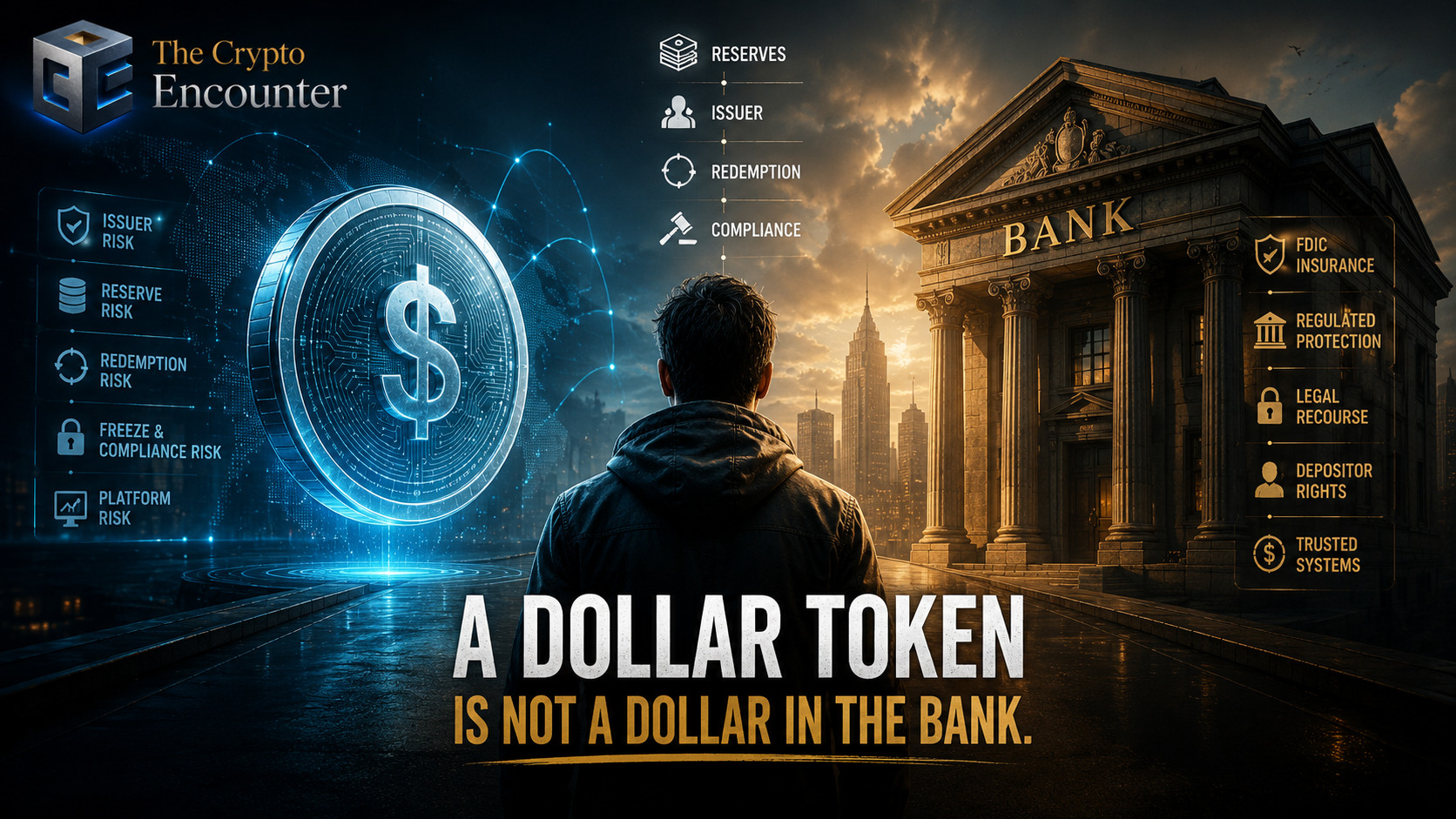
A dollar token can look almost identical to cash in a banking app. It may trade near $1, move quickly, and help someone pay a supplier or send money abroad. However, the resemblance can hide an important difference. A dollar token is usually a claim tied to a private issuer and its reserve structure, while a bank deposit is a liability of a regulated bank. Those two forms of money come with different protections, redemption paths, compliance controls, and failure risks. For households, freelancers, merchants, and remittance users, that distinction matters because a stable price does not automatically create the same legal protection as money in an insured bank account.
Key Facts: What a Dollar Token Actually Represents
A payment stablecoin is designed to maintain a fixed value, usually $1, and the issuer typically promises redemption at that value under stated conditions. In the United States, the GENIUS Act defines a payment stablecoin as a digital asset used for payment or settlement whose issuer is obligated to redeem it for a fixed monetary value. The law became Public Law 119-27 on July 18, 2025.
That definition already reveals the key point. A dollar token represents an issuer-linked redemption promise. It is not the same legal object as a dollar deposit sitting on a bank’s balance sheet.
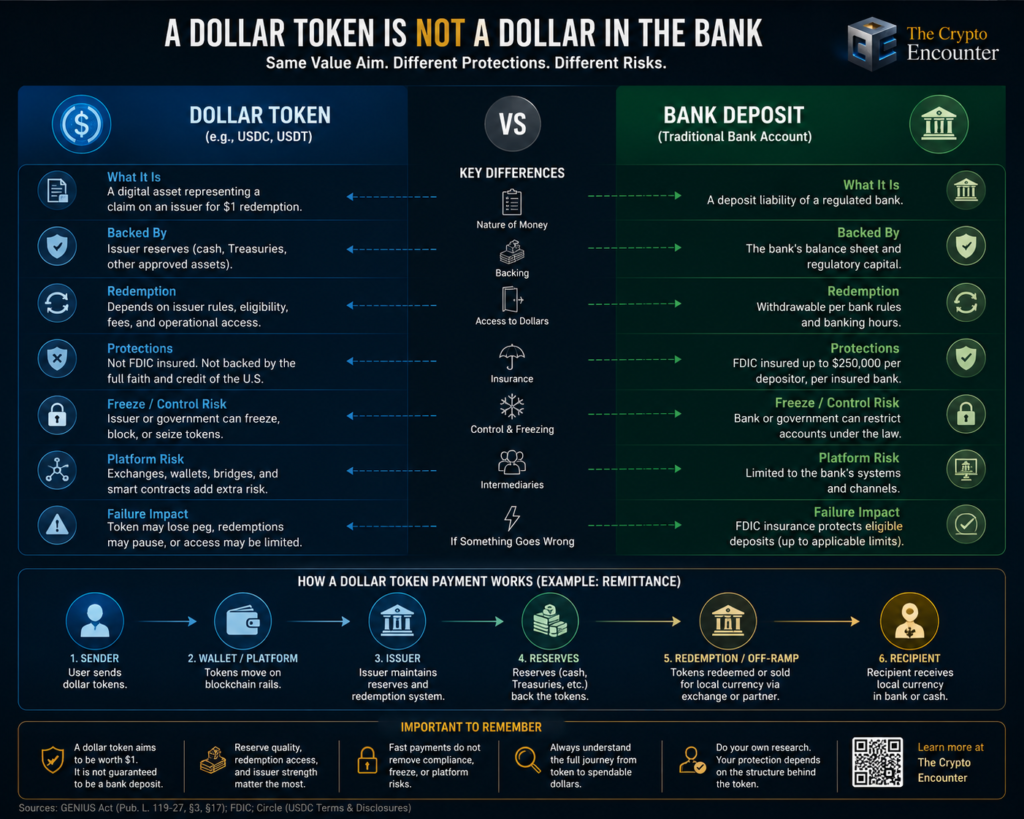
| Question | Dollar Token | Bank Deposit |
|---|---|---|
| What do you hold? | A digital asset with a redemption claim against an issuer, subject to applicable terms | A deposit claim against a bank |
| Does it aim to equal $1? | Usually, yes | It is denominated directly in dollars |
| FDIC insurance in the U.S.? | Payment stablecoins are not FDIC-insured | Eligible deposits are insured up to applicable limits |
| Can it use blockchain rails? | Yes | Traditional deposits usually use bank payment systems, although tokenized deposits can also use distributed ledgers |
| Can transfers be restricted? | Some issuers can block or freeze tokens under legal or compliance controls | Banks can also restrict accounts under applicable law and compliance rules |
| What matters during stress? | Reserves, liquidity, redemption, issuer strength, platform access | Bank condition, deposit-insurance coverage, and account access |
The FDIC currently provides standard deposit insurance of $250,000 per depositor, per insured bank, for each account ownership category. By contrast, U.S. law expressly states that payment stablecoins do not receive federal deposit insurance.
A stable value therefore tells you only part of the story. The rest sits behind the token.
Why a Dollar Token Can Stay at $1 and Still Carry Risk
Price stability feels like safety because people naturally associate one dollar with another dollar. Yet a dollar token stays close to $1 only while markets believe the redemption structure will work.
Consider the chain behind a simple token balance. First, the issuer needs sufficient reserves. Next, those reserves need enough liquidity to support redemptions. Banks, custodians, exchanges, and blockchain infrastructure must also keep operating. Finally, a user needs either direct redemption access or a functioning market where another buyer will accept the token near its intended value.
If one of those links weakens, the market price can move away from $1. Circle itself states that although USDC is intended to maintain a one-dollar value, prices on third-party platforms can fluctuate above or below $1.
That does not mean every dollar token is fragile. Instead, the $1 quote reflects confidence in a structure that sits behind the screen. Therefore, users should evaluate that structure, not only the displayed price.
Why Dollar Token Reserves Matter More Than the $1 Label
A reserve is the pool of assets that supports redemption. For a dollar token, the quality and availability of that pool can determine whether the issuer can meet withdrawals during stress.
Under the GENIUS Act, permitted U.S. payment stablecoin issuers must maintain reserves on at least a one-to-one basis. Eligible reserve assets include U.S. currency, qualifying demand deposits, short-dated U.S. Treasury securities, and certain overnight repurchase arrangements. The framework also requires issuers to disclose redemption policies and reserve information.
Those safeguards can reduce risk. Still, they do not turn the dollar token itself into an insured bank deposit, and they do not give a dollar token deposit insurance.
The distinction becomes especially important when reserve assets sit inside the banking system. A stablecoin issuer may hold cash at a bank, but the token holder does not automatically become the insured depositor of that reserve account.
In April 2026, the FDIC proposed implementation rules stating that deposits held as reserves backing a payment stablecoin would not receive pass-through deposit insurance for stablecoin holders.
In other words, reserve cash sitting at an insured bank and an insured deposit owned directly by you are different financial relationships.
The 2023 USDC Episode Showed How Dollar Token Reserve Risk Reaches Users
A real event makes the difference easier to see.
In March 2023, Circle disclosed that $3.3 billion of the reserves backing USDC, about 8% of its total reserve at the time, sat at Silicon Valley Bank when the bank failed. Uncertainty around those reserve funds coincided with USDC moving away from its intended one-dollar price in secondary markets.
U.S. authorities subsequently invoked a systemic-risk exception that protected all Silicon Valley Bank depositors. For a dollar token holder, that intervention mattered because reserve access supported confidence in redemption. The FDIC transferred all deposits into a bridge bank, while Circle said its $3.3 billion reserve deposit would become fully available.
The episode did not prove that USDC lacked reserves. Rather, it demonstrated how a dollar token can inherit risk from where its reserves sit and how quickly those assets can become available.
That distinction is crucial. Even when an issuer expects full recovery, holders can face price volatility while the underlying problem gets resolved.
Redemption Is the Bridge Between a Dollar Token and an Actual Dollar
Redemption means exchanging the token for traditional currency at the promised rate. It sounds straightforward. In practice, access depends on the issuer’s rules.
Circle, for example, states that direct USDC redemption through Circle requires an eligible Circle Mint account. Holders who do not have such an account cannot directly redeem through Circle unless they meet the eligibility requirements and open one. Circle also states that its one-for-one redemption commitment remains subject to its terms, applicable law, and relevant fees.
Therefore, someone holding a dollar token in a personal wallet may have a different redemption path from an institutional customer with direct issuer access.
That difference becomes more important during stress. A retail user may need to sell through an exchange or another market participant instead of redeeming directly with the issuer. If market liquidity weakens, the available sale price could fall below $1 even while eligible customers continue redeeming directly at par.
Consequently, “redeemable for one dollar” and “every holder can instantly receive one bank dollar” are not equivalent statements.
A Dollar Token Can Also Be Frozen
Many people assume blockchain money moves without intermediaries. Yet a dollar token can preserve an issuer’s control even when users hold it in private wallets.
Circle’s USDC terms, for example, allow the company to block certain addresses and freeze associated USDC in specified circumstances. The terms also state that Circle may freeze assets or surrender associated dollars when required by a valid government order.
The GENIUS Act likewise defines lawful orders that can require an issuer to seize, freeze, burn, or prevent the transfer of payment stablecoins.
Meanwhile, U.S. regulators continue to develop anti-money-laundering, sanctions, and customer-identification rules for permitted payment stablecoin issuers. A federal customer-identification proposal remained open for comments through August 21, 2026.
For ordinary users, the practical point is straightforward. Blockchain settlement does not remove compliance risk. A dollar token may travel through an open network, yet an issuer can still exercise control through the token contract or redemption relationship.
Banks also restrict accounts when laws or compliance obligations require it. The difference is that a dollar token can also face controls embedded in the token’s operational framework. With some stablecoins, those controls can affect transferability directly on-chain.
Fast Dollar Token Payments Do Not Guarantee Bank-Level Protection
Speed is one reason stablecoins appeal to businesses and families. A dollar token can move through blockchain infrastructure without following the same settlement path as a conventional international bank transfer.
Still, faster movement does not automatically provide stronger consumer protection. The dollar token may settle quickly while the wider payment journey remains exposed to other risks.
Imagine a worker sending the equivalent of $500 to a relative overseas using a dollar token. The transfer reaches the recipient’s wallet. However, the recipient may still need a reliable exchange or payment service to convert it into local currency.
Several things can then matter. An exchange may delay withdrawals. The sender could use the wrong blockchain address. Compliance checks could interrupt access. The token might temporarily trade below $1. Local exchange rates and service fees could also reduce the amount the recipient ultimately receives.
This is an illustrative example, not a claim that those problems occur in every stablecoin transfer.
Instead, it shows why transaction speed and end-to-end payment protection deserve separate evaluation.
A conventional bank payment may involve more intermediaries. However, eligible bank deposits sit inside an established deposit-insurance framework in the United States. A dollar token can improve settlement flexibility while shifting other responsibilities toward issuers, exchanges, wallets, payment providers, and users.
The Biggest Everyday Risks Behind a Dollar Token
For households and everyday payment users, five risks deserve particular attention.
1. Issuer Risk Can Affect a Dollar Token
The issuer manages the promise that one token can become one dollar. If that issuer faces insolvency, major operational problems, legal restrictions, or governance failures, confidence in the dollar token can weaken.
The United States now has a federal statutory framework for payment stablecoins through the GENIUS Act. However, implementation remains underway. As of August 18, 2026, federal agencies were still advancing proposed rules covering prudential standards, anti-money-laundering obligations, sanctions compliance, reporting, and customer identification.
2. Reserve Risk Sits Behind Every Dollar Token
Users should ask what assets back the dollar token, where those assets sit, who controls them, how frequently the issuer reports reserve information, and what redemption demands those assets may need to meet.
The Silicon Valley Bank episode demonstrated why reserve location matters alongside reserve value. A reserve asset can exist while access to that asset becomes uncertain or temporarily constrained. Markets may react before the issuer resolves the underlying problem.
3. Redemption Risk Determines Whether $1 Is Accessible
A dollar token may carry a one-for-one redemption promise, yet eligibility requirements, banking infrastructure, compliance reviews, fees, and operational interruptions can influence how a particular holder reaches traditional dollars.
Retail users should therefore check whether they can redeem directly with the issuer or whether they depend on an exchange. Circle’s current USDC terms, for example, distinguish between holders with eligible Circle Mint accounts and other USDC holders.
4. Freeze and Compliance Risk Can Stop a Dollar Token
Centralized stablecoin issuers can maintain mechanisms that block addresses or stop transfers. Legal orders, sanctions requirements, fraud controls, and issuer terms can all affect access.
Consequently, self-custody does not always mean unconditional transfer freedom. A user may control the wallet’s private key while the issuer retains separate powers over the dollar token contract. Circle’s published USDC terms provide a clear real-world example of that distinction.
5. Platform Risk Can Sit Between You and the Dollar Token
Many users never interact directly with the issuer. Instead, they hold stablecoins through exchanges, apps, payment companies, or custodial wallets.
That introduces another layer around the dollar token. Even when the underlying stablecoin continues functioning, the platform through which a customer accesses it can experience operational, security, liquidity, or compliance problems.
Therefore, users should distinguish between the risk of the token itself and the risk of the company holding that token for them.
Why Bank Protection Differs From Dollar Token Protection
Highlighting stablecoin risk should not create the impression that banks cannot fail. They can. Silicon Valley Bank itself provides a recent example.
The important difference is the protection structure.
In the United States, the FDIC currently insures eligible deposits up to $250,000 per depositor, per insured bank, for each ownership category.
The GENIUS Act, by contrast, explicitly states that payment stablecoins are not backed by the full faith and credit of the United States, guaranteed by the federal government, or subject to federal deposit insurance. The law also prohibits representing them that way.
That legal separation is one of the clearest reasons a dollar token is not simply a bank balance placed on a blockchain.
Importantly, a tokenized bank deposit belongs in another category.
The GENIUS Act’s definition excludes a deposit, including a deposit recorded using distributed-ledger technology, from the payment stablecoin category.
Therefore, “money represented by a token” does not always mean “stablecoin.” A tokenized bank deposit can remain a bank deposit, while a dollar token issued as a payment stablecoin represents a different legal claim.
For consumers, that distinction may matter more than the technology on the screen.
How to Judge a Dollar Token Before Using It as Everyday Money
A user does not need to become a financial analyst. However, a few checks can reveal the biggest risks.
Start with the issuer. Identify the legal entity responsible for redemption. Then review the reserve composition and disclosure process. Afterward, check who can redeem directly and what conditions apply.
Next, understand where you will hold the dollar token. A self-custody wallet creates different risks from an exchange account. Likewise, verify the blockchain and address before sending funds because blockchain transactions can be difficult or impossible to reverse. Circle’s USDC terms specifically warn users that sending tokens to an incorrect address can result in permanent loss of access.
Finally, consider the entire payment journey.
For a remittance, ask how the recipient will cash out. Check which service provides the local conversion. Review fees and exchange rates. Consider what happens if the chosen exchange becomes unavailable or adds a compliance review.
That process turns “Does it stay at $1?” into a much more useful question:
“What has to keep working for me to receive, redeem, and use this dollar token?”
Dollar Token Regulation Is Strengthening the Framework, Not Erasing the Difference
The U.S. regulatory framework is moving toward clearer reserve, disclosure, redemption, supervision, and compliance standards.
The GENIUS Act became law on July 18, 2025. It establishes one-to-one reserve requirements for permitted issuers, specifies eligible reserve assets, requires redemption policies, and bars claims that payment stablecoins receive federal deposit insurance.
The statute says its provisions take effect on the earlier of 18 months after enactment or 120 days after the primary federal regulators issue final implementing regulations.
As of August 18, 2026, implementation was still progressing through regulatory proposals. The FDIC had proposed prudential and deposit-insurance treatment in April, while federal regulators were also seeking comments on customer-identification requirements.
The Crypto Encounter’s broader coverage of how regulation is becoming a major filter for crypto markets provides additional context on why legal structure increasingly matters alongside technology.
Better rules can make a dollar token more transparent and resilient. They can also make a dollar token easier to evaluate by standardizing expectations around reserves, disclosure, redemption, and supervision.
Nevertheless, regulation does not transform the product into a bank deposit. It creates a framework for a different form of financial claim.
Why a Dollar Token Matters for Remittances and Household Money
Stablecoins have practical payment uses precisely because they connect blockchain infrastructure with dollar-linked value.
For someone receiving payment from an overseas client, a dollar token can provide another route for receiving and transferring dollar-denominated value. A family moving money across borders, it can create an alternative settlement method. For an online merchant, it can support payments through digital-asset infrastructure.
However, using a dollar token as everyday money means accepting a different bundle of protections and responsibilities. That is why a dollar token should be judged as a payment product, not merely by its $1 price.
The safest mental model is not “digital cash sitting in my bank account.”
A more accurate model is this:
A transferable digital claim designed to track the dollar, supported by an issuer, reserve assets, redemption rules, technological infrastructure, and compliance controls.
That description sounds more complicated. Yet it better explains what a user actually owns.
Conclusion: A Dollar Token Is Useful Because It Is Different
A dollar token can be fast, practical, and relatively stable in price. Those qualities help explain its usefulness for crypto settlement, digital commerce, cross-border transfers, and other payment applications.
Still, a $1 price should never erase the legal and operational structure underneath it.
Reserve assets can face liquidity or access problems. Redemption can depend on eligibility and financial infrastructure. Issuers may freeze addresses under applicable rules. Platforms can create another layer of risk. Compliance procedures can interrupt access. Most importantly, federal deposit insurance does not protect a payment stablecoin simply because its reserves may include deposits held at insured banks.
Therefore, anyone considering a dollar token for savings, remittances, payments, or household money should understand the claim they actually hold.
In everyday use, a dollar token can behave much like a digital dollar.
Legally and financially, however, it does not carry the same claim or the same protection structure as a dollar held in an insured bank account.
That difference is exactly what consumers need to understand before the technology becomes invisible.
FAQs
Is a Dollar Token the Same as Cash?
No. A dollar token is a digital asset designed to maintain a dollar-linked value. It relies on an issuer, reserves, redemption arrangements, market infrastructure, and applicable rules. Physical currency and bank deposits have different legal characteristics.
Is a Dollar Token FDIC-Insured?
No payment stablecoin is itself FDIC-insured under the GENIUS Act. An issuer may hold some reserve assets as deposits at insured banks, but that does not make every token holder an insured bank depositor.
Can a Stablecoin Issuer Freeze My Dollar Token?
Some centralized issuers can block addresses or freeze tokens under their terms or when a lawful order requires action. USDC provides one current example through Circle’s published terms.
What Happens if a Dollar Token Falls Below $1?
A temporary depeg can occur when markets question reserve access, redemption, liquidity, or issuer risk. USDC’s March 2023 disruption showed how concern around reserve access can affect a token’s secondary-market price.
Is a Tokenized Bank Deposit the Same as a Stablecoin?
No. Under current U.S. law, a bank deposit recorded through distributed-ledger technology remains distinct from a payment stablecoin. The legal claim behind the digital representation matters more than the fact that both may use token-like technology.
Is a Dollar Token Useful for Remittances?
It can be. A dollar token can provide another way to transfer dollar-linked digital value across blockchain networks. However, users should also consider wallet security, conversion access, service fees, exchange rates, compliance checks, and the recipient’s ability to spend or redeem it.