



Bitcoin traded above $66,000 on July 21 as U.S. federal debt hovered around $39.5 trillion. Yet the debt milestone itself may be less important for markets than what comes next.
The U.S. Treasury will update its quarterly borrowing estimate on August 3, followed by its quarterly refunding announcement on August 5. Treasury currently expects to borrow $671 billion in privately held net marketable debt during the July-to-September quarter. Any meaningful change in that estimate, or in the mix of securities used to finance it, could affect Treasury yields and broader financial conditions.
For Bitcoin, that creates a real liquidity test. Higher government-bond yields can compete with a non-yielding asset for capital. At the same time, renewed spot Bitcoin ETF inflows, regulatory developments, and corporate treasury activity provide potential counterweights.
Why the U.S. Debt Story Matters for Bitcoin
The first distinction is essential.
U.S. federal debt and Treasury’s quarterly borrowing requirement measure different things.
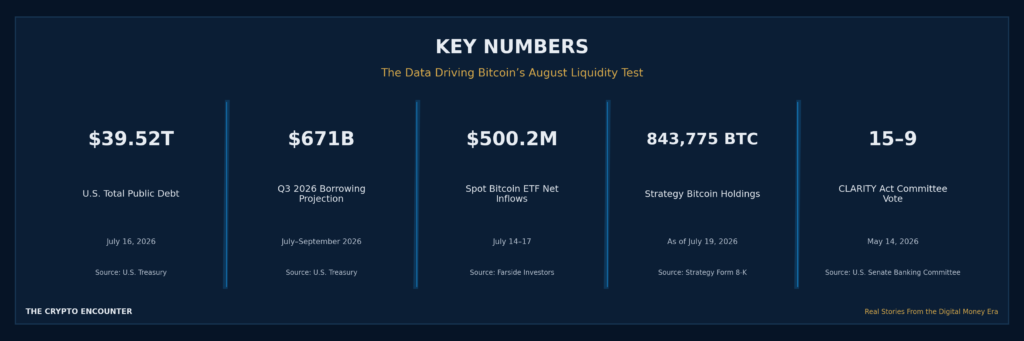
Treasury’s Debt to the Penny dataset defines total public debt outstanding as the combination of debt held by the public and intragovernmental holdings. The total stood at roughly $39.52 trillion on July 16, according to the latest figure used in this audit.
Treasury’s quarterly borrowing estimate, by contrast, measures the amount of privately held net marketable debt the government expects to borrow over a specific period.
On May 4, Treasury projected $671 billion of privately held net marketable borrowing from July through September 2026, assuming a $950 billion cash balance at the end of September.
That difference matters because a rising federal debt total does not translate dollar-for-dollar into new marketable issuance during any single quarter.
Debt levels reflect maturities, intragovernmental obligations, cash management, and other Treasury financing operations.
The near-term market question is therefore not simply whether federal debt reaches $40 trillion.
It is how much additional financing private investors must absorb and under what terms.
August 3 and August 5 Are the Key Treasury Dates
Treasury’s official refunding calendar says the next financing-estimate release is scheduled for August 3, 2026.
The full quarterly refunding announcement follows on August 5.
The August 3 release should show whether Treasury has revised its current $671 billion third-quarter borrowing estimate. It should also provide an estimate for the following quarter.
Then, the August 5 announcement will give markets more information about financing strategy and auction plans.
That composition matters.
Treasury can finance itself through bills, notes, bonds, Treasury Inflation-Protected Securities, and floating-rate notes. Different maturity profiles can affect the market in different ways.
A larger amount of longer-duration issuance may place more duration risk into private portfolios. Greater reliance on shorter-term bills could interact differently with money-market liquidity.
That is why the financing mix deserves as much attention as the headline borrowing number.
Treasury Borrowing Creates Competition for Capital
Bitcoin’s fixed supply often features prominently in debates about rising government debt.
The Bitcoin protocol caps total issuance at 21 million BTC. Supporters frequently contrast that scarcity with government balance sheets that can continue expanding over time.
That argument, however, does not mean higher federal debt automatically raises Bitcoin’s price.
In the short run, additional Treasury supply can create competition for capital.
If investors require higher yields to absorb government securities, Treasuries become more attractive relative to assets that do not provide contractual income.
Bitcoin pays no coupon.
As a result, higher risk-free yields can increase the opportunity cost of holding it.
The relationship is not mechanical. Bitcoin can rise while yields rise, and it can fall while yields decline. ETF demand, risk appetite, Federal Reserve policy, leverage, geopolitical events, and crypto-specific developments all matter.
Still, the interest-rate channel has economic support.
A May 2026 Federal Reserve research paper estimated that a 1 percentage-point increase in expected U.S. debt relative to GDP raises the 10-year Treasury term premium by about 2 to 3 basis points. The authors also estimated an increase of roughly 1 to 2 basis points in the longer-run neutral interest rate.
Those estimates do not predict what will happen after the August Treasury announcements.
They do help explain why government financing expectations can matter for risk assets.
For more on this relationship, The Crypto Encounter has previously examined why Bitcoin still reacts to Federal Reserve policy, dollar liquidity and Treasury yields.
Treasury’s Financing Mix Could Matter More Than $40 Trillion
Treasury’s May refunding statement said it expected to maintain nominal coupon and floating-rate-note auction sizes for at least the next several quarters, based on its projected financing needs.
It also said unexpected changes in financing requirements could be handled through adjustments to regular bill auctions or cash-management bills.
That makes the August update especially important.
If Treasury keeps longer-duration auction sizes broadly stable, markets may respond differently than they would to an unexpected increase in coupon issuance.
Likewise, a revision to the borrowing estimate does not guarantee higher yields.
Demand from domestic institutions, foreign investors, money-market funds, and other Treasury buyers can influence how new supply is absorbed.
Inflation expectations and Federal Reserve policy may matter even more.
The $40 trillion figure is therefore a powerful fiscal milestone, but it is not a standalone Bitcoin trading signal.
Spot Bitcoin ETFs Provide a Demand Counterweight
Bitcoin also has a source of demand that did not exist in the same form during earlier macro cycles: U.S. spot Bitcoin ETFs.
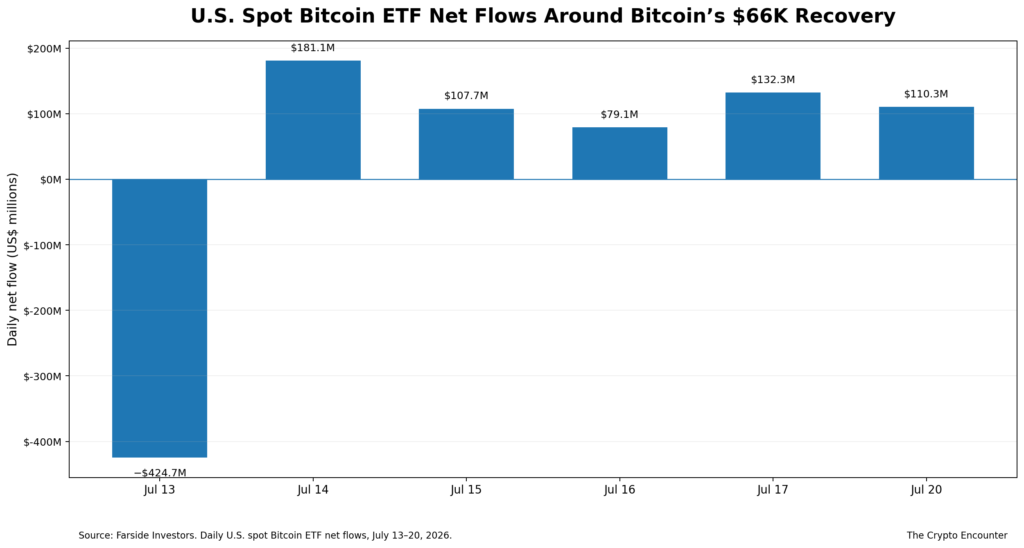
Farside Investors recorded $181.1 million in net inflows on July 14, $107.7 million on July 15, $79.1 million on July 16, and $132.3 million on July 17.
Those four sessions produced $500.2 million of combined net inflows.
On July 20, the funds recorded another $110.3 million in net inflows, according to Farside’s latest available table.

That matters because ETF flows provide a direct channel for traditional-market capital to reach Bitcoin.
Still, recent inflows should not be treated as proof that institutional demand will continue.
The same Farside dataset shows a $424.7 million net outflow on July 13, only one session before the four-day inflow streak began.
Flows can reverse quickly.
The more useful question for August is whether ETF demand remains resilient if Treasury yields move higher or broader liquidity conditions tighten.
Readers can follow related developments through The Crypto Encounter’s Bitcoin coverage.
CLARITY Act Progress Adds a Regulatory Variable
Regulation adds another potential source of market support, although the legislative outlook remains uncertain.
On May 14, 2026, the Senate Banking Committee voted 15-9 to advance H.R. 3633, the Digital Asset Market Clarity Act of 2025. The committee said the bill would move toward Senate floor consideration.
The legislation is designed to establish a broader regulatory framework for digital commodities and define responsibilities across the Securities and Exchange Commission and Commodity Futures Trading Commission.
On July 21, news reports said President Donald Trump had agreed to proposed ethics restrictions intended to address one of the political obstacles surrounding the bill.
That remains a reported political development, not enacted law.
I cannot confirm a final, publicly released White House version of the proposed ethics language.
Contemporary reporting also indicated that Democrats had not yet reviewed the revised language when the reports emerged.
That distinction is important.
Even if negotiations improve, the CLARITY Act still requires further congressional action before it can become law.
Forecasts linking passage of the legislation to a specific Bitcoin target, including projections as high as $200,000, are therefore speculative scenarios.
They are not established consequences of the bill.
Strategy’s Latest Filing Shows Why Liquidity Matters
The same liquidity theme is visible at the corporate level.
Strategy disclosed in a July 20 Form 8-K that it sold 2,732,318 Class A common shares between July 13 and July 19, generating $263.5 million in net proceeds through its at-the-market program.
The company reported no Bitcoin purchases during that period.
As of July 19, Strategy held 843,775 BTC.
Its aggregate purchase cost was $63.69 billion, with an average acquisition price of $75,476 per Bitcoin, including fees and expenses.
Strategy also reported a $3.225 billion U.S. dollar reserve.
The company said that reserve is intended to support preferred-stock dividend payments and interest on outstanding debt. It also noted that the balance included expected proceeds from ATM share sales that had not yet settled as of July 19.
The filing does not show that Strategy has abandoned its Bitcoin strategy.
Instead, it illustrates another feature of large corporate Bitcoin treasuries.
Holding Bitcoin does not eliminate dollar obligations.
Companies still need liquidity for financing costs, dividends, and other contractual commitments.
Strategy can raise that liquidity through equity markets rather than selling Bitcoin, although repeated share issuance also creates dilution considerations for common shareholders.
Liquidity Has a Price at Every Level
Treasury and Strategy operate on vastly different scales, so the comparison should not be taken too far.
Still, both developments highlight an important principle.
Liquidity has a cost.
The federal government must finance obligations through the Treasury market.
Companies must maintain enough cash to meet financial commitments.
Investors must decide how to allocate capital among cash, government bonds, equities, Bitcoin ETFs, and other assets.
For Bitcoin, that means scarcity is only one part of the market structure.
Access to liquidity and the return available on competing assets can matter just as much over shorter periods.
That argument also fits Bitcoin’s recent behavior during geopolitical stress. In earlier TCE analysis, Bitcoin initially held up better than some traditional markets during renewed U.S.-Iran tensions but later weakened as broader risk pressure increased. That episode also showed why short-term resilience should not be confused with full macro independence. Read the related TCE analysis

Risks, Limits and Unanswered Questions
Several uncertainties prevent the Treasury story from becoming a straightforward bullish or bearish Bitcoin signal.
First, Treasury may leave its third-quarter borrowing estimate close to the current $671 billion projection.
Second, issuance composition matters. A change concentrated in bills may have different market effects from a significant increase in longer-duration securities.
Third, Treasury supply is only one force affecting bond yields. Inflation, labor-market data, Federal Reserve expectations, foreign demand, and geopolitical developments can all influence rates.
Bitcoin ETF flows are another uncertainty. Recent inflows have improved, but they can reverse quickly.
The CLARITY Act also remains unfinished legislation. Committee advancement and reported political compromises should not be confused with enactment.
Finally, Strategy is not representative of every institutional Bitcoin holder. Its large BTC treasury, preferred-stock structure, debt obligations, and extensive use of capital markets make it an unusual case.
What to Watch in Bitcoin's Early-August Liquidity Test
The early-August Bitcoin setup involves several interconnected variables. Treasury borrowing and financing decisions form the central macro test, while ETF demand, yields, regulation and corporate treasury activity provide additional signals.
| Indicator | Verified Baseline | What to Watch | Why It Matters for Bitcoin |
|---|---|---|---|
| Treasury borrowing estimate | $671B projected Q3 privately held net marketable borrowing | August 3 revision and initial Q4 estimate | A larger requirement could increase the amount of Treasury securities private markets must absorb. |
| Treasury financing mix | Treasury previously expected broadly stable nominal coupon and FRN auction sizes | August 5 bill, note, bond and other financing plans | The maturity mix can influence duration risk and how issuance interacts with market liquidity. |
| Treasury cash assumption | $950B end-September balance assumed in May projection | Any change to Treasury's cash target | Cash rebuilding can affect the timing and scale of financing requirements. |
| U.S. spot Bitcoin ETF flows | $500.2M net inflows from July 14–17, plus $110.3M on July 20 | Whether positive flows persist or reverse | ETF flows provide a direct institutional demand channel for Bitcoin. |
| Treasury yields | Market-determined | Reaction in two-year and 10-year yields after Treasury updates | Higher risk-free yields can increase Bitcoin's opportunity cost, although the relationship is not mechanical. |
| CLARITY Act | Advanced 15–9 by Senate Banking Committee on May 14 | Published legislative text and further congressional action | Regulatory progress could affect institutional confidence, but the bill is not law. |
| Strategy treasury activity | 843,775 BTC held as of July 19; $3.225B USD reserve | Future BTC purchases, reserve changes and equity issuance | Shows how a major corporate Bitcoin holder balances accumulation with dollar liquidity requirements. |
The first indicator is Treasury’s August 3 borrowing estimate.
Investors should compare the new third-quarter figure with the current $671 billion projection and examine Treasury’s initial estimate for the following quarter.
The second event is the August 5 quarterly refunding announcement.
The balance between bills and longer-duration securities will help show how Treasury intends to meet its financing needs.
Treasury yields will then provide a market response.
Bitcoin ETF flows will show whether institutional demand remains strong enough to offset tighter financial conditions if yields rise.
Legislative developments around the CLARITY Act also deserve attention, but official text and congressional action matter more than political expectations or prediction-market probabilities.
Strategy’s next filings will provide another institutional signal. Investors can watch whether Bitcoin purchases resume, whether cash reserves continue rising, and how the company balances equity issuance with its BTC treasury.
Bitcoin’s move above $66,000 therefore arrives at an important moment.
The real August test is not whether federal debt crosses a round-number threshold.
It is whether the next phase of U.S. government financing changes the liquidity environment in which Bitcoin is trying to sustain its recovery.
FAQs
Why does U.S. Treasury borrowing matter for Bitcoin?
Additional Treasury borrowing increases the amount of government securities markets may need to absorb. If yields rise as a result, Bitcoin can face greater competition for capital because it does not provide contractual interest. However, Treasury issuance does not determine Bitcoin’s price by itself.
When is the next Treasury borrowing update?
Treasury’s next financing-estimate release is scheduled for August 3, 2026. Its next quarterly refunding announcement is scheduled for August 5, 2026.
How much does the Treasury currently expect to borrow?
Treasury currently projects $671 billion in privately held net marketable borrowing for July through September 2026, assuming a $950 billion end-of-quarter cash balance.
Are Bitcoin ETFs seeing inflows?
Yes, based on the latest available data used in this audit. U.S. spot Bitcoin ETFs recorded $500.2 million of combined net inflows from July 14 through July 17 and another $110.3 million on July 20. ETF flows can reverse quickly.
Has the CLARITY Act become law?
No. The Senate Banking Committee advanced H.R. 3633 by a 15-9 vote on May 14, 2026, but further congressional action is still required before the legislation can become law.
Did Strategy stop its Bitcoin strategy?
There is no evidence in the July 20 filing that Strategy abandoned its Bitcoin strategy. The company reported no Bitcoin purchases during July 13 to July 19 while maintaining holdings of 843,775 BTC and increasing its U.S. dollar reserve.
Disclaimer
This article is for informational and educational purposes only. It does not provide financial, investment, legal, tax, or accounting advice. Cryptocurrency and digital asset markets involve risk, including possible loss of capital. Readers should conduct their own research before making any financial decision.