



Latest reported Bitcoin recovery is approaching an important reality check.
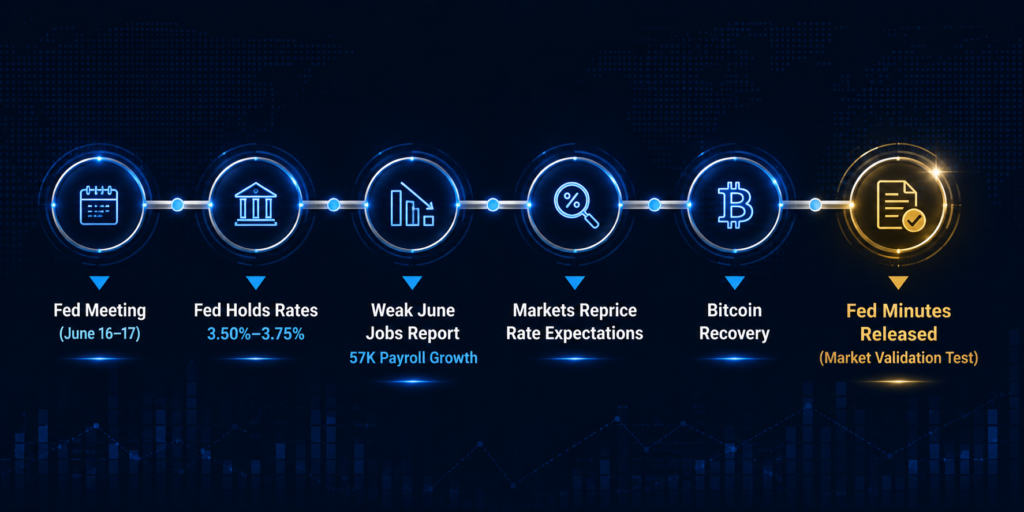
Over the past week, the world’s largest cryptocurrency has rebounded sharply after weaker-than-expected U.S. employment data prompted investors to reconsider how long the Federal Reserve can maintain restrictive monetary policy. That shift helped lift Bitcoin alongside equities and gold as markets priced in the possibility that future interest-rate increases could become less likely.
Now, attention has turned to one document that could either reinforce or challenge that optimism.
The minutes from the Federal Reserve’s June 16 to 17 policy meeting are expected to provide investors with the clearest explanation yet of how policymakers viewed inflation, employment, and broader economic risks before the latest labor market data changed market expectations. While the minutes cannot predict future policy decisions, they may reveal whether investors correctly interpreted the Fed’s thinking or simply moved ahead of the evidence.
That distinction matters because Bitcoin’s recent recovery has been driven far more by macroeconomic expectations than by crypto-specific developments. The next phase of the rally may depend less on blockchain fundamentals and more on whether the broader economic narrative continues to support risk assets.
Why One Federal Reserve Document Matters So Much
Federal Reserve meeting minutes rarely attract attention outside financial circles. This time is different.
Unlike the short statement released immediately after each policy meeting, the minutes provide a more detailed record of the discussions that shaped the central bank’s decision. Investors study them closely for signs of disagreement among policymakers, changing views on inflation, concerns about financial stability, and confidence in the labor market.
Markets have already formed an opinion following the latest employment report. The minutes now offer an opportunity to test whether that opinion reflects the Fed’s internal thinking.
If policymakers had already begun discussing signs of economic slowing before the labor market weakened further, investors may feel more confident that expectations for a less aggressive policy path are justified.
If, however, inflation remained the dominant concern throughout the meeting, markets could reassess whether they became too optimistic too quickly.
Importantly, the minutes describe discussions that occurred before the June employment report was released. They therefore provide historical context rather than a direct response to the latest economic data.
That timing makes the document valuable, but it also limits how much investors should read into it.
The Jobs Report Changed the Conversation
The catalyst behind Bitcoin’s rebound was not a major crypto announcement or a surge in blockchain activity.
Instead, it came from the U.S. labor market.
According to the Bureau of Labor Statistics, employers added 57,000 jobs in June, significantly below market expectations. Previous months were also revised lower, while labor-force participation declined to 61.5%, suggesting that headline unemployment figures alone did not fully capture the underlying weakness in employment.
Those figures immediately reshaped expectations for monetary policy.
Investors began pricing in a greater possibility that the Federal Reserve would slow or pause further tightening if economic activity continued to cool.
That shift extended well beyond cryptocurrency markets.
Treasury yields eased, gold strengthened, and equity markets also reacted positively as investors adjusted their outlook for interest rates.
Bitcoin participated in the same macro-driven move.
This is an important distinction.
The recovery was not necessarily a vote of confidence in Bitcoin itself. Rather, it reflected changing expectations about the broader financial environment in which Bitcoin now trades.
| Indicator | Latest Reported Figure* | Why It Matters for Bitcoin |
| June Nonfarm Payrolls | 57,000 jobs | Weaker hiring can reduce expectations for additional rate hikes. |
| Unemployment Rate | 4.2% | Indicates labor market conditions the Fed monitors closely. |
| Labor Force Participation | 61.5% | Shows fewer workers participating in the labor market. |
| April–May Payroll Revision | -74,000 jobs | Suggests employment was weaker than previously reported. |
| Fed Target Rate | 3.50%–3.75% | Higher rates generally reduce liquidity for risk assets. |
| Spot Bitcoin ETF Flows | Positive daily inflow after 10-day outflow streak | Indicates improving, but not yet sustained, institutional demand. |
*Figures are based on the sources cited in the article and should always be interpreted within their reported date.
Bitcoin Is No Longer Trading in Isolation

Bitcoin’s relationship with traditional financial markets has evolved dramatically over the past several years.
During earlier market cycles, crypto prices often responded primarily to industry-specific events, including exchange failures, mining developments, network upgrades, or regulatory announcements.
Today’s market looks very different.
Institutional investors now play a much larger role through regulated investment vehicles, professional trading desks, hedge funds, and exchange-traded funds.
As a result, Bitcoin increasingly reacts to the same macroeconomic forces that influence equities, bonds, and commodities.
Interest rates, inflation expectations, central-bank communication, and liquidity conditions have become central drivers of investor behavior.
This growing integration helps explain why a Federal Reserve document can influence sentiment across digital assets.
It also highlights how Bitcoin’s investment profile continues to evolve.
Rather than existing outside the traditional financial system, Bitcoin has become increasingly connected to it through institutional capital.
That connection offers benefits, including broader adoption and improved market access. At the same time, it exposes Bitcoin to risks that originate well beyond the cryptocurrency ecosystem.
ETF Flows Tell Only Part of the Story
Institutional participation remains one of the most closely watched indicators in today’s Bitcoin market.
Recent data showed U.S. spot Bitcoin ETFs recorded fresh inflows after an extended period of withdrawals, providing an encouraging sign that institutional investors had not completely abandoned the market.
However, that signal deserves careful interpretation.
One positive trading session does not establish a sustainable trend.
Large institutional investors typically build positions over weeks or months rather than responding to a single economic report. Short-term inflows can also reflect portfolio rebalancing instead of long-term conviction.
For that reason, ETF flows should be viewed as supporting evidence rather than the primary explanation for Bitcoin’s recent recovery.
A stronger case for renewed institutional demand would require multiple weeks of consistent inflows across several major issuers.
Until then, ETF activity suggests stabilization rather than confirmation.
A Market Built on Expectations Carries Additional Risk
Perhaps the most important feature of the current rally is that it rests on expectations rather than confirmed policy changes.
The Federal Reserve has not announced easier monetary policy.
Interest rates remain elevated.
Inflation continues to influence policymakers’ decisions.
The labor market, although weaker than expected, remains historically resilient by longer-term standards.
Yet markets have already adjusted to a more optimistic outlook.
That creates an interesting situation.
If future economic data continues supporting expectations for slower monetary tightening, Bitcoin may benefit from improved liquidity conditions.
If inflation remains persistent or future economic reports prove stronger than expected, investors may need to reconsider some of the assumptions that helped fuel the latest rebound.
Neither outcome is predetermined.
Instead, the market is entering a period where each major economic release carries greater significance because investors are trying to determine whether the recent shift in expectations reflects a lasting trend or a temporary reaction.
Institutional Investors and Retail Traders Are Reading the Same Signals Differently
The current rally also highlights a growing divide between institutional and retail investors.
Professional investors tend to focus on macroeconomic data, interest-rate expectations, and portfolio allocation. Their decisions often reflect changing views on liquidity rather than short-term market excitement.
Retail traders, on the other hand, often respond more quickly to price momentum.
Several analysts have noted that optimism among smaller investors has increased as Bitcoin recovered toward the $64,000 level. While improving sentiment is not unusual during a rebound, it should not be viewed as proof that the market has entered a sustained uptrend.
Sentiment indicators are useful because they show how investors feel. They do not explain why markets move, nor can they reliably predict future direction.
That is particularly important in the current environment. Bitcoin’s recovery has been driven largely by expectations surrounding monetary policy, not by a major change in blockchain adoption, network activity, or corporate investment.
For long-term investors, that distinction matters.
A rally supported mainly by changing expectations can remain intact if economic data continues moving in the same direction. However, if those expectations change, market sentiment can shift just as quickly.
Bitcoin’s Market Structure Has Changed
One reason macroeconomic events now have a greater influence on Bitcoin is the asset’s evolving investor base.
Spot Bitcoin ETFs have expanded access for pension funds, asset managers, family offices, and institutional investors that previously had limited exposure to cryptocurrencies.
That broader participation has improved market depth and liquidity. It has also strengthened Bitcoin’s relationship with traditional financial markets.
As a result, many institutional investors now evaluate Bitcoin alongside other risk assets rather than as a completely separate investment category.
This does not mean Bitcoin has lost its unique characteristics.
Its fixed supply, decentralized network, and global accessibility remain key features that distinguish it from traditional financial assets.
However, in the short term, macroeconomic developments often dominate market behavior because they influence the flow of capital across global markets.
The recent recovery illustrates that reality.
Rather than responding to crypto-specific news, Bitcoin moved as investors reassessed interest-rate expectations following weaker employment data.
Risks Remain Despite the Recovery
Bitcoin’s rebound has improved market sentiment, but several important uncertainties remain:
- Inflation pressure:
Inflation remains a major focus for the Federal Reserve. If future inflation reports come in higher than expected, policymakers may keep interest rates restrictive for longer than markets anticipate. - Institutional demand:
Recent Bitcoin ETF inflows are a positive signal, but one strong session does not confirm a sustained return from institutional investors. Consistent inflows over a longer period would provide stronger evidence of renewed confidence. - Economic uncertainty:
The Fed minutes reflect discussions that happened before the latest employment data. They offer useful context, but they should not be viewed as a direct prediction of future policy decisions. - Bitcoin market volatility:
Bitcoin remains sensitive to changing conditions. Regulatory developments, geopolitical events, security issues, and shifts in market liquidity can quickly affect investor sentiment.
Overall, these risks do not remove Bitcoin’s long-term narrative. They highlight why investors should separate confirmed developments from market expectations.
What Investors Should Watch Next
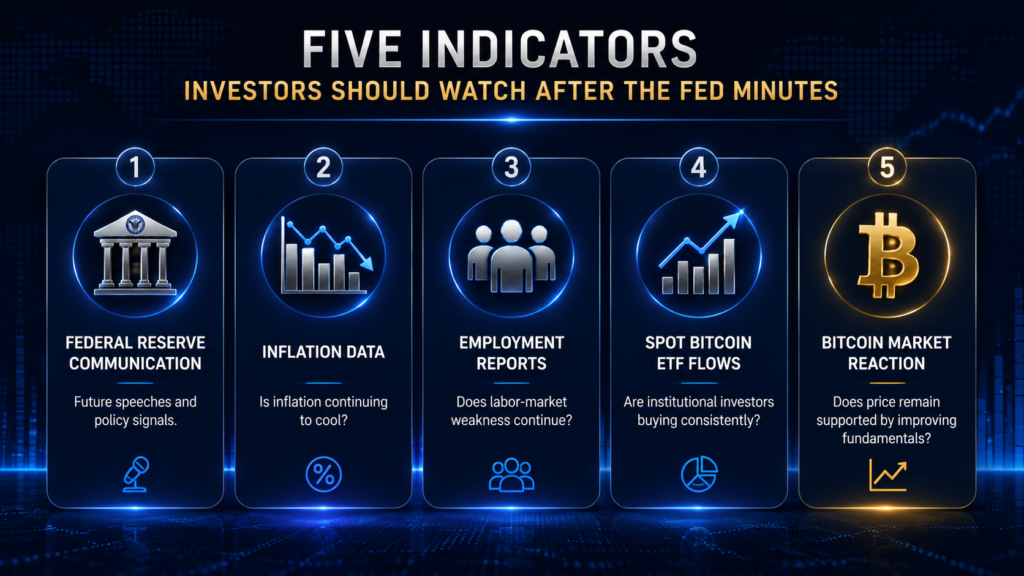
Rather than focusing on short-term price targets, investors should monitor the factors that are shaping the broader macro narrative.
The Federal Reserve minutes will provide one important piece of information, but they represent only one step in a longer process.
Over the coming weeks, investors should pay close attention to:
- Future inflation reports and whether price pressures continue to ease.
- Upcoming U.S. employment data for signs that labor-market weakness is becoming more persistent.
- Federal Reserve speeches and policy guidance following the release of the minutes.
- CME FedWatch probabilities to see how markets adjust interest-rate expectations.
- Spot Bitcoin ETF flows to determine whether institutional demand becomes more consistent.
- Broader market performance across equities, Treasury yields, and gold, which often reflect changes in investor appetite for risk.
Viewed together, these indicators provide a more complete picture than any single report.
Bitcoin’s next major move is unlikely to depend on one document alone. Instead, it will depend on whether the broader economic narrative continues to support the assumptions that fueled the latest recovery.
Why This Story Matters
The significance of this story extends beyond Bitcoin’s short-term price movement.
It reflects how the cryptocurrency market has matured.
Bitcoin is no longer influenced solely by blockchain innovation or crypto-native events. Today, it operates within a broader financial system where central-bank policy, institutional capital, and macroeconomic conditions play increasingly important roles.
For investors, this means understanding Bitcoin requires more than following cryptocurrency headlines.
It also requires understanding how monetary policy, economic data, and financial-market expectations interact.
The upcoming Federal Reserve minutes will not determine Bitcoin’s future on their own.
However, they may help answer an increasingly important question: Did markets correctly anticipate the Fed’s thinking, or has optimism moved ahead of the evidence?
That answer could shape investor confidence well beyond this week’s trading activity.
Frequently Asked Questions
Why are the Federal Reserve minutes important for Bitcoin?
The minutes provide additional insight into how policymakers discussed inflation, employment, and interest rates. Because Bitcoin has become more connected to global financial markets, those discussions can influence investor expectations and liquidity conditions.
Did weaker jobs data cause Bitcoin to rally?
The weaker-than-expected employment report changed market expectations around future monetary policy. Many investors viewed that as supportive for risk assets, including Bitcoin. However, multiple factors influence cryptocurrency prices, and no single economic report determines market direction.
Why do Bitcoin ETF flows matter?
Spot Bitcoin ETF flows offer insight into institutional participation. Consistent inflows may suggest growing demand from professional investors, while prolonged outflows can indicate weaker institutional interest. One trading session alone does not establish a long-term trend.
Are the Fed minutes a prediction of future policy?
No. The minutes summarize discussions from a previous policy meeting. They provide valuable context but do not commit the Federal Reserve to future interest-rate decisions.
What should investors monitor after the Fed minutes?
Investors should continue following inflation data, employment reports, Federal Reserve communications, ETF flows, and broader market conditions. Together, these indicators provide a clearer picture of the environment influencing Bitcoin.
Disclaimer
This article is for informational and educational purposes only. It does not provide financial, investment, legal, tax, or accounting advice. Cryptocurrency and digital asset markets involve risk, including the possible loss of capital. Readers should conduct their own research and consider their financial circumstances before making any investment decision.