



Bitcoin initially held near $63,800 on July 13 as renewed U.S.-Iran hostilities pushed oil higher and unsettled equities, bonds, and precious metals. That early stability attracted attention because Bitcoin has often fallen with other risk-sensitive assets during periods of geopolitical stress. Hours later, however, the cryptocurrency slipped below $63,000 as market pressure widened.
The sequence matters more than either price snapshot alone. Bitcoin showed greater early resilience than several traditional markets, but it did not escape the risk-off environment. The episode therefore offers a useful test of Bitcoin’s changing market structure, institutional participation, and sensitivity to global liquidity. It does not yet prove that crypto has decoupled from equities or become a reliable geopolitical safe haven.
Why This Story Matters
Bitcoin’s role in global portfolios remains unsettled.
Supporters often describe it as digital gold because of its fixed issuance model and independence from central banks. In practice, however, Bitcoin has frequently traded like a volatile risk asset. Its price has responded to interest-rate expectations, dollar liquidity, leverage, equity-market sentiment, and changes in institutional demand.
The latest U.S.-Iran escalation provides another real-time test. If Bitcoin repeatedly absorbs geopolitical shocks better than equities and other high-beta assets, investors may begin treating it as a more independent macro asset. One morning of relative stability, however, cannot establish that conclusion.
The more defensible finding is narrower: Bitcoin initially reacted less sharply than several traditional markets, then weakened as the session progressed.
Bitcoin Initially Resists the Broader Market Shock
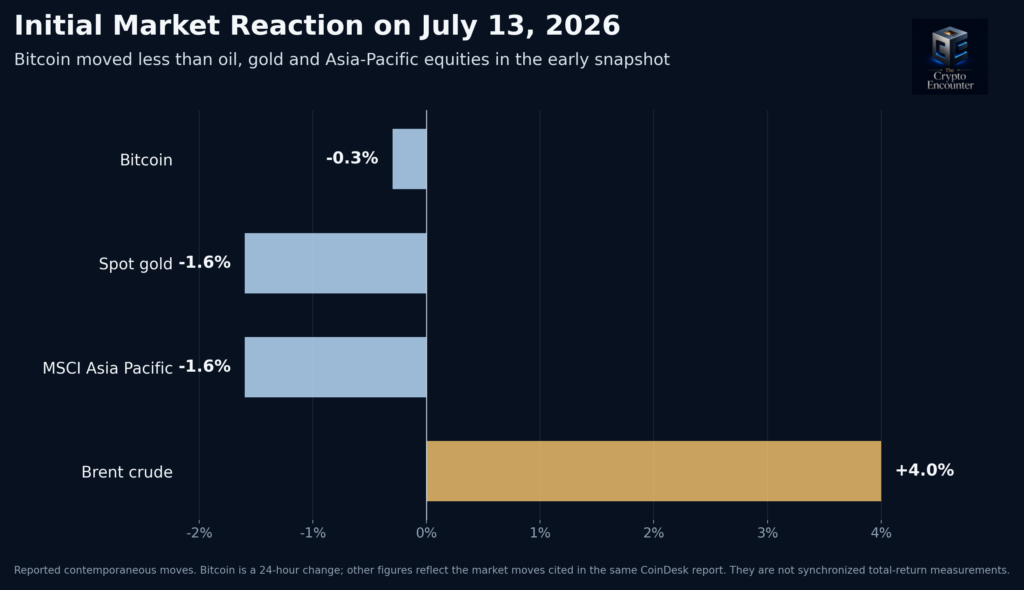
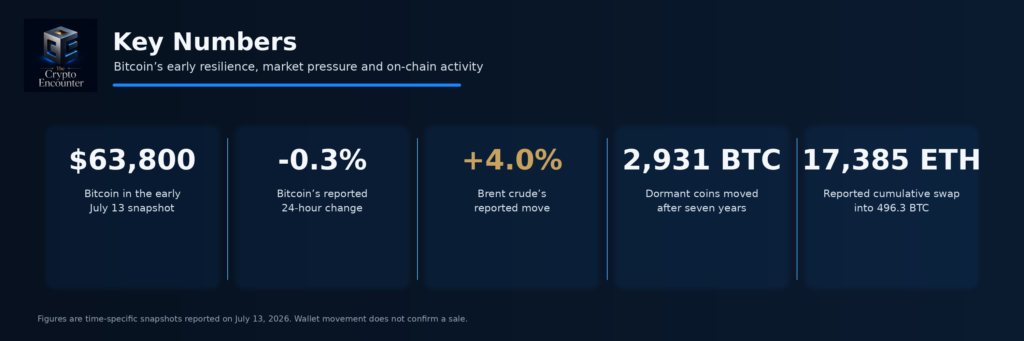
CoinDesk reported at 4:48 a.m. on July 13 that Bitcoin was trading near $63,800, down 0.3% over 24 hours and up 2% over seven days. Ether was close to $1,800, and little changed on the day.
Traditional markets moved more sharply during the same period.
Brent crude rose 4% to above $79 per barrel. Spot gold fell as much as 1.6% toward $4,050 per ounce. The MSCI Asia Pacific equity index declined 1.6%, while Treasury prices fell and yields rose. CoinDesk linked those moves to concerns that a wider conflict could keep energy costs elevated and complicate the Federal Reserve’s inflation outlook.

eported that U.S. spot Bitcoin ETFs recorded approximately $197 million in net inflows during their first positive week in nine weeks. The report, citing SoSoValue, said this followed eight consecutive weeks of outflows, including about $2.43 billion in May and $4.5 billion in June. July had recorded approximately $124 million in net inflows at that point.
Those figures suggest some renewed demand, but they do not establish broad institutional conviction. The preceding outflows were much larger than the latest weekly inflow.
ETF flows should therefore be treated as a monitoring indicator, not proof that institutions viewed Bitcoin as protection against geopolitical risk.
Dormant Whale Activity Creates a Separate Market Test
Crypto-native risks were also developing beneath the macro headlines.
Bitcoin.com reported that a wallet inactive for seven years moved 2,931 BTC to a fresh wallet on July 12. The publication valued the holdings at approximately $188 million using Bitcoin’s price at the time. It also reported that the coins had originally been received when Bitcoin traded near $6,513.
The transaction is visible on-chain, but its meaning is uncertain.
The destination was not identified as a known exchange address. That weakens any immediate claim that the holder intended to sell. The transfer could reflect a custody change, wallet consolidation, a security upgrade, estate planning, or preparation for an over-the-counter transaction.
I cannot confirm the wallet owner’s identity or intention.
Bitcoin.com also reported, citing on-chain analyst EmberCN, that another trader had cumulatively exchanged 17,385 ETH, valued at about $31 million, for 496.3 BTC at an ETH-to-BTC ratio near 0.0285.

That transaction indicates one large account increased its Bitcoin exposure relative to Ether. It does not prove a market-wide rotation or an institutional strategy. I cannot confirm the trader’s identity, investment thesis, or future plans.
Risks, Limits, and Unanswered Questions
| Signal | Confirmed observation | What it may indicate | What it does not prove |
| Bitcoin’s early market reaction | Bitcoin traded near $63,800 and was down 0.3% over 24 hours in the early July 13 snapshot. | Bitcoin initially absorbed the geopolitical shock better than several traditional markets. | It does not prove permanent decoupling or safe-haven status. |
| Later Bitcoin weakness | Bitcoin later fell below $63,000 as the session progressed. | Broader risk aversion and market leverage still affected crypto. | It does not prove that geopolitical conflict was the sole cause of the decline. |
| Oil and traditional-market moves | Brent crude rose 4%, while spot gold and the MSCI Asia Pacific index each fell as much as 1.6% in the cited snapshot. | Investors were repricing energy, inflation, interest-rate, and geopolitical risks. | The figures are not a perfectly synchronized cross-asset return comparison. |
| Dormant wallet activity | A wallet moved 2,931 BTC after seven years of inactivity to a fresh wallet. | Large long-term holders may be reorganizing custody or preparing for another transaction. | The transfer does not confirm a sale, exchange deposit, or bearish intention. |
| ETH-to-BTC rotation | A separate trader reportedly converted a cumulative 17,385 ETH into 496.3 BTC. | One large account favored Bitcoin relative to Ether. | It does not demonstrate a market-wide or institutional rotation. |
Several limitations prevent a firm from decoupling.
First, the observation window is short. Correlations can weaken for hours or days and then return during a larger liquidity shock.
Second, Bitcoin remained inside a month-long trading range. Its early stability may have reflected positioning, limited leverage, or the absence of forced selling rather than a new safe-haven role. CoinDesk reported that liquidations during the later decline were only about one-sixth of the worst level seen over the previous 30 days, based on CoinGlass data.
Third, the conflict remained fluid. Further disruption to energy supply or commercial shipping could produce a different market response.
Fourth, whale transfers are transparent but ambiguous. A move to a private wallet is not the same as an exchange deposit or completed sale.
Finally, ETF demand has recently improved but remains weak when compared with the preceding outflow period.
What to Watch Next
Readers should monitor a group of connected indicators rather than rely on a price forecast.
Watch Bitcoin’s performance relative to the Nasdaq, gold, oil, the U.S. dollar, and Treasury yields during the next major geopolitical update.
Follow daily and weekly spot Bitcoin ETF flows. Persistent inflows would offer stronger evidence of institutional demand than one positive week.
Monitor whether the 2,931 BTC moves again, especially if the coins reach addresses linked to exchanges or prime brokers.
Track derivatives funding, open interest, and liquidation volumes. A low-leverage market can absorb shocks differently from an overheated one.
Finally, watch inflation data and Federal Reserve guidance. CoinDesk identified the June inflation report on July 14 and the decouple, to 29 Fed meeting, as major near-term events for risk assets.
Bitcoin’s July 13 performance was noteworthy because it initially resisted a market shock that moved several traditional assets sharply. Its later decline showed that the separation was incomplete.
The evidence supports a case for conditional resilience. It does not yet support a declaration that Bitcoin has decoupled from global risk markets.
Frequently Asked Questions
Why did Bitcoin initially perform better than other markets?
Bitcoin’s relatively limited decline during the initial market reaction suggests investors did not immediately treat it like a typical high-risk asset. However, later price weakness showed that it remained sensitive to broader risk sentiment. One trading session is not enough to conclude that Bitcoin has fundamentally changed its behavior.
Does this mean Bitcoin is now a safe-haven asset?
Not yet. While Bitcoin showed relative resilience compared with some traditional markets during the early stages of the geopolitical shock, there is insufficient evidence to classify it alongside traditional safe-haven assets such as U.S. Treasuries or, in some circumstances, gold. More consistent performance across multiple geopolitical and macroeconomic events would be needed before drawing that conclusion.
Why are dormant Bitcoin wallets important?
Large wallets that become active after years of inactivity often attract market attention because they may represent significant potential supply. However, moving coins between wallets does not necessarily indicate an intention to sell. Holders may be reorganizing custody, improving security, or preparing for private over-the-counter transactions.
How could the U.S.-Iran conflict affect Bitcoin over the longer term?
The conflict’s indirect effects may prove more important than the military events themselves. Rising oil prices could increase inflation, influence central bank policy, strengthen or weaken the U.S. dollar, and affect global liquidity. Those macroeconomic factors have historically played a significant role in Bitcoin’s performance.
What should investors monitor next?
Rather than focusing solely on Bitcoin’s daily price movements, investors should watch:
- Developments in the U.S.-Iran conflict and the Strait of Hormuz.
- Oil prices and inflation expectations.
- Spot Bitcoin ETF inflows and outflows.
- Activity from the recently reactivated dormant Bitcoin wallet.
- Exchange reserves, stablecoin liquidity, and derivatives positioning.
- Bitcoin’s performance relative to equities, gold, and other risk assets during future geopolitical events.
Disclaimer
This article is for informational and educational purposes only. It does not provide financial, investment, legal, tax, or accounting advice. Cryptocurrency and digital asset markets involve risk, including the possible loss of capital. Readers should conduct their own research before making any financial decision.