



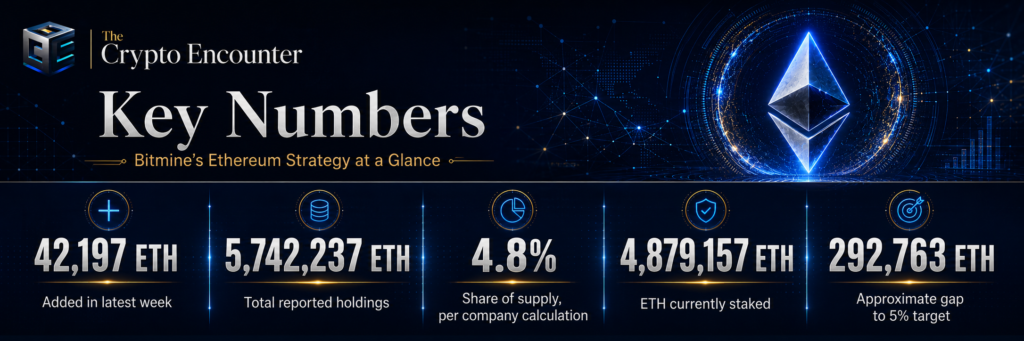
Bitmine Immersion Technologies added 42,197 ETH over the past week. As a result, it’s reported that Ethereum holdings reached 5,742,237 ETH as of July 5, 2026.
The company says this position represents about 4.8% of the 120.7 million ETH supply figure used in its calculations. Therefore, Bitmine is now close to its stated goal of holding an amount equal to 5% of the Ethereum supply.
The additional ETH was worth about $74 million using a market price near $1,750. However, Bitmine did not disclose the exact purchase cost in its corrected release. At the company’s $1,800 reference price, the same 42,197 ETH would be worth about $76 million.
Meanwhile, Chairman Thomas “Tom” Lee has connected the company’s accumulation strategy with improving expectations around the U.S. CLARITY Act. The legislation has advanced through the Senate Banking Committee but has not become law.

For now, investors have several developments to watch. These include Bitmine’s progress toward its 5% benchmark, further changes in its staking operations, and the next stage of the CLARITY Act.
Why This Story Matters
Bitmine’s latest ETH purchase was larger than the 27,084 ETH acquisition disclosed for the previous week. More importantly, the company’s strategy now has three connected parts.
First, Bitmine is accumulating ETH at scale. Second, it is staking much of that position to generate validator rewards. Third, management believes clearer U.S. crypto rules could create a stronger environment for Ethereum-based financial activity.
As of July 5 at 6:30 p.m. ET, Bitmine reported 5,742,237 ETH and 206 BTC. It also reported $527 million in cash and marketable securities.
In addition, the company listed a $180 million stake in Beast Industries and a $71 million stake in Eightco Holdings.
Using ETH at $1,800, together with the company’s stated values for its other positions, Bitmine reported approximately $11.1 billion in combined crypto, cash, marketable securities, and selected equity holdings.
However, that figure needs context. The $11.1 billion total is based on company-reported reference values. It should not automatically be treated as net asset value available to common shareholders. It also does not guarantee equivalent liquidation proceeds.
For a broader context, The Crypto Encounter’s Ethereum coverage follows institutional adoption, DeFi infrastructure, staking, and other developments across the network.
Bitmine Is About 293,000 ETH Short of Its 5% Benchmark
Bitmine calls its accumulation target the “Alchemy of 5%.”
The calculation is straightforward:
120.7 million ETH × 5% = 6.035 million ETH
6.035 million ETH − 5.742237 million ETH = 292,763 ETH

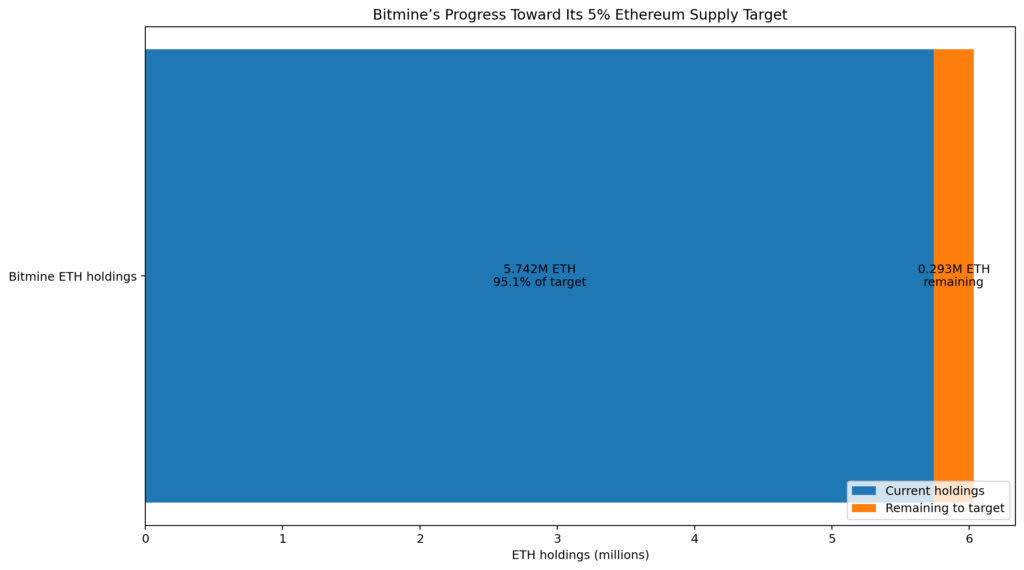
Based on that static supply assumption, Bitmine needs about 293,000 more ETH to reach its stated benchmark.
However, the exact requirement could change. Ethereum’s relevant supply denominator may move over time. Therefore, Bitmine’s 4.8% figure should be understood as the company’s calculation based on the 120.7 million ETH figure used in its July 6 statement.
The scale of the position makes Bitmine unusual among public digital asset treasury companies. Its strategy is heavily concentrated in one crypto asset.
Still, accumulation alone does not answer the most important long-term question. The bigger issue is whether Bitmine can use such a large ETH position productively.
That is where staking and MAVAN become important.
The CLARITY Act Is Part of Bitmine’s Thesis, Not a Guaranteed Catalyst
Lee has made regulatory expectations a visible part of Bitmine’s Ethereum thesis.
In the corrected July 6 release, Lee said investors had become more optimistic about the CLARITY Act. He also referred to prediction-market probabilities near 50%. According to Lee, that was the highest level in two weeks.
He argued that greater regulatory clarity could benefit crypto markets. In particular, he highlighted smart-contract platforms such as Ethereum.
However, this remains Lee’s assessment.
Prediction-market odds reflect the expectations of participants in those markets. They do not prove that legislation will pass. Similarly, they do not establish that ETH prices or Ethereum adoption will rise if the legislation becomes law.
Nevertheless, the CLARITY Act has made significant legislative progress.
The House of Representatives passed H.R. 3633 by a bipartisan 294-134 vote on July 17, 2025. Later, the Senate Banking Committee advanced the legislation by a 15-9 vote on May 14, 2026.
The full Senate has not yet passed the measure.
| Development | Date | Status |
|---|---|---|
| House passed H.R. 3633 | July 17, 2025 | Passed House by 294-134 |
| Senate Banking Committee action | May 14, 2026 | Advanced by 15-9 |
| Full Senate passage | Pending | Not completed |
| Final enactment | Pending | Bill has not become law |
Key distinction: Senate committee approval represents legislative progress, but the CLARITY Act has not completed the full legislative process required to become law.
Political uncertainty also remains.
Reuters reported after the committee vote that negotiations were still fluid. In addition, the two Democrats who supported the bill’s advancement from committee had not guaranteed support on the Senate floor.
Concerns raised during the process included anti-money laundering provisions and ethics restrictions involving political officials and crypto interests.
For Ethereum, the regulatory connection is understandable. However, it is not automatic.
Ethereum supports smart contracts. Its Layer 2 ecosystem also aims to offer faster and cheaper execution for applications that can include payments and tokenization.
Therefore, clearer market-structure rules could influence how companies assess legal and operational risk before building digital asset products.
Still, any benefit to Ethereum would depend on several factors. These include the final legislative text, later rulemaking, implementation, regulatory interpretation, and actual business adoption.
The wider relationship between regulation and crypto business models is also explored in The Crypto Encounter’s analysis of how crypto regulation is becoming the market’s next big filter.
Staking Changes the Economics of Bitmine’s Treasury Strategy
Bitmine’s approach differs from a completely passive crypto treasury because most of its reported ETH is staked.
The company reported 4,879,157 staked ETH as of July 5. That equals roughly 85% of its total 5.74 million ETH holdings.
At Bitmine’s $1,800 ETH reference price, the staked position was worth about $8.8 billion.
The company also said its staking operations had generated a seven-day yield of 2.68% on an annualized basis.
Using that rate, Bitmine projected about $235 million in annualized staking revenue from its currently staked position.
Furthermore, the company projected roughly $277 million in annualized revenue if its full ETH treasury were staked through MAVAN and other staking partners.
The calculations are approximately:
4,879,157 ETH × $1,800 × 2.68% = $235.4 million annually
For the entire reported ETH position:
5,742,237 ETH × $1,800 × 2.68% = $277.0 million annually
However, these figures are projections. They are not fixed future revenue.
The dollar value of staking rewards can change with the ETH price. Returns can also vary based on the amount of ETH staked, network reward conditions, and validator performance.
Ethereum rewards validators for correct participation. At the same time, validators can face penalties for certain failures. Serious protocol violations can also result in slashing.
Bitmine launched MAVAN, or the Made in America Validator Network, as staking infrastructure for its treasury.
According to management, the company plans to expand the platform to institutions, custodians, and other ecosystem participants.
However, that remains an expansion objective. MAVAN should not yet be described as an established external revenue business at scale.
Still, the platform is worth watching. Bitmine already has a large internal staking base. The next question is whether MAVAN can become a meaningful infrastructure service for outside clients.
For a related example, The Crypto Encounter has also covered the confidential DeFi yield vault involving Zama, Morpho, and Steakhouse Financial.
Bitmine Is Buying ETH as a strategy to sell Bitcoin
Bitmine’s latest ETH acquisition came as Strategy took a different approach to its own digital asset treasury.
According to Strategy’s July 6 Form 8-K, the company sold 1,363 BTC for $80.8 million between June 29 and June 30.
It then sold another 2,225 BTC for $135.2 million between July 1 and July 5.
Together, the transactions totaled 3,588 BTC and approximately $216 million in net sale proceeds.
As of July 5, Strategy reported aggregate holdings of 843,775 BTC. It also reported a $2.55 billion USD reserve.
The filing stated that Bitcoin sale proceeds were used to fund preferred-stock distributions. The company also used the proceeds to replenish the part of its USD reserve used for those payments.
The contrast with Bitmine is notable. However, it should not be exaggerated.
These disclosures do not prove that corporations are broadly rotating from Bitcoin into Ethereum.
Bitmine and Strategy have different balance sheets. They also have different capital structures, funding arrangements, and liquidity requirements.
Therefore, the more useful comparison is between the two treasury models.
Bitmine continues to increase exposure to its primary digital asset. At the same time, it stakes much of that ETH.
By contrast, Strategy used part of its Bitcoin holdings during the disclosed period to meet capital-management needs connected to distributions and cash reserves.
As a result, investors should look beyond the number of tokens held. Financing costs, preferred-stock commitments, staking economics, liquidity reserves, asset concentration, and capital-market access can all shape treasury decisions.
Risks, Limits, and Unanswered Questions
Bitmine’s proximity to its 5% benchmark gives the company a clear strategic narrative. However, the same strategy also creates substantial concentration risk.
A sustained decline in ETH’s market price would reduce the value of Bitmine’s largest reported asset position.
Moreover, shareholders face risks beyond direct ETH ownership. These include operating expenses, financing decisions, capital structure, execution risk, and changes in how the market values digital asset treasury companies.
Staking provides potential revenue. However, the returns are variable.
The company’s $235 million and $277 million annualized figures depend on several assumptions. These include the cited 2.68% annualized rate and the reference value assigned to ETH.
Therefore, actual results may differ.
Regulatory uncertainty remains another important issue. Senate committee approval marks progress, but it does not mean the CLARITY Act will become law.
Several variables remain unresolved. These include the final text, the timing of a Senate vote, congressional agreement, implementation, and later regulatory interpretation.
Finally, MAVAN’s future should be assessed carefully.
The platform already supports Bitmine’s staking strategy. However, its potential role as an external institutional service remains a management objective.
Future disclosures will need to show whether third-party participation can develop into a meaningful business.
What to Watch Next
The next stage of the Bitmine story will involve more than another ETH purchase.
First, investors should watch the CLARITY Act.
Further movement in the Senate will matter. Changes to the legislation’s text will also require attention. Most importantly, the market will be watching for evidence that the proposal has enough support to advance.
Second, Bitmine’s accumulation pace remains important.
Based on the company’s own supply denominator, it remains about 293,000 ETH short of its stated 5% benchmark.
Third, staking performance deserves close attention.
Future company disclosures should show whether the share of staked ETH continues to rise. They should also indicate how actual staking economics compare with management’s current annualized projections.
MAVAN is another major factor.
Evidence of external institutional participation would help investors assess the platform’s progress. Custody relationships, operating scale, third-party demand, and actual revenue contribution would also provide useful signals.
Finally, the broader policy question remains open.
Bitmine is explicitly connecting regulatory expectations with its Ethereum thesis. Therefore, the CLARITY Act could become an important test of whether U.S. legislative developments begin influencing corporate crypto treasury strategies more directly.
FAQs
How much Ethereum does Bitmine own?
Bitmine reported 5,742,237 ETH as of July 5, 2026, at 6:30 p.m. ET.
The company said the position represented about 4.8% of the 120.7 million ETH supply figure used in its calculation.
Did Bitmine spend exactly $74 million on its latest ETH purchase?
I cannot confirm that Bitmine paid exactly $74 million.
The company disclosed that it acquired 42,197 ETH. However, it did not disclose the actual purchase cost in its corrected release.
CoinDesk estimated the position at about $74 million using an ETH price near $1,750. At Bitmine’s $1,800 reference price, the same ETH amount would be worth about $76 million.
How close is Bitmine to its 5% Ethereum target?
Using Bitmine’s stated denominator of 120.7 million ETH, a 5% position would equal approximately 6.035 million ETH.
With reported holdings of 5,742,237 ETH, Bitmine is about 292,763 ETH short. This calculation assumes that the supply denominator remains unchanged.
Has the CLARITY Act passed?
No.
The House passed H.R. 3633 by a 294-134 vote in July 2025. Later, the Senate Banking Committee advanced the legislation by a 15-9 vote in May 2026.
However, the bill has not completed the remaining legislative process required to become law.
Why does Tom Lee believe the CLARITY Act matters for Ethereum?
Lee argues that clearer U.S. digital asset rules could support smart-contract platforms such as Ethereum.
His view is based partly on the possibility that crypto could become more integrated into payments and other financial applications.
However, this is Bitmine management’s thesis. It is not a guaranteed outcome of the legislation.
How much ETH has Bitmine staked?
Bitmine reported 4,879,157 staked ETH as of July 5. That represents roughly 85% of its total ETH holdings.
Based on a 2.68% seven-day annualized yield, the company projected about $235 million in annualized staking revenue.
However, actual results may differ from that projection.
Disclaimer
This article is for informational and educational purposes only. It does not provide financial, investment, legal, tax, or accounting advice. Cryptocurrency and digital asset markets involve risk, including possible loss of capital. Readers should conduct their own research before making any financial decision.