

Crypto payments can look like the cleanest version of digital money. A customer sends a dollar-linked token, the merchant receives it quickly, and the transaction may settle without card-network delays. Yet the picture changes once a refund, mistaken transfer, frozen wallet, or redemption problem appears. Crypto payments can move fast, but speed does not automatically provide the consumer protections people expect from cards or bank transfers. Stablecoins may reduce price volatility. However, users still depend on issuers, reserves, redemption rules, wallet providers, compliance systems, and the merchant’s refund process.
That distinction matters because payment systems are tested most severely when something goes wrong.
Key Takeaways
- Stablecoins can make crypto payments faster and more predictable than paying with volatile cryptocurrencies.
- A blockchain transfer is generally final. Therefore, a refund usually requires a new transaction instead of reversing the original one.
- “Stable” describes a token’s target price. It does not guarantee that every holder can always redeem instantly or without restrictions.
- Issuers can freeze or block tokens in certain circumstances, especially when legal orders, sanctions, fraud controls, or compliance requirements apply.
- Consumer protection depends heavily on the merchant, payment processor, issuer, jurisdiction, wallet, and payment flow.
- Good crypto payments therefore need clear refund and dispute rules, not simply fast settlement.
Why Crypto Payments Feel Easier Than Traditional Payments
The appeal of crypto payments is easy to understand.
Stablecoins such as USDC aim to track a fiat currency, usually the U.S. dollar. As a result, buyers and merchants can avoid much of the short-term price volatility associated with paying directly in Bitcoin or Ether.
Settlement can also happen around the clock. In cross-border commerce, that feature matters.
Traditional international transfers may move through several banks, different time zones, and separate settlement systems. By contrast, stablecoin-based crypto payments can send value over a blockchain without waiting for a normal banking day.
The International Monetary Fund says stablecoins could make cross-border payments and remittances faster and cheaper, particularly where conventional channels remain slow or costly. However, the IMF also identifies financial-stability, operational, legal, financial-integrity, and regulatory risks.
Therefore, crypto payments can feel simple at checkout while becoming far more complicated after the sale.
What a Refund Really Means in Crypto Payments
A card refund usually happens inside a payment system built around reversals, disputes, and chargebacks.
Crypto payments work differently.
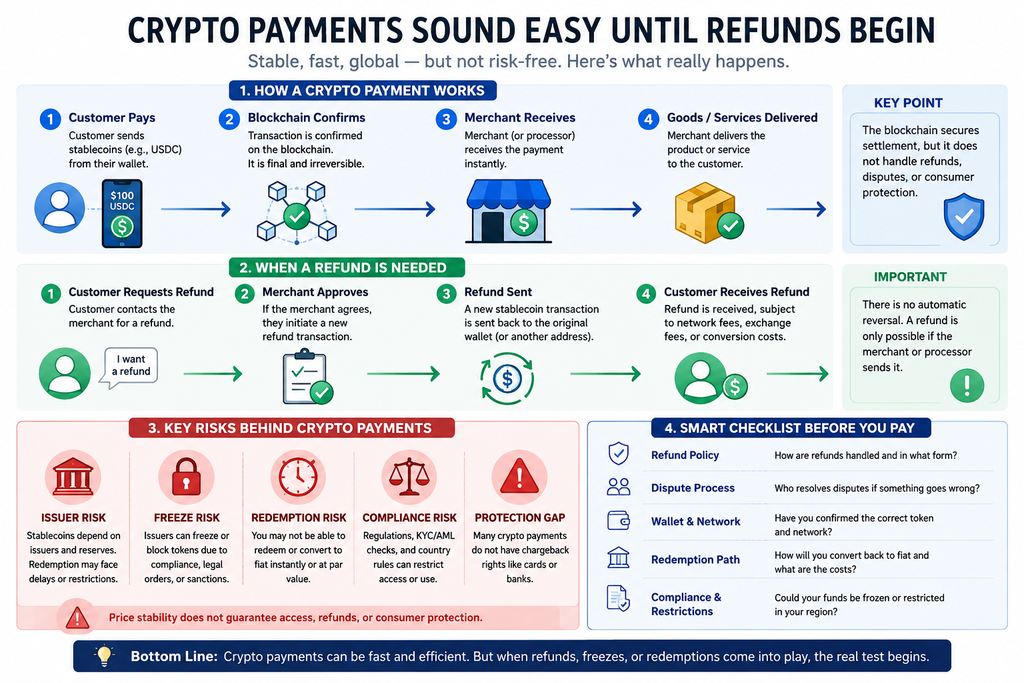
Once a blockchain transaction confirms, the sender generally cannot cancel it. Circle’s current USDC terms state that transfers to third-party blockchain addresses are irreversible and that Circle cannot reverse or recall a transaction once initiated.
Consequently, when a merchant agrees to return money, the merchant normally creates another transaction back to the customer.
Suppose a shopper pays $80 in USDC for a pair of shoes. The store receives the payment. Two days later, the shopper returns the shoes.
The original transfer does not rewind.
Instead, the merchant or processor sends another $80 worth of stablecoins to the customer.
Some processors hide much of this complexity. Stripe, for example, says its supported stablecoin payments allow full and partial refunds. Those refunds return stablecoins to the customer’s original wallet. However, Stripe currently lists dispute support as unavailable for stablecoin payments.
This is a useful example of how crypto payments can recreate a familiar refund experience even though the blockchain transaction underneath remains final.
So, refunds are possible.
They simply work differently from reversing a card payment.
Why Refunds and Chargebacks Are Different in Crypto Payments
“Refund” and “chargeback” sound similar. However, they describe different protections.
A refund happens when the merchant or payment provider agrees to return money.
A chargeback gives a cardholder a route through the card issuer or bank to challenge a transaction. The payment network can investigate the dispute and, under applicable rules, potentially remove funds from the merchant.
Many crypto payments do not include an equivalent built-in chargeback mechanism.
If someone sends stablecoins directly to a merchant wallet and the merchant refuses to cooperate, the blockchain does not determine whether the product was defective, whether it arrived, or whether the seller misrepresented it.
The network only records that a valid transaction occurred.
That finality can benefit merchants because it reduces traditional chargeback exposure. However, buyers may have fewer recovery options.
For that reason, crypto payments should be evaluated according to the entire protection system surrounding the transaction, rather than settlement speed alone.
Before paying, a customer should know the answer to one practical question:
Who resolves the dispute if the seller and buyer disagree?
The answer may be a payment processor, marketplace, merchant, bank, court, regulator, or nobody at all.
Stable Prices Do Not Remove Crypto Payments Risk
Stablecoins try to maintain a stable value.
Nevertheless, crypto payments depend on much more than the token’s quoted price.
A fiat-backed stablecoin relies on an issuer and a reserve structure that support redemption. Therefore, reserves matter because those assets help back the tokens in circulation.
Redemption also matters because users ultimately need a reliable path from a digital token back to conventional money.
The United States created a federal regulatory framework for payment stablecoins when the GENIUS Act became law on July 18, 2025.
Under the law, permitted payment-stablecoin issuers must maintain reserves of at least one dollar in permitted assets for each dollar of payment stablecoins outstanding. The framework also requires redemption procedures and public reserve disclosures.
Those requirements strengthen the infrastructure surrounding some crypto payments.
However, they do not mean that a stablecoin becomes identical to an insured bank deposit.
In fact, the law prohibits issuers from misleading consumers by claiming that qualifying stablecoins are federally insured, legal tender, or backed by the U.S. government.
Therefore, a token can remain close to $1 while a particular user faces an account review, redemption restriction, technical outage, or compliance delay.
Well-designed crypto payments must account for both price stability and access risk.
A stable price matters.
So does the ability to actually use the money.
Issuer Risk Sits Behind Many Crypto Payments
When people use a centrally issued stablecoin, they also rely on the company behind it.
Circle states that eligible Circle Mint customers can redeem USDC for U.S. dollars, subject to its terms, applicable law, and account requirements. However, holders without a qualifying Circle Mint account cannot necessarily redeem directly with Circle unless they become eligible and register for one.
For everyday crypto payments, that creates an important distinction.
Holding a stablecoin in a wallet is not always the same thing as maintaining a direct redemption relationship with its issuer.
During normal conditions, most consumers may never notice the difference.
During stress, however, it could matter.
Imagine thousands of holders trying to convert tokens back into dollars at the same time.
Now reserve quality matters. Banking relationships matter. Liquidity matters. Redemption procedures matter. Technical capacity matters too.
The IMF has warned that stablecoins can remain vulnerable to runs when confidence weakens. It also notes that even high-quality reserves do not eliminate every liquidity and financial-stability risk.
At scale, crypto payments therefore depend on financial infrastructure that most customers never see.
Fast settlement at the surface can still rely on banks, custodians, reserve assets, market liquidity, compliance teams, and redemption systems underneath.
Why Freeze Controls Matter for Crypto Payments
People often hear that blockchains allow unstoppable transfers.
Centralized stablecoins complicate that description.
The GENIUS Act requires permitted stablecoin issuers to maintain the technical capability to comply with lawful orders that may require them to seize, freeze, burn, or prevent transfers of payment stablecoins. The law also subjects permitted issuers to Bank Secrecy Act requirements.
Circle’s USDC terms provide a real-world example.
Circle states that it may block certain addresses and freeze associated USDC under specified circumstances. Those circumstances can include suspected prohibited activity and valid government orders.
These mechanisms support sanctions enforcement, anti-money-laundering controls, fraud prevention, and law enforcement.
Nevertheless, they also reveal something important about crypto payments.
A blockchain may operate continuously, yet access to a centralized stablecoin can still depend on an issuer’s compliance obligations.
Therefore, “on-chain” does not always mean “outside institutional control.”
For ordinary households, the practical question is whether a transfer, refund, or redemption can become restricted after money has already moved.
Crypto Payments Become More Important in Remittances
The benefits and trade-offs become especially visible in cross-border payments.
A worker sending money home may care little about crypto speculation. Instead, that person cares about fees, speed, exchange rates, and whether family members can actually access the money.
Stablecoins can sometimes simplify that journey.
The IMF reported in June 2026 that Nigerian households and small businesses increasingly use dollar-linked stablecoins for cross-border transactions. The IMF also cited World Bank figures showing that sending $200 to sub-Saharan Africa costs roughly 9% of the transaction value on average, compared with about 6% globally.
That difference helps explain why crypto payments attract attention in remittance markets.
However, the blockchain fee tells only part of the story.
A customer may also pay:
- An exchange spread
- A wallet or service fee
- A local conversion fee
- A withdrawal or cash-out fee
- A currency-conversion spread
- Network fees
- Compliance-related costs or delays
Therefore, a transfer that looks extremely cheap on-chain may cost more by the time the recipient receives usable local currency.
In practice, crypto payments should be compared using the full amount that reaches the recipient, rather than the blockchain fee alone.
Refunds introduce another complication.
Suppose someone uses USDC to order a product from another country. Later, the merchant refunds the same amount of USDC.
The token amount may return in full. However, the buyer could still pay another spread or conversion fee when changing the refund back into local currency.
The refund succeeded technically.
The household still lost money during the payment journey.
Everyday Crypto Payments Need Protection, Not Just Speed
For crypto payments to become routine household infrastructure, users need more than quick settlement.
They need straightforward answers about:
- Refunds
- Merchant errors
- Fraud
- Products that never arrive
- Duplicate payments
- Wrong wallet addresses
- Account restrictions
- Lost wallet access
- Redemption problems
- Customer support
Payment design therefore becomes critical.
A processor can build a refund button on top of irreversible blockchain settlement.
Likewise, a marketplace can create buyer-protection policies. Merchants can define return rules. Wallet applications can warn users before they send money to unfamiliar addresses.
However, those protections normally sit above the blockchain.
The ledger itself usually cannot decide whether a customer deserves a refund.
That means better crypto payments may eventually look surprisingly familiar.
Consumers could interact with payment applications, merchant protection programs, regulated issuers, fraud checks, customer support, and refund systems while blockchain technology operates quietly underneath.
In other words, the winning consumer experience may depend less on exposing blockchain mechanics and more on making those mechanics safe enough that ordinary people rarely need to think about them.
A Practical Crypto Payments Checklist Before You Pay
Before using crypto payments for an everyday purchase, check five areas.
1. Read the Refund Policy
Determine exactly how the seller returns money.
Will you receive the original stablecoin?
Will the business send fiat currency instead?
Could it offer only store credit?
Also check whether network or processing fees reduce the amount returned.
2. Identify the Dispute Process
Ask what happens if the merchant rejects a refund that you believe is valid.
Does a marketplace provide buyer protection?
Can the payment processor intervene?
Does your wallet provider offer assistance?
If no intermediary can review the dispute, understand that risk before sending money.
3. Confirm the Wallet and Network
Crypto payments can fail because the sender chooses the wrong address, token, or network.
Before approving the transaction, confirm all three.
A small test payment may reduce address risk for larger transfers. However, it does not prove that the recipient is trustworthy.
For broader wallet and transaction-safety practices, The Crypto Encounter’s guide to crypto safety and irreversible transfers explains why secure blockchain technology cannot prevent every user-level loss.
4. Understand Redemption
Ask how you would turn the stablecoin back into money you normally spend.
Check the exchange rate.
Then, check withdrawal fees, eligibility rules, account requirements, and regional restrictions.
A stablecoin that tracks one dollar is less useful when converting it into spendable money becomes difficult.
5. Consider Compliance Restrictions
Stablecoin issuers, exchanges, wallets, and payment processors may review transactions to meet sanctions, anti-money-laundering, fraud, or legal requirements.
Therefore, crypto payments can face restrictions even when the underlying blockchain continues operating normally.
These checks cannot remove every risk.
Instead, they show where the risk sits before money leaves the wallet.
What Merchants Should Explain Before Accepting Crypto Payments
Businesses also need strong policies.
First, a merchant should state which token and blockchain network it accepts.
Next, the business should explain whether refunds return to the original wallet.
It should also clarify who pays the network fee, how long a refund may take, and what happens when a customer can no longer access the original wallet.
For merchants, crypto payments also create accounting and operational responsibilities.
Even when a store prices goods in dollars and receives a dollar-linked stablecoin, it needs reliable records covering:
- The purchase
- Transaction fees
- Settlement
- Conversion
- Refunds
- Customer disputes
Fraud controls also change.
Traditional card chargeback exposure may decrease. Yet stolen wallets, compromised accounts, sanctioned addresses, fraud screening, and incorrect transfers still require procedures.
Moreover, merchants that keep stablecoins after payment take on risks that disappear when a processor immediately converts the payment into fiat.
Stripe, for example, currently allows supported U.S. businesses to accept stablecoin payments while completed transactions settle into the merchant’s Stripe balance in U.S. dollars.
That structure moves some stablecoin complexity away from the merchant.
Direct wallet acceptance does not necessarily do the same.
Consequently, crypto payments can remove one form of payment friction while creating another set of responsibilities.
A Refund Reveals Who Really Controls the Money
The most useful way to evaluate a payment system is to follow the money when something goes wrong.
Consider four scenarios.
| Situation | What the customer expects | What may actually matter |
|---|---|---|
| Product returned | Money comes back | Merchant refund policy and wallet destination |
| Seller refuses refund | Someone investigates | Whether a dispute or buyer-protection process exists |
| Stablecoin redemption fails | Token converts to dollars | Issuer eligibility, reserves, banking access, and redemption rules |
| Wallet or token freezes | User regains access quickly | Compliance review, issuer policy, legal orders, and jurisdiction |
This is the hidden architecture behind crypto payments.
The blockchain handles settlement.
However, the surrounding institutions determine many of the protections people associate with money.
That distinction also connects with a broader custody problem. A balance displayed inside an exchange does not necessarily provide the same control as assets held in a personally controlled wallet. The Crypto Encounter explains that distinction in Your Exchange Balance Is Not the Same as Your Crypto.
The lesson applies equally to payments.
Users need to know who controls each stage of the transaction.
The Real Test for Crypto Payments Begins After Checkout
The easiest crypto payments happen when everything goes right.
The customer sends the correct token.
The merchant delivers the product.
Nobody requests a refund.
The stablecoin stays near its target price.
No compliance system blocks the transaction.
However, real payment infrastructure must also work when the normal path breaks.
That is why refunds reveal more about crypto payments than transaction speed does.
They expose who controls the token.
They show who holds the reserves.
They reveal who can redeem.
They identify who can freeze assets.
Most importantly, they show who carries the loss when the technology, merchant policy, or customer expectation does not line up.
Stablecoins may still improve everyday payments. In particular, they could reduce cross-border friction and expand access to dollar-linked digital value. The IMF continues to identify those benefits while also warning that stablecoin growth creates new financial, regulatory, and cross-border risks.
The strongest crypto payments will therefore combine fast settlement with transparent redemption, sensible compliance controls, clear refund procedures, and understandable consumer protection.
Speed can make a payment convenient.
The ability to solve problems makes a payment system dependable.
Frequently Asked Questions
Are crypto payments refundable?
Yes, crypto payments can be refunded when the merchant or payment service supports refunds. However, the original confirmed blockchain transaction usually remains final. The refund normally occurs through a second transaction back to the customer.
Do crypto payments have chargebacks?
Many crypto payments do not provide traditional card-style chargebacks. Some processors offer merchant refunds, but dispute and recovery rights depend on the payment service, merchant agreement, jurisdiction, and applicable law.
Why can a stablecoin wallet be frozen?
Centralized stablecoin issuers may block addresses or freeze tokens under certain legal and compliance circumstances. For example, Circle states that USDC may become subject to blocking when specified prohibited activity or valid government orders apply.
Are stablecoins safer than Bitcoin for payments?
Stablecoins can reduce price volatility because they target a fixed value, commonly one U.S. dollar. However, they introduce other risks involving issuers, reserves, redemption, compliance, operations, and access. Lower price volatility does not mean zero risk.
Can crypto payments make remittances cheaper?
They may reduce some transfer costs and settlement delays. However, users should compare the complete cost, including conversion spreads, exchange fees, network charges, wallet fees, and local cash-out costs.
Does the GENIUS Act guarantee that stablecoins are safe?
No. The GENIUS Act creates reserve, disclosure, redemption, supervision, compliance, and other requirements for permitted U.S. payment-stablecoin issuers. It does not make stablecoins federally insured bank deposits or remove every operational, liquidity, compliance, or consumer-protection risk.
Conclusion: Crypto Payments Need a Plan for When Things Go Wrong
Crypto payments can make transferring digital dollars look almost effortless. Stablecoins reduce the dramatic price swings associated with assets such as Bitcoin, while blockchain networks can move value across borders at almost any hour.
However, refunds expose the deeper system.
Users still depend on merchants, processors, issuers, reserves, redemption channels, compliance rules, wallets, and customer-support systems.
Therefore, good crypto payments cannot be judged only by how quickly money arrives. They should also explain how that money comes back when a purchase fails, a merchant makes a mistake, an account becomes restricted, or someone needs to turn a digital dollar back into ordinary money.
Ultimately, crypto payments become dependable everyday infrastructure when consumers understand both sides of the transaction: how money moves forward and how problems get resolved afterward.