

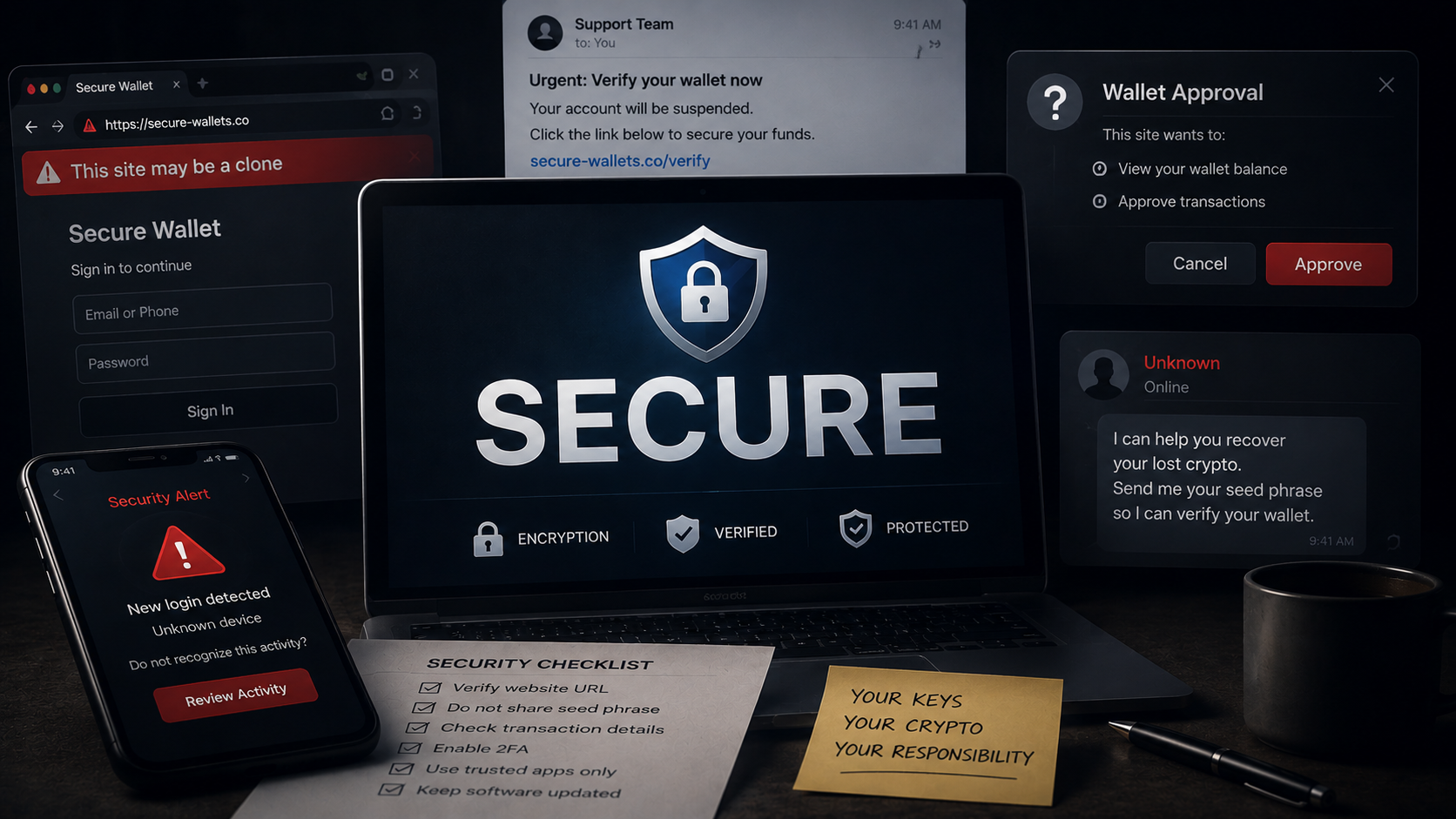
Most people believe crypto security depends on strong technology. They assume that if a blockchain is secure or a wallet uses advanced encryption, their money is automatically safe. Unfortunately, that assumption has cost countless people their savings.
The truth is much more complicated. A blockchain can operate exactly as designed while someone loses every digital asset they own. A hardware wallet can remain uncompromised while a scammer empties it. Likewise, an exchange can protect its infrastructure while an attacker steals a customer’s account through phishing or social engineering.
That is why the most dangerous word in crypto is secure.
The problem is not the technology itself. Instead, the problem begins when people mistake technical security for complete personal protection. In reality, crypto security depends on much more than code. It also depends on human decisions, online behavior, device protection, and recognizing scams before they succeed.
This guide explains why the word “secure” often creates false confidence, where crypto users remain vulnerable, and what practical steps everyone can take to reduce risk.
Quick Answer
Crypto security does not mean your cryptocurrency is impossible to steal.
Instead, it means certain parts of a system have protections against specific threats. Everything outside those protections remains your responsibility.
Understanding that difference may be the single most important lesson every crypto user learns.
Key Takeaways
| Question | Answer |
|---|---|
| Is blockchain technology secure? | Generally yes, but blockchain security does not eliminate scams or human mistakes. |
| Can secure wallets still lose funds? | Yes. Users often approve malicious transactions or reveal recovery phrases. |
| Who do scammers usually attack? | People, not blockchains. |
| Can a transaction be legitimate and still be fraudulent? | Yes. If you authorize a scam transaction, the blockchain simply processes your instruction. |
| What improves crypto security the most? | Good habits, verification, skepticism, and layered protection. |
Why Crypto Security Is Often Misunderstood
When companies advertise crypto security, most people imagine an invisible shield protecting every digital asset they own.
That is rarely what the claim actually means.
Security always applies to something specific.
A blockchain may resist unauthorized changes.
A wallet may encrypt private keys.
An exchange may protect its servers.
A hardware wallet may isolate cryptographic secrets from the internet.
All those statements can be true at the same time.
Yet none of them guarantee that an ordinary user cannot lose money.
This misunderstanding creates one of the biggest problems in cryptocurrency.
People stop asking questions once they hear the word secure.
Instead, they assume every risk has disappeared.
Unfortunately, criminals understand this better than anyone.
Rather than attacking Bitcoin, Ethereum, or another blockchain directly, they usually attack the person sitting behind the screen.
Consequently, crypto security has become less about breaking encryption and more about manipulating human behavior.
Blockchain Security Is Not the Same as Crypto Security
One of the biggest misconceptions in cryptocurrency is believing blockchain security and crypto security are identical.
They are not.
Blockchain security focuses on protecting the network itself.
Crypto security focuses on protecting your assets.
Those are very different goals.
Imagine a bank building with reinforced concrete walls, advanced cameras, and secure vaults.
The building may be extremely secure.
However, if someone tricks you into handing over your debit card, PIN, and online banking password, none of those physical protections matter anymore.
The same principle applies to cryptocurrency.
Bitcoin’s blockchain has never been hacked in the way many people imagine. Instead, attackers usually target exchanges, wallets, websites, browser extensions, email accounts, mobile phones, and people.
In other words, they avoid the strongest part of the system.
Instead, they attack the weakest one.
If you’re interested in the broader myths surrounding digital asset protection, our guide on what they never told you about the security of cryptocurrencies explains why many popular security assumptions don’t match reality.
The Real Target Is Usually You
Hollywood often portrays hackers breaking through complicated firewalls using flashing computer screens.
Real crypto crime usually looks much simpler.
A fake website.
A convincing email.
A fraudulent investment group.
A counterfeit mobile application.
A fake customer support representative.
A phishing message.
An urgent warning.
A QR code.
A recovery phrase request.
These attacks work because they manipulate trust instead of mathematics.
Cryptography remains extremely difficult to defeat.
Human psychology is not.
That is why modern crypto security depends just as much on awareness as technology.
Why Scammers Rarely Attack Blockchains
Breaking into Bitcoin or Ethereum would require extraordinary computing power and technical expertise.
Convincing someone to approve a malicious transaction takes far less effort.
For criminals, the economics are obvious.
Why attack millions of computers when one frightened person may willingly send their cryptocurrency?
Many scams follow a remarkably similar pattern.
First, the attacker creates urgency.
Then they build authority.
Finally, they ask the victim to perform a seemingly harmless action.
Each step feels reasonable.
Together, they become devastating.
The blockchain never fails.
Instead, the victim unknowingly authorizes the theft.
Consequently, the transaction appears completely legitimate from the network’s perspective.
That distinction lies at the heart of modern crypto security.
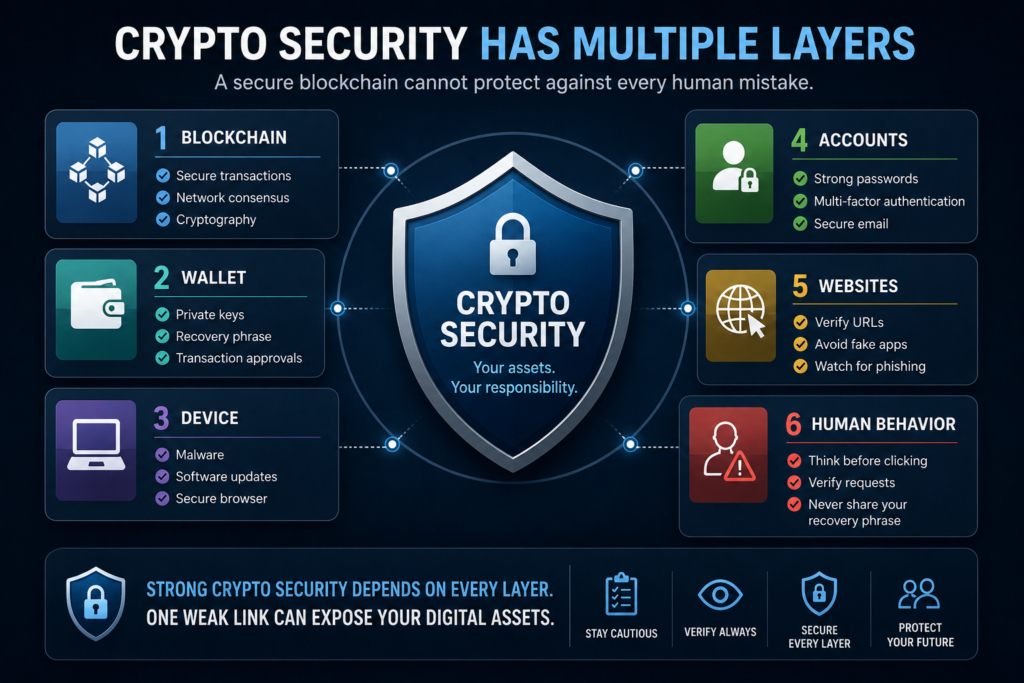
Crypto Security Has Multiple Layers
Many beginners think cryptocurrency security depends on choosing the right wallet.
In reality, crypto security resembles a chain.
Every link matters.
If one breaks, everything connected to it becomes vulnerable.
Crypto security is only as strong as its weakest layer. While blockchain technology provides a secure foundation, protecting your digital assets also depends on secure wallets, trusted websites, protected devices, strong accounts, and informed user behavior.
Layer One: Blockchain Security
The blockchain validates transactions through cryptography and decentralized consensus.
Its job is to prevent unauthorized spending and maintain an accurate ledger.
However, it cannot determine whether you intended to send funds to a scammer.
The network only verifies that you signed the transaction.
It does not judge your decision.
Layer Two: Wallet Security
A wallet protects the credentials that control cryptocurrency.
Contrary to popular belief, wallets usually do not store coins themselves.
Instead, they manage the private keys that authorize blockchain transactions.
Strong wallet security protects those keys.
However, it cannot stop someone from voluntarily revealing a recovery phrase or approving a malicious smart contract.
For additional wallet best practices, the Ethereum.org Wallet Security Guide explains how private keys, recovery phrases, and wallet management work in greater detail
Layer Three: Device Security
Even the safest wallet becomes vulnerable on an infected device.
Malware can monitor keyboards.
Browser extensions can manipulate websites.
Clipboard malware can replace wallet addresses.
Remote-access software can give criminals complete control.
As a result, your phone or computer becomes an essential part of crypto security.
Ignoring device security creates opportunities that attackers actively exploit.
Layer Four: Account Security
Many people secure their wallets but overlook their email accounts.
That mistake can become expensive.
Email accounts often control password resets, authentication requests, exchange notifications, and identity verification.
If criminals gain access to your email, they may never need your wallet.
Instead, they simply take over the services connected to it.
Strong passwords, phishing-resistant multi-factor authentication, and regular account monitoring significantly improve overall crypto security.
Layer Five: Human Security
This final layer is also the weakest.
Every technical protection depends on human decisions.
People click links.
People scan QR codes.
People install fake applications.
People approve transactions.
People reveal recovery phrases.
Every scam eventually reaches a person.
That reality explains why attackers spend so much time studying psychology instead of cryptography.
Fear.
Greed.
Excitement.
Urgency.
Curiosity.
Authority.
These emotions bypass technology faster than malicious software ever could.
Why Wallet Security Alone Cannot Protect You
Many advertisements imply that buying a hardware wallet solves every security problem.
Hardware wallets certainly improve crypto security.
However, they do not eliminate risk.
Imagine purchasing the world’s strongest safe.
Then imagine handing the combination to a stranger.
The safe still works perfectly.
The outcome changes completely.
Hardware wallets follow the same principle.
They protect private keys.
They cannot protect poor decisions.
If someone enters their recovery phrase into a fake website, no hardware wallet can reverse the damage.
Likewise, if someone approves a malicious transaction without understanding what it does, the wallet simply follows instructions.
The device remains secure.
The assets disappear anyway.
This distinction surprises many newcomers.
Unfortunately, scammers understand it extremely well.
Why “Audited” Does Not Mean Completely Safe
Another common misunderstanding involves audited smart contracts.
Audits certainly improve confidence.
They identify coding mistakes.
They uncover vulnerabilities.
They recommend fixes.
Nevertheless, audits have limits.
An audit does not guarantee a project is honest.
It does not promise developers will never change the code.
It does not eliminate economic risks.
It does not prevent insider abuse.
It cannot stop social engineering attacks.
Most importantly, it does not guarantee users will make good decisions.
Therefore, good crypto security always asks additional questions.
Who performed the audit?
When did it happen?
Which contracts were reviewed?
Were vulnerabilities fixed?
Can administrators upgrade the contract later?
Does the protocol include emergency controls?
Those questions matter far more than simply seeing the word “Audited.”
Why Secure Exchanges Can Still Lose Customer Funds
Many people believe that keeping cryptocurrency on a well-known exchange guarantees safety. Strong infrastructure certainly improves crypto security, but it does not remove every risk.
An exchange protects its servers, wallets, and internal systems. However, customers still control several important pieces of the security puzzle.
For example, an attacker might steal login credentials through a phishing email. Alternatively, malware could capture passwords from an infected computer. In other cases, criminals perform SIM-swap attacks to intercept text-message verification codes.
None of these incidents require breaking the exchange’s security systems.
Instead, attackers bypass them by targeting the customer.
This is why securing your exchange account requires more than choosing a reputable platform. You also need a unique password, phishing-resistant multi-factor authentication, and a secure email account.
Even then, remain cautious. If someone contacts you claiming to represent an exchange, verify their identity through the company’s official website rather than replying directly to the message.
Social Engineering Is the Biggest Threat to Crypto Security
When people imagine cybercrime, they often picture sophisticated hackers writing complex code.
In reality, the biggest threat to crypto security usually begins with a simple conversation.
Social engineering is the art of manipulating people into making decisions that benefit criminals.
Instead of attacking technology, scammers attack emotions.
They exploit fear.
They exploit urgency.
They exploit excitement.
Most importantly, they exploit trust.
As a result, victims often believe they are protecting their assets while unknowingly giving them away.
How Social Engineering Works
Nearly every successful crypto scam follows a familiar pattern.
Step 1: Build Trust
The scammer pretends to be someone important.
Examples include:
- Exchange support staff
- Wallet developers
- Government agencies
- Investment advisors
- Famous crypto personalities
- Friends whose accounts have been compromised
The goal is simple.
If the victim trusts the messenger, they become far less likely to question the request.
Step 2: Create Urgency
Next comes pressure.
The victim may hear messages such as:
- “Your wallet has been compromised.”
- “Your account will be suspended.”
- “Someone is trying to steal your crypto.”
- “This investment closes in one hour.”
- “Verify your wallet immediately.”
Urgency reduces critical thinking.
Consequently, victims act before they verify.
Step 3: Request an Action
Finally, the attacker asks for something.
Perhaps they request:
- A recovery phrase
- A QR code scan
- A wallet connection
- A transaction approval
- A cryptocurrency transfer
- Installation of remote-access software
At this stage, the victim believes they are solving a problem.
Instead, they are creating one.
Strong crypto security always begins by slowing down whenever someone demands immediate action.
The Most Common Crypto Security Mistakes
Technology rarely causes most cryptocurrency losses.
Human mistakes do.
Fortunately, many of these mistakes are preventable.
Saving Recovery Phrases Online
Cloud storage feels convenient.
Unfortunately, convenience creates risk.
Anyone who discovers your recovery phrase can usually recreate your wallet.
Instead, store recovery phrases offline in secure physical locations.
Never upload them to cloud drives.
Never email them.
Never send them through messaging applications.
Clicking Sponsored Search Results
Scammers frequently purchase advertisements that imitate legitimate crypto companies.
At first glance, these websites appear authentic.
However, one small spelling difference may lead to a fake login page.
Bookmark official websites instead.
Then access them through those bookmarks whenever possible.
This simple habit significantly improves crypto security.
Reusing Passwords
Password reuse creates unnecessary risk.
If one online service suffers a data breach, attackers often test those same credentials across exchanges, wallets, and email providers.
Every important crypto account deserves its own unique password.
Password managers make this much easier.
Ignoring Transaction Details
Many users approve transactions without reading them carefully.
That habit can become expensive.
Always review:
- Recipient address
- Network
- Transaction amount
- Token permissions
- Smart contract interactions
If something looks unfamiliar, stop immediately.
Verification takes seconds.
Recovering stolen cryptocurrency often proves impossible.
Trusting Anyone Offering Guaranteed Returns
Promises of guaranteed profits should immediately raise suspicion.
Legitimate investments involve uncertainty.
Likewise, responsible companies avoid absolute claims.
If someone promises risk-free cryptocurrency profits, they are selling confidence instead of evidence.
The FTC Cryptocurrency Scams Guide also highlights common warning signs, including fake investment opportunities, impersonation scams, and fraudulent payment requests that target cryptocurrency users.
Practical Crypto Security Checklist
Improving crypto security does not require advanced technical knowledge.
Instead, it requires consistent habits.
Use this checklist before managing digital assets.
Protect Your Recovery Phrase
- Store it offline.
- Keep multiple secure backups.
- Never photograph it.
- Never share it.
Secure Every Important Account
- Use unique passwords.
- Enable phishing-resistant multi-factor authentication.
- Protect your email account.
- Review login activity regularly.
Verify Everything
Before sending cryptocurrency:
- Confirm wallet addresses.
- Check website URLs.
- Verify customer support contacts.
- Review transaction approvals.
If anything feels unusual, stop.
Separate Long-Term Storage
Avoid keeping every asset in one wallet.
Instead:
- Use one wallet for everyday transactions.
- Use another wallet for long-term holdings.
This approach limits potential losses if one wallet becomes compromised.
Keep Software Updated
Software updates often fix security vulnerabilities.
Update:
- Wallet applications
- Browsers
- Operating systems
- Antivirus software
- Hardware wallet firmware
Ignoring updates weakens crypto security over time.
What Should You Do If You Think You’ve Been Scammed?
Quick action cannot guarantee recovery.
However, it may reduce additional damage.
First, stop communicating with the suspected scammer.
Next, save every piece of evidence.
This includes:
- Wallet addresses
- Transaction hashes
- Emails
- Screenshots
- Phone numbers
- Website URLs
Afterward, contact the relevant exchange if funds passed through one.
Some centralized exchanges may freeze assets before criminals withdraw them.
Although recovery remains uncertain, reporting the incident quickly increases the chance of assistance.
Finally, report the scam to the appropriate authorities in your jurisdiction.
Equally important, avoid companies promising guaranteed cryptocurrency recovery.
Many recovery services are simply another scam targeting previous victims.
Why Crypto Security Is Ultimately About Human Behavior
The cryptocurrency industry invests enormous resources into stronger encryption, better wallets, smarter authentication systems, and more resilient blockchains.
Those improvements matter.
However, criminals continue stealing billions of dollars because they attack something much easier.
People.
Every phishing website.
Every fake investment.
Every fraudulent support message.
Every counterfeit wallet.
Every impersonation attempt.
They all depend on one assumption.
Someone will trust them.
That is why crypto security extends far beyond software.
It includes patience.
It includes skepticism.
It includes verification.
Most importantly, it includes understanding that no technology can replace careful decision-making.
Conclusion
Crypto security is not a single product, feature, or guarantee.
Instead, it is a continuous process that combines secure technology with responsible human behavior.
A blockchain can remain secure while a scammer steals someone’s recovery phrase.
A hardware wallet can function perfectly while its owner approves a malicious transaction.
An exchange can protect its infrastructure while an attacker compromises a customer’s email account.
These examples highlight an important truth.
The most dangerous word in crypto is secure because many people interpret it as a promise rather than a description.
Real crypto security requires asking better questions.
What exactly is protected?
Who controls the private keys?
What happens if my device becomes infected?
Could this website be fake?
Am I acting because I verified the information or because someone created urgency?
Those questions may seem simple.
Nevertheless, they often separate safe cryptocurrency users from scam victims.
Technology will continue to improve.
Scammers will continue to adapt.
Therefore, your strongest defense will always be informed decision-making combined with good security habits.
Treat the word secure as the beginning of a conversation, not the end of one.
Understanding security is only one part of becoming a better crypto investor. It’s equally important to understand how macroeconomic forces affect digital assets, as explained in our article on why Bitcoin moves with the Fed.
Frequently Asked Questions
What is crypto security?
Crypto security refers to the practices, technologies, and behaviors used to protect cryptocurrency, wallets, accounts, private keys, and digital assets from theft, fraud, and unauthorized access.
Can blockchain technology be secure while users still lose money?
Yes. Blockchains can validate transactions correctly while scammers trick users into authorizing fraudulent transfers. In these cases, the network functions exactly as intended even though the victim suffers a financial loss.
What is the biggest threat to crypto security?
For most people, phishing and social engineering present greater risks than attacks on blockchain technology. Criminals usually target users instead of attempting to compromise major cryptocurrency networks.
Is a hardware wallet enough for crypto security?
No. Hardware wallets improve crypto security by protecting private keys, but they cannot prevent users from revealing recovery phrases or approving malicious transactions.
Why should I never share my recovery phrase?
Anyone with your recovery phrase can usually recreate your wallet and control your cryptocurrency. Legitimate wallet providers, exchanges, or customer support teams should never ask for it.
How can beginners improve crypto security?
Beginners should use strong unique passwords, enable phishing-resistant multi-factor authentication, store recovery phrases offline, verify websites before connecting wallets, review every transaction carefully, and remain skeptical of urgent requests.
Disclaimer
This article is for informational and educational purposes only. It does not provide financial, investment, legal, tax, accounting, cybersecurity, or recovery advice. Cryptocurrency and digital asset transactions involve significant risk, including scams, theft, technical failures, irreversible transfers, and possible loss of capital. No wallet, exchange, blockchain, or security tool can guarantee complete protection. Readers should verify information independently and seek qualified professional advice where appropriate.