


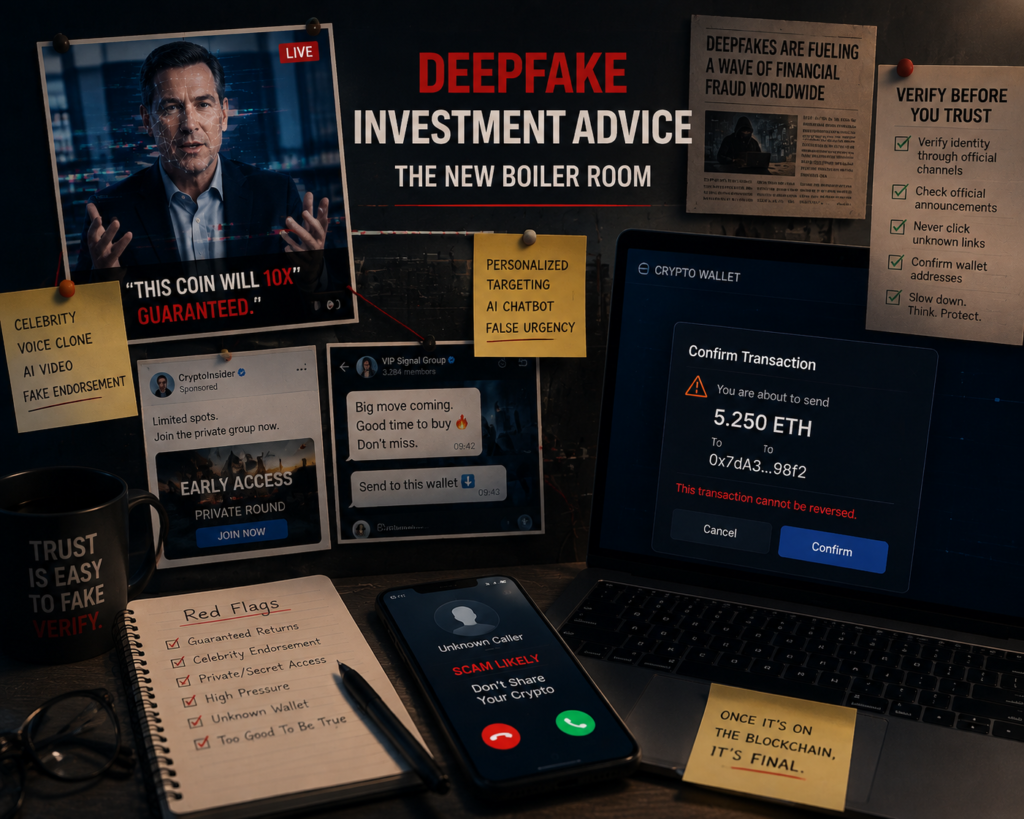
Deepfake investment advice is turning an old fraud model into something faster, cheaper, and harder to recognize. Traditional boiler rooms relied on teams of salespeople who cold-called strangers, applied pressure, and pushed questionable investments. Today, AI can imitate a trusted voice, generate a convincing face, personalize a pitch, and deliver the same manipulation through social media, video calls, messaging apps, or fake livestreams. For crypto users, the danger is especially sharp because a believable lie can end with a real blockchain transaction that may be difficult to reverse. Deepfake investment advice therefore changes the verification problem. Seeing a familiar face or hearing a familiar voice can no longer count as proof that the person actually made the recommendation.
Deepfake Investment Advice Revives the Boiler Room at AI Scale
A boiler room is a large-scale investment fraud operation that uses aggressive, high-pressure sales tactics to push people into acting quickly. Investor.gov warns that boiler room operators may use calls, email, text messages, social media, and other channels to reach potential victims. Investor.gov’s boiler room guidance
Deepfake investment advice keeps the same basic psychology but removes many of the old limits.
A human salesperson can only speak to so many people in a day. AI systems, however, can generate thousands of personalized messages, synthetic videos, cloned voices, and follow-up responses. In addition, scammers can adapt tone, language, age cues, interests, and financial concerns to make a pitch feel unusually relevant.
The FBI’s 2025 Internet Crime Report says investment scammers use AI to enhance conversations with potential victims and generate large numbers of individualized interactions. It also says fraudulent investment clubs use AI-generated videos and voices of celebrities, CEOs, or other trusted figures. Reported losses tied to investment complaints with an AI nexus exceeded $632 million in 2025. That figure does not mean every case involved a deepfake. However, it shows how quickly AI has become part of the investment-fraud toolkit. FBI 2025 Internet Crime Report
That is why deepfake investment advice resembles a digital boiler room. In practice, deepfake investment advice turns old persuasion tactics into reusable software. The pressure remains. The false authority remains. Yet the salesperson can now be synthetic, endlessly replicated, and tailored to each target.


What Deepfake Investment Advice Actually Means
A deepfake is synthetic or manipulated audio, video, or imagery designed to make a person appear to say or do something that they did not actually say or do.
Deepfake investment advice applies that capability to financial persuasion.
For example, a scammer might create a fake video of a well-known executive appearing to endorse a token. Another operation could clone the voice of a financial commentator and send a private audio message that sounds personal. A fake livestream might appear to show a recognizable public figure answering questions while a chat window pushes viewers toward a wallet address or trading platform.
The strongest deepfake investment advice does not need to look perfect. In many cases, deepfake investment advice only needs to survive a few minutes of scrutiny. It only needs to look credible long enough for someone to act.
That matters because financial fraud rarely depends on one lie. Instead, fraudsters build a sequence. First comes recognition. Then comes trust. Afterward, urgency appears. Finally, the victim receives a payment instruction.
For readers who want the broader distinction between strong technology and unsafe user outcomes, our guide to crypto security versus crypto safety explains why secure systems can still produce harmful results when people receive deceptive information.
Why Deepfake Investment Advice Is More Dangerous in Crypto
Deepfake investment advice can target any financial market. Crypto, however, adds several features that can increase the consequences.
First, blockchain transfers can settle quickly. Once a user sends assets to an attacker-controlled address, there may be no bank, card network, or centralized dispute process capable of reversing the transaction.
Second, crypto users often make decisions through digital channels. Wallets, exchanges, Telegram groups, X posts, Discord servers, YouTube videos, livestreams, and direct messages already shape how information travels. Deepfake investment advice can enter those same channels without looking obviously out of place.
Third, the public still tends to confuse technical authenticity with financial legitimacy. A transaction can be cryptographically valid even when the human decision behind it was manipulated.
That distinction is central. The blockchain can prove that a wallet signed a transaction. It cannot prove that the person controlling the wallet understood the situation, recognized the scam, or received truthful advice.
This wider security gap matters whenever a valid transaction follows a manipulated decision. Likewise, readers who interact with DeFi should understand how old token approvals can create delayed wallet risk even after the original transaction has finished.
As a result, deepfake investment advice attacks the human decision layer rather than the blockchain itself. That makes deepfake investment advice a social-engineering problem with financial consequences.
Key Facts About Deepfake Investment Advice
| Question | What readers should know |
|---|---|
| What is it? | Deepfake investment advice uses synthetic or manipulated media to make an investment pitch appear to come from a real, trusted person. |
| Why is it scalable? | AI can generate personalized video, audio, text, and follow-up conversations for many targets at once. |
| Why does crypto increase the stakes? | Crypto transfers may settle quickly and can be difficult to reverse after a victim authorizes them. |
| What does the FBI report? | Investment complaints with a reported AI nexus exceeded $632 million in losses in 2025. |
| What is the main defense? | Verify the source through an independent channel before sending money, connecting a wallet, or signing anything. |
Deepfake Investment Advice Exploits Trust Before It Exploits Technology
Most people do not verify every video they watch. They use shortcuts.
A familiar face feels safer than an unknown account. A recognizable voice reduces suspicion. A polished interview looks more credible than a text message full of spelling errors. Social proof from comments, follower counts, or fake testimonials can reduce caution even further.
Deepfake investment advice exploits those shortcuts. At scale, deepfake investment advice can repeat the same trust pattern across thousands of targets.
More importantly, AI can combine them. A scam campaign can pair a fake celebrity clip with a convincing website, automated customer support, fabricated account balances, and a private message that appears to continue the conversation. Each layer reinforces the others.
This is where the new fraud model becomes more dangerous than a crude impersonation video. The victim may not be evaluating one suspicious artifact. They may be walking through an entire synthetic environment designed to feel consistent.
The Crypto Encounter has already examined how everyday security habits can become the weakest link. Deepfake investment advice adds another problem: even careful users may struggle when the evidence they normally trust has been manufactured.
The New Rule for Deepfake Investment Advice: Verify Outside the Pitch
A useful rule for deepfake investment advice is simple: never use the suspicious content itself as proof that the content is genuine.
If a video says a famous investor recommends a token, do not verify the claim by looking for another copy of the same video. Scammers can repost identical synthetic media across many accounts.
Instead, move to an independent channel.
Check the person’s verified website or official account. Search for an original announcement. If the pitch claims to come from an exchange, open the exchange through a saved bookmark rather than a link in the message. If a supposed adviser calls, end the call and contact the firm through a number you already trust.
Deepfake investment advice becomes weaker when the victim changes channels because the scammer loses control over the evidence. Therefore, deepfake investment advice should always trigger an independent-source check.
This principle also applies to wallets. If a video or message asks you to connect a wallet, claim an airdrop, or approve a token, treat the request as a separate security event. Our DeFi wallet separation rule explains how keeping everyday interaction funds away from long-term holdings can reduce the amount exposed when a website or approval turns malicious.
Deepfake Investment Advice Can Personalize Pressure
Classic boiler rooms worked from scripts. Modern AI can make the script feel improvised.
Suppose a victim mentions retirement, recent losses, or fear of missing the next market rally. An AI-assisted scammer can instantly adjust the conversation. It can respond with reassurance, create a tailored explanation, translate the pitch, and continue messaging at any hour.
Therefore, deepfake investment advice can feel less like mass marketing and more like a one-to-one relationship.
The danger increases when scammers collect public information. A person’s employer, hobbies, location, favorite public figures, and recent posts can help shape a pitch. None of that requires a sophisticated breach. Much of it may already be public.
This personalization can also change the pressure tactic. One victim may receive urgency. Another may receive flattery. Someone else may see a fake warning that their current investments are unsafe unless they move funds immediately.
Deepfake investment advice is powerful because the underlying persuasion can change while the scam infrastructure stays the same. As a result, deepfake investment advice can adapt faster than a fixed scam script.
Why Blockchain Transparency Does Not Solve Deepfake Investment Advice
Crypto advocates often point out that blockchains create transparent transaction records. That is useful for tracing movement after a transaction occurs. However, transparency does not automatically prevent deception before the transaction.
A blockchain can show that funds moved from Wallet A to Wallet B. It may show the time, amount, token, and smart-contract interaction.
It cannot tell you whether Wallet A’s owner watched deepfake investment advice first.
Nor can the ledger determine whether a fake CEO, cloned voice, or synthetic analyst persuaded the user to approve the transfer.
This creates an important AI-blockchain overlap. AI can corrupt the information layer while blockchain faithfully executes the resulting instruction.
The same tension appears as AI agents begin making payments automatically. Our analysis of security risks when AI agents start spending crypto shows how machine-speed decisions can amplify mistakes when authorization and verification controls lag behind automation.
Deepfake investment advice affects humans today, but the underlying lesson is broader: trustworthy settlement does not guarantee trustworthy decision-making.
How to Check Deepfake Investment Advice Before You Act
When an investment recommendation arrives through video, audio, livestream, or direct message, use a deliberate verification process.
1. Separate identity from evidence
A familiar face is not proof. A familiar voice is not proof either. Treat deepfake investment advice as possible whenever money, tokens, wallet connections, or urgent transfers are involved.
2. Verify the claim independently
Open the official website or verified account yourself. Do not use the link supplied by the person or video making the pitch.
3. Look for financial pressure
Guaranteed returns, low-risk claims, secret access, limited-time offers, and demands to act immediately are classic warning signs. Deepfake investment advice may modernize the delivery, but the underlying pressure tactics remain familiar.
4. Check the payment destination
A real person can still be impersonated through a fake wallet address, QR code, or payment page. Verify where funds will actually go before approving anything.
5. Slow the transaction down
Scams benefit from momentum. Waiting creates time to compare sources, ask another person, and notice inconsistencies.
6. Limit wallet exposure
Keep long-term holdings away from routine browsing and speculative interactions. Our analysis of why “secure” can become a dangerous word in crypto explains why strong cryptography cannot protect a user who authorizes the wrong action.
7. Preserve evidence if something feels wrong
Save messages, usernames, wallet addresses, transaction hashes, websites, and timestamps. Do not keep sending money because someone promises that one more transfer will release funds or recover a previous loss.
What Platforms and Publishers Need to Change
Deepfake investment advice is not only an individual-user problem.
Social platforms, exchanges, wallet providers, media companies, and financial publishers all operate inside the same trust environment. Therefore, they need controls that assume realistic synthetic media will become normal.
Platforms can improve impersonation reporting and make provenance signals easier to inspect. Exchanges can add stronger warnings before withdrawals to new addresses. Wallets can explain transaction permissions in plain language. Publishers can link readers back to original interviews, filings, recordings, and official statements.
Meanwhile, users need better habits, not just better deepfake detectors.
Detection tools can help, but no detector will catch every manipulated file. Models improve. Compression removes clues. Screenshots and reposts strip metadata. Live impersonation also creates pressure before a specialist tool can analyze the content.
Deepfake investment advice should therefore push financial verification away from “Does this look real?” and toward “Can I confirm this claim independently?” That is the practical standard deepfake investment advice now requires.
That shift matters far beyond crypto. Deepfake investment advice makes independent verification a basic financial-safety habit.
Deepfake Investment Advice Creates a Trust Crisis, Not Just a Content Problem
The most damaging effect of deepfake investment advice may be uncertainty itself.
When fake media becomes convincing, real media also becomes easier to dismiss. A scammer can exploit a fake endorsement. At the same time, a genuine public statement may face immediate claims that it was generated by AI.
Consequently, ordinary users inherit a harder burden. Deepfake investment advice forces them to check both the message and the messenger. They must verify both authenticity and context.
That does not mean people should distrust everything. It means trust must come from stronger signals: official channels, independently confirmed statements, regulated disclosures where applicable, known contact information, and deliberate transaction checks.
The Learning Corner provides broader explainers on crypto custody, security, and user responsibility that can help readers build those verification habits before money is on the line.
Conclusion: Deepfake Investment Advice Is the Boiler Room Without the Room
Deepfake investment advice takes the core mechanics of a boiler room and gives them software-scale reach. The pitch can be personalized. The salesperson can be synthetic. The trusted face can be copied. The follow-up can happen instantly. Meanwhile, the payment can move through crypto before the victim realizes that the authority behind the recommendation never existed.
The practical response to deepfake investment advice is not to become an expert in detecting every deepfake. Instead, change how trust works.
Treat investment content as a claim, not proof. Verify important recommendations through an independent channel. Slow down when urgency appears. Keep wallet exposure limited. Most importantly, never assume that realistic audio or video proves identity.
Deepfake investment advice succeeds when appearance becomes authority. The safer standard is independent verification before action.
FAQs About Deepfake Investment Advice
What is deepfake investment advice?
Deepfake investment advice is financial or investment content that uses manipulated or AI-generated audio, video, or imagery to make a recommendation appear to come from a real person who did not actually make it.
Why is deepfake investment advice compared with a boiler room?
Both rely on persuasion, urgency, false authority, and pressure. However, deepfake investment advice can automate and personalize those tactics across social media, messaging apps, video, and live digital channels.
Can a blockchain detect deepfake investment advice?
No. A blockchain can verify transaction data and cryptographic authorization. It cannot determine whether a user made a decision after seeing fraudulent or manipulated investment content.
What is the safest response to deepfake investment advice?
Do not act from the original message. Verify the identity and claim through a separate official channel. Then independently check the investment, platform, wallet address, and transaction before sending funds.
Are all AI-generated investment videos scams?
No. AI-generated media can have legitimate uses. The risk appears when synthetic media impersonates a person, hides its origin, makes false financial claims, or pressures users to transfer money or crypto.
What should I do if I already sent crypto after following deepfake investment advice?
Stop sending additional funds. Preserve transaction hashes, wallet addresses, messages, usernames, and websites. Contact the relevant exchange or service promptly and report the incident to the appropriate law-enforcement or consumer-protection authority in your jurisdiction.
Disclaimer
This article is for informational and educational purposes only. It does not provide financial, investment, legal, tax, or accounting advice. Cryptocurrency and digital asset markets involve risk, including possible loss of capital. Readers should conduct their own research before making any financial decision.