



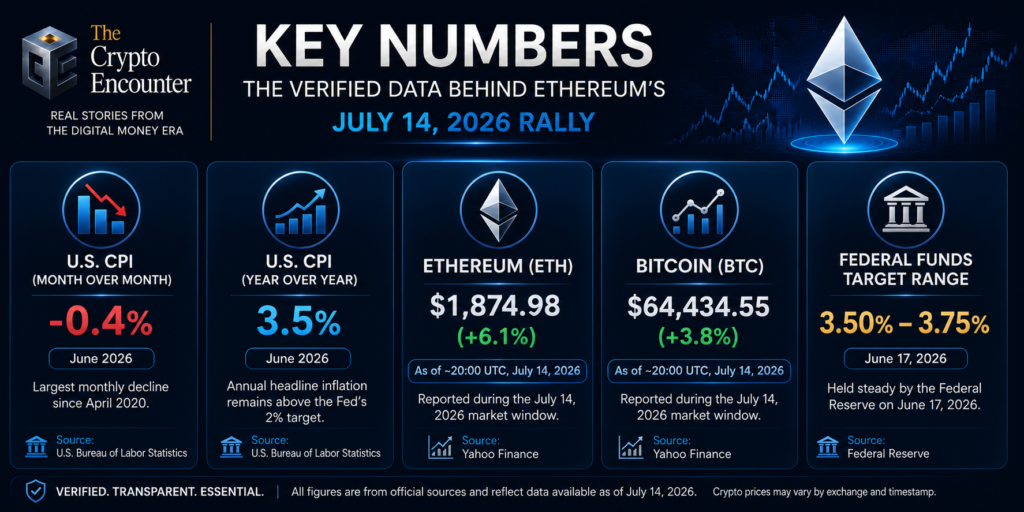
Ethereum rose sharply after a cooler U.S. inflation report reduced immediate concerns about further Federal Reserve tightening. In early-evening trading on July 14, 2026, ETH was reported at $1,874.98, up 6.1%, while Bitcoin gained 3.8% to $64,434.55.
The move matters because it shows how strongly Ethereum still responds to changes in interest-rate expectations and global risk appetite. However, the rally does not yet establish a lasting recovery. One favorable inflation report can improve sentiment, but durable demand would require stronger trading activity, sustained capital inflows, healthier network use, and continued progress on Ethereum’s technical roadmap.
The central question is therefore not whether Ethereum rallied. It is whether the market can convert a macro-driven rebound into a broader and more credible recovery.
Softer Inflation Gave Crypto Markets Immediate Relief
The U.S. Bureau of Labor Statistics reported on July 14 that the Consumer Price Index fell 0.4% in June on a seasonally adjusted basis. Headline CPI was still 3.5% higher than a year earlier. Core CPI, which excludes food and energy, was unchanged for the month and rose 2.6% over the previous 12 months.
The monthly decline in headline CPI was the largest since April 2020. That helped ease some fears that renewed inflation pressure could force the Federal Reserve to raise interest rates again.
Still, the inflation data did not amount to a policy decision.
At its June 17 meeting, the Federal Open Market Committee kept the federal funds target range at 3.50% to 3.75%. The committee also continued to describe inflation as elevated relative to its 2% goal.
As a result, claims that the Fed has shifted toward rate cuts would be premature. The CPI report changed market expectations, but future policy will depend on further inflation readings, employment data, economic growth, and official Fed guidance.
Why Lower Inflation Can Support Ethereum
Ethereum often trades like a high-risk technology asset during major macroeconomic events.
When interest rates rise, government bonds and other lower-risk assets can offer more attractive returns. Higher borrowing costs can also reduce liquidity across financial markets. Both conditions tend to weigh on speculative assets.
Cooling inflation can produce the opposite reaction. Investors may expect less restrictive monetary policy, which can encourage greater exposure to equities, cryptocurrencies, and other risk-sensitive markets.
That connection helps explain why Ethereum reacted strongly to the June CPI report.
However, inflation is only one influence on ETH. Crypto markets can also move because of leverage, derivatives positioning, short-term liquidity, exchange flows, regulation, protocol developments, and changes in investor sentiment.
Therefore, the inflation report should be treated as an important catalyst, not a complete explanation for every part of the price move.
Readers seeking broader context can review The Crypto Encounter’s analysis of why Bitcoin still moves with the Federal Reserve. Many of the same liquidity forces affect Ethereum, although ETH can respond more sharply because it is generally more volatile.

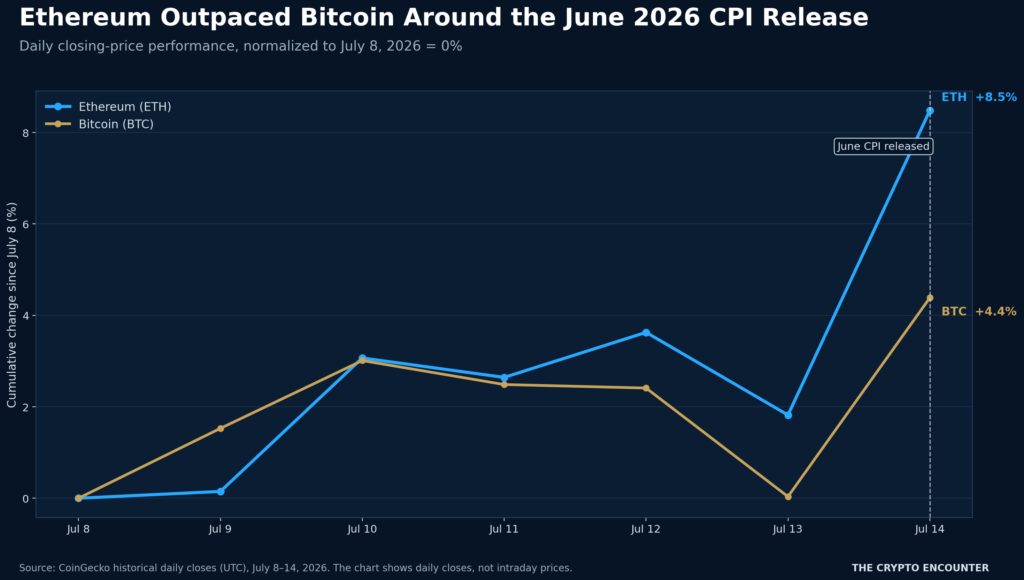
Ethereum Outperformed Bitcoin During the Initial Move
Ethereum’s reported 6.1% gain exceeded Bitcoin’s 3.8% rise during the same reporting window.
That relative strength is notable, but one trading session does not confirm a lasting shift in market leadership.
Several explanations are possible. Ethereum may have had more room to rebound after previous weakness. Traders may also have moved toward higher-volatility assets as macro sentiment improved. In addition, derivatives positioning may have amplified the move.
I cannot confirm which factor contributed most because the available reports do not provide sufficient exchange-level volume, liquidation, or positioning data.
This distinction matters. Relative outperformance can reflect genuine demand, but it can also result from short-term positioning and thinner liquidity.
Verified Market and Economic Snapshot
| Indicator | Verified figure | Context | Primary source |
|---|---|---|---|
| U.S. CPI (MoM) | -0.4% | June 2026 monthly change | U.S. Bureau of Labor Statistics |
| U.S. CPI (YoY) | 3.5% | Annual headline inflation | U.S. Bureau of Labor Statistics |
| Core CPI (YoY) | 2.6% | Excludes food and energy | U.S. Bureau of Labor Statistics |
| Federal funds target range | 3.50%–3.75% | Held unchanged on June 17, 2026 | Federal Reserve |
| Ethereum (ETH) | $1,874.98 (+6.1%) | Reported during the July 14, 2026 market window | Yahoo Finance |
| Bitcoin (BTC) | $64,434.55 (+3.8%) | Reported during the July 14, 2026 market window | Yahoo Finance |
Figures reflect the dates and reporting windows stated in the article. Crypto prices vary by exchange and timestamp.
The Technical Setup Improved, but the Breakout Is Not Final
FinanceFeeds identified the area around $1,835 as an important resistance zone and argued that Ethereum’s move above it strengthened the short-term technical outlook.
The analysis used Fibonacci levels and an Elliott Wave framework to identify $2,000 as a possible next target. That is an analyst projection, not a verified destination.
Technical analysis can help describe how traders view support, resistance, and momentum. It cannot establish future prices with certainty.
A stronger breakout would usually require ETH to remain above its former resistance area, maintain healthy spot volume, and avoid a rapid reversal. A move back below the same zone would weaken the bullish interpretation.
For that reason, the phrase “confirmed bullish breakout” should be used carefully. The market crossed the cited resistance level, but the durability of that move remains unconfirmed.
Ethereum’s Roadmap Provides a Separate Fundamental Story
The immediate rally followed the inflation report. Ethereum’s protocol development offers a different, longer-term source of context.
Ethereum’s official roadmap lists Glamsterdam as an upgrade in development for the second half of 2026. The upgrade is designed to support further Layer 1 scaling and improve how Ethereum handles block construction and resource pricing.
Ethereum Foundation updates have also described 200 million gas as a credible post-Glamsterdam gas-limit target. That figure reflects development progress involving proposer-builder separation, block access optimizations, and state-growth repricing. It should not be described as a guaranteed launch-day capacity increase.
This roadmap matters because higher capacity could give developers more room to build directly on Ethereum’s base layer. Yet protocol progress does not automatically translate into token-price appreciation.
The market will still need to assess whether greater capacity produces higher usage, more application activity, stronger fee demand, or deeper institutional adoption.
A relevant comparison is Ethereum’s developing role in institutional DeFi. The Crypto Encounter recently examined how Zama, Morpho, and Steakhouse are building confidential DeFi infrastructure on Ethereum. Such products may support future institutional use, but their adoption remains separate from short-term macro trading.
What Would Make the Rally More Credible?
A durable recovery requires evidence beyond a single price increase.
Stronger Spot-Market Participation
Sustained spot volume would indicate that buyers are committing capital rather than relying mainly on leveraged derivatives.
The original reports did not provide verified exchange-level volume data for the rally. Therefore, no conclusion about the quality of buying should be drawn from price alone.
Institutional and Fund Flows
Institutional demand can be assessed through regulated investment-product flows, custody activity, and large capital allocations.
The article does not cite verified Ethereum ETF-flow figures because none were established in the source material. Any future flow data should include the reporting date, fund names, and the source methodology.
Stablecoin and On-Chain Liquidity
Stablecoins are a major source of transactional liquidity across Ethereum and decentralized finance. Growth in stablecoin supply and transfer activity may show that more capital is entering the ecosystem.
However, rising stablecoin balances do not always mean that users are buying ETH. The funds may remain idle, move to lending markets, or support trading in other assets.
Network Use
Transaction demand, active addresses, decentralized exchange activity, Layer 2 settlement, and application revenues can provide insight into Ethereum’s economic use.
These indicators should be analyzed together. A single metric can be distorted by bots, incentives, temporary campaigns, or changes in fee conditions.
Risks, Limits, and Unanswered Questions
The strongest risk is that the inflation improvement may not continue.
Headline CPI remains above the Federal Reserve’s 2% objective. Fed officials have also highlighted the possibility that inflation could remain more persistent than expected.
A renewed increase in inflation, stronger wage pressure, or unexpected economic resilience could revive expectations of tighter monetary policy. That would likely challenge risk-sensitive markets.
Ethereum also faces crypto-specific risks.
A sharp rally can reverse if leverage rises too quickly. Weak spot demand may leave the market dependent on derivatives. Regulatory developments, security incidents, exchange failures, and protocol delays can also damage confidence.
Technical upgrades carry execution risk as well. Glamsterdam remains in development, and its final scope or timing could change. Ethereum.org currently identifies the second half of 2026 as the planned window, but that is a roadmap target rather than a legally or operationally guaranteed deadline.
Finally, Ethereum’s price does not always move in line with network progress. Developers can deliver technical improvements while market conditions remain weak.

What to Watch Next
The next stage of the story should be judged through a monitoring framework, not a fixed price prediction.
First, future CPI, employment, and wage data will show whether June’s inflation decline was part of a broader trend.
Second, Federal Reserve statements will reveal whether policymakers view the improvement as sufficient to change their policy stance.
Third, traders should watch whether ETH can remain above the resistance area identified near $1,835. A sustained hold would strengthen the technical case, while a reversal would weaken it.
Fourth, investors should examine spot volume, regulated product flows, stablecoin activity, and on-chain demand. These measures offer more useful evidence than price action alone.
Finally, Ethereum’s development process deserves close attention. Confirmed upgrade specifications, testnet results, client readiness, and an official mainnet schedule will matter more than unverified claims about future capacity or fee reductions.
Ethereum’s latest rally reflects a meaningful change in market sentiment. It does not yet prove that a lasting recovery has begun.
Frequently Asked Questions
Why did Ethereum rise after the June inflation report?
Ethereum rose as investors interpreted the softer CPI data as reducing immediate pressure for further Federal Reserve tightening. The move also reflected a broader increase in demand for risk assets. The CPI report itself did not guarantee a change in Fed policy.
How much did Ethereum rise?
Ethereum was reported at $1,874.98 in early-evening trading on July 14, 2026, up 6.1% during the cited period. Market prices vary by exchange and timestamp.
Did the Federal Reserve announce a rate cut?
No. The Federal Reserve did not announce a rate cut in response to the CPI report. At its June 17 meeting, it held the federal funds target range at 3.50% to 3.75%.
Is Ethereum certain to reach $2,000?
No. The $2,000 level is a technical projection cited by an analyst. It is not a guaranteed outcome. Ethereum could continue rising, consolidate, or reverse depending on market and economic conditions.
What is the Glamsterdam upgrade?
Glamsterdam is an Ethereum upgrade planned for the second half of 2026. It is intended to support further scaling and protocol improvements. The final implementation and timing remain subject to development and testing.
What should readers monitor next?
Readers should watch inflation and labor data, Federal Reserve guidance, Ethereum’s ability to hold above former resistance, spot and institutional flows, on-chain activity, and official Glamsterdam development updates.
Disclaimer
This article is for informational and educational purposes only. It does not provide financial, investment, legal, tax, or accounting advice. Cryptocurrency and digital asset markets involve risk, including possible loss of capital. Readers should conduct their own research before making any financial decision.