


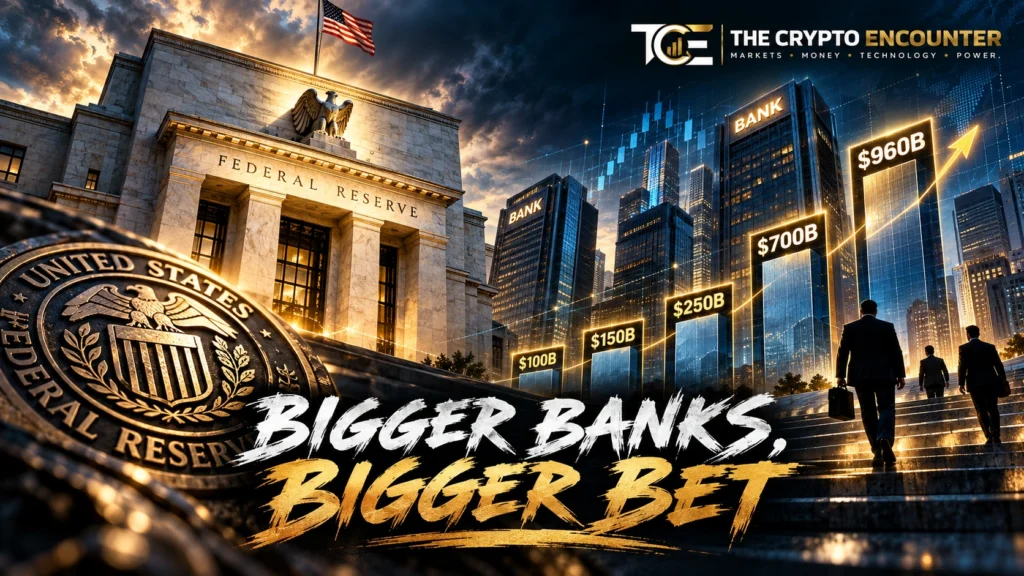
A bank can become larger without becoming riskier at exactly the same speed. The Federal Reserve is now considering whether its rulebook should recognize that difference.
According to Reuters, the Fed is developing a plan to raise several asset thresholds that determine when U.S. banks become subject to tougher capital, liquidity, stress-testing, reporting and supervisory requirements.
The idea sounds technical.
Its consequences could be anything but.
Current regulations become progressively stricter as banking organizations move through major asset thresholds around $100 billion, $250 billion and $700 billion.
Those numbers help determine which supervisory category a bank falls into and what additional obligations it faces.
But most of the framework was calibrated years ago.
The economy grew.
Prices rose.
Bank balance sheets expanded.
The thresholds largely stayed where they were.
Fed Vice Chair for Supervision Michelle Bowman has argued that this creates a structural problem: a bank with a stable business model can cross into a tougher supervisory category simply because nominal economic growth pushes its balance sheet higher.
The Fed is now considering whether those thresholds should move with the economy instead.
Reuters reported that the $700 billion threshold could potentially rise toward roughly $960 billion, while some additional Fed requirements currently associated with banks around $100 billion could begin closer to $150 billion.
Nothing is final.
No formal rule proposal containing those numbers had been released when this article was prepared.
But the direction matters because regulation can influence something much larger than compliance departments.
It can influence whether banks grow.
Whether they merge.
How much capital they hold.
How aggressively they lend.
And which institutions become large enough to build the next generation of financial infrastructure.
- The Federal Reserve is reportedly considering higher asset thresholds for stricter bank oversight.
- The existing framework escalates requirements around $100 billion, $250 billion and $700 billion of assets.
- Reuters sources said the highest Fed threshold could move toward roughly $960 billion.
- Some Fed-imposed requirements associated with the $100 billion category could potentially begin closer to $150 billion.
- The $250 billion threshold includes statutory requirements that the Fed cannot simply eliminate without congressional action.
- Regional banks including U.S. Bancorp, Capital One, PNC and Truist could gain more room to grow before reaching the toughest non-G-SIB category.
- Higher thresholds could make some bank mergers more financially attractive.
- Supporters argue fixed thresholds have become outdated as the economy has grown.
- Critics warn that allowing banks to grow larger before tougher rules apply could increase concentration and financial-system risk.
- The proposal is not a crypto rule, but larger regional banks increasingly matter to stablecoins, tokenization, custody and digital payments.
What Bank Oversight Thresholds Is the Fed Considering Changing?
The current Federal Reserve framework separates large banking organizations into supervisory categories using asset size and several measures of complexity.
Under the existing Federal Reserve categorization rules, organizations with at least $100 billion in assets enter the large-bank framework.
The major categories broadly work like this:
| Current Threshold | General Significance | Possible Direction |
|---|---|---|
| $100 Billion | Entry into large-bank categorization and additional supervisory requirements | Some Fed-specific requirements could reportedly move closer to $150 billion |
| $250 Billion | Important Category III and statutory enhanced-prudential threshold | Some requirements are set by law and cannot simply be changed by the Fed |
| $700 Billion | One route into Category II and significantly tougher standards | Reuters sources suggest approximately $960 billion could be considered |
| G-SIB Framework | Applies to globally systemically important U.S. banks | Separate and more stringent regime |
The crucial distinction is between thresholds created by Congress and thresholds created through regulatory discretion.
The Fed has considerable authority to tailor some supervisory requirements.
It cannot unilaterally rewrite every requirement embedded in federal banking law.
Reuters noted that Congress requires stress testing for certain banks in the $100 billion range and enhanced prudential standards for institutions above $250 billion.
That means a future Fed proposal could significantly change the regulatory burden around these thresholds without simply making the entire existing framework disappear.
Why Does the Fed Want to Reindex Bank Size Thresholds?
The argument begins with inflation and economic growth.
Imagine a regulation created when a $100 billion bank represented a particular share of the U.S. economy.
Years pass.
Nominal GDP increases.
Asset prices rise.
Deposits grow.
Loan books expand.
The bank’s nominal balance sheet becomes larger even if its basic business model and risk profile have not fundamentally changed.
If the regulatory threshold stays frozen at $100 billion, more banks eventually cross it.
Bowman argued in a January speech that this can force firms into increasingly complex requirements even when their underlying risk profile remains stable.
She proposed considering nominal GDP as a way to index thresholds because nominal GDP captures both real economic growth and inflation.
The Fed’s own explanation of that approach makes the logic explicit: regulatory thresholds should potentially evolve with the economy rather than remain permanently fixed.
This is not an entirely new principle in banking regulation.
Some other regulatory thresholds are already periodically adjusted for inflation.
The question is whether the same logic should apply to the much larger thresholds governing major banking organizations.
Why Is the $100 Billion Threshold So Important to Regional Banks?
Crossing $100 billion can change how a bank has to operate internally.
Reuters reported that banks approaching the threshold may need major additional investment in:
- compliance staff;
- risk-management systems;
- stress-testing infrastructure;
- regulatory reporting;
- liquidity management; and
- supervisory processes.
Industry participants told Reuters those costs can reach tens of millions of dollars annually.
That creates what economists often describe as a regulatory cliff.
A bank worth $99 billion and a bank worth $101 billion may not suddenly have radically different risk profiles.
But crossing the regulatory line can trigger a material change in operating costs.
Management therefore has a reason to think about the threshold before making an acquisition, opening new businesses or expanding aggressively.
The result is that regulation can influence corporate strategy before regulators ever conduct an examination.
Which Banks Could Benefit From Higher Thresholds?
Reuters identified several institutions that could gain additional room to grow if the thresholds rise.
U.S. Bancorp, Capital One, PNC Financial and Truist are among the lenders positioned closest to the existing $700 billion threshold.
If that threshold moved closer to roughly $960 billion, those banks could potentially expand further without immediately entering some of the most demanding requirements applied to the largest non-G-SIB institutions.
Reuters also identified Western Alliance and Zions among banks that could gain more flexibility around the lower threshold.
Pinnacle Financial Partners and some institutions already between $100 billion and $150 billion could potentially shed certain Fed-imposed requirements if the lower regulatory boundary were raised.
Exactly which rules would disappear or remain depends on the eventual proposal.
That document does not yet exist publicly.
So the reported threshold changes should be treated as a developing regulatory plan rather than settled policy.
Could Higher Bank Thresholds Trigger More Mergers?
This may be the most immediate commercial consequence.
Bank acquisitions are often evaluated through more than purchase price and expected earnings.
A deal can also push the buyer into a more expensive regulatory category.
Imagine a bank with $90 billion in assets considering buying a lender with $20 billion.
The acquisition may make strategic sense.
But the combined institution crosses $100 billion.
Management now has to include the additional regulatory infrastructure associated with crossing that threshold when calculating whether the deal is worthwhile.
Move the line to $150 billion and the same transaction looks different.
This is what Reuters means when it reports that reindexing could unlock more regional-bank consolidation.
Only 33 bank and thrift acquisitions involving institutions with $50 billion to $700 billion in assets were announced during the past decade, according to S&P Global Market Intelligence figures cited by Reuters.
Seven were announced last year.
Higher thresholds could change the regulatory mathematics surrounding future deals.
Would More Bank Mergers Be Good for Consumers?
There is no automatic answer.
Consolidation can create efficiencies.
A larger bank may spread technology, compliance and cybersecurity costs across a bigger customer base.
It may gain the scale to compete more aggressively with the largest U.S. banks.
It may finance larger companies or invest more heavily in digital infrastructure.
But fewer independent banks can also mean less local competition.
Customers may have fewer institutions competing for deposits, mortgages, small-business accounts and commercial lending relationships.
Critics of consolidation also argue that increasingly large institutions can create larger problems when something goes wrong.
This tension is familiar across financial markets.
The Crypto Encounter explored a related problem in our analysis of stablecoins and bank funding: efficiencies in one part of the financial system can move costs or risks somewhere else.
The relevant question is therefore not simply whether consolidation occurs.
It is whether the resulting institutions become more efficient without creating disproportionate concentration or systemic risk.
Would Higher Thresholds Mean Banks Are Deregulated?
Not in the absolute sense.
Banks that fall below a newly indexed threshold would still operate under extensive federal and state regulation.
Deposit insurance rules would remain.
Capital rules would remain.
Liquidity requirements would continue where applicable.
Anti-money-laundering obligations would remain.
Consumer-protection laws would remain.
Supervisors could still examine banks and respond to unsafe practices.
The more precise description is that some institutions could remain in a less demanding supervisory category for longer as they grow.
This matters because regulation is cumulative.
A change in categorization can alter multiple requirements at once even when basic banking regulation remains in place.
The distinction resembles a point The Crypto Encounter has made repeatedly about digital finance: regulation and risk are not opposites.
A regulated institution can still fail.
A less intensively regulated institution can still be well managed.
The difficult part is calibrating oversight to the risks that actually matter.
Could Less Regulatory Burden Increase Bank Lending?
Banking industry supporters of higher thresholds argue that reducing compliance costs could increase the capacity of banks to lend to consumers and businesses.
That is plausible.
It is not automatic.
A dollar not spent on regulatory infrastructure does not necessarily become a dollar of new lending.
Banks decide how much to lend based on several factors:
- borrower demand;
- credit quality;
- deposit and wholesale funding costs;
- capital availability;
- economic conditions;
- interest rates;
- expected loan losses; and
- shareholder return requirements.
Reduced regulatory costs can improve economics at the margin.
They do not override those other forces.
This matters because banking capacity is becoming increasingly relevant to digital finance too.
Stablecoin issuers, fintechs, exchanges and tokenization companies continue to depend on banks for deposits, custody, payments and access to conventional financial rails.
Our guide to who actually holds the dollars behind stablecoins shows how deeply digital-dollar systems still depend on regulated banks and other traditional custodians.
Why Could the $250 Billion Threshold Be Harder to Move?
Because not every major banking threshold comes only from Federal Reserve regulation.
Congress changed the post-financial-crisis framework in 2018.
Federal law still attaches certain enhanced prudential requirements to banks above specified levels.
Reuters notes that some requirements above $250 billion are statutory.
The Federal Reserve therefore cannot simply decide through ordinary rulemaking that those congressional requirements no longer exist.
This creates a layered system.
Some thresholds can be changed by regulators.
Others require lawmakers.
Still others combine asset size with complexity metrics such as cross-border activity, wholesale funding, nonbank assets or off-balance-sheet exposures.
That is why the eventual proposal matters more than a single headline number.
A bank can move below one regulatory trigger while remaining subject to another.
Why Does the Fed Use More Than Asset Size to Measure Bank Risk?
Because two banks with the same balance-sheet size can pose very different risks.
A traditional regional bank may primarily take deposits and make loans.
Another institution of identical size may operate a large securities business, rely heavily on short-term wholesale funding, hold substantial off-balance-sheet exposures or run significant international operations.
The Federal Reserve framework therefore uses additional risk indicators alongside total assets.
Cross-jurisdictional activity is one example.
Wholesale funding is another.
Bowman has suggested that future regulation could go further by considering business model and risk profile more directly rather than relying heavily on single numerical thresholds.
This gets to the central weakness of regulatory cliffs.
Size is easy to measure.
Risk is harder.
What Did Silicon Valley Bank Teach Regulators About Size and Risk?
The 2023 banking crisis remains an unavoidable part of this debate.
Silicon Valley Bank was not one of America’s largest universal banks.
Yet its collapse triggered contagion fears across the regional banking system and required extraordinary government intervention.
The problem involved more than the size of its balance sheet.
Its deposit concentration, interest-rate exposure, securities portfolio and liquidity vulnerabilities all mattered.
That experience supports two seemingly competing arguments.
Supporters of risk-sensitive regulation can argue that raw asset size alone failed to capture the real danger.
Supporters of tougher regional-bank oversight can argue that a bank does not need a trillion-dollar balance sheet to threaten financial stability.
Both observations are relevant.
The Fed’s challenge is determining whether a higher threshold improves calibration without leaving material risks outside the tougher supervisory framework.
Why Does This Matter to Crypto and Digital Finance?
The reported change is a banking rule.
It is not a crypto deregulation proposal.
But banking regulation increasingly shapes crypto infrastructure indirectly.
Stablecoin reserves can sit inside banks.
Crypto companies need banking relationships.
Tokenized assets depend on custody and settlement infrastructure.
Payment companies require access to fiat rails.
Institutional digital-asset products need regulated custodians and cash-management services.
The Crypto Encounter’s reporting on Wall Street’s move into tokenized real-world assets shows why bank scale increasingly matters to blockchain finance.
Building institutional tokenization infrastructure requires capital, compliance systems, custody capabilities, technology budgets and regulatory expertise.
Larger regional banks may be better positioned to make those investments.
But consolidation can also concentrate digital-finance infrastructure inside fewer institutions.
That creates another trade-off.
Could Bigger Regional Banks Compete More Aggressively in Stablecoins?
Potentially, although higher oversight thresholds alone would not create that outcome.
U.S. banks are increasingly examining stablecoin issuance, tokenized deposits, blockchain settlement, crypto custody and related financial infrastructure.
A larger regional bank may have more technology capacity than a small community lender while remaining more focused than a global systemically important bank.
If regulatory threshold changes make growth or acquisitions easier, some institutions could eventually gain the scale required to compete more seriously in those markets.
But stablecoin activity has its own regulatory requirements.
A higher general bank-supervision threshold would not exempt a bank from rules specifically governing digital dollars.
This distinction matters because stablecoins and bank payments increasingly compete while still depending on one another.
The future financial system may involve banks issuing tokens, safeguarding reserves and supplying settlement infrastructure rather than being displaced entirely by blockchain networks.
Could Bank Consolidation Change the Stablecoin Deposit Debate?
Yes, indirectly.
Stablecoins increasingly compete with banks for dollar balances.
If users move money from deposits into stablecoins, banks may lose a source of relatively inexpensive funding.
Larger institutions can sometimes absorb changes in funding more easily because they have broader deposit bases and more access to wholesale funding markets.
Smaller institutions may have fewer options.
That is why digital dollars outside traditional banks create a more complicated banking question than simply whether blockchain payments are faster.
The financial system still has to decide where the underlying dollars sit.
Our analysis of stablecoin competition and bank funding costs explores how deposit migration could affect that equation.
Why Is the Fed Changing Its Supervisory Philosophy Now?
The threshold discussion sits inside a broader shift toward more explicitly risk-focused supervision.
The Fed updated its supervisory operating principles on September 24, one day before Reuters reported the threshold plans.
The central bank says supervisors should focus on material threats to bank safety and soundness and respond proportionately to those risks.
Earlier this month, federal regulators also expanded the number of smaller institutions eligible for an 18-month examination cycle.
Those actions do not prove what the eventual large-bank threshold proposal will contain.
They do show that the threshold debate is part of a wider reconsideration of how supervisory intensity should be calibrated across the banking system.
What Could Go Wrong if the Thresholds Rise Too Far?
The primary risk is regulatory lag.
A bank could grow substantially before entering the tougher framework designed for larger institutions.
If its risk-management systems do not grow at the same pace, supervisors may discover weaknesses only after they become significant.
Higher thresholds could also encourage mergers that create larger institutions and greater concentration.
Another risk is behavioral.
Banks may expand more aggressively when the regulatory cost of crossing a threshold falls.
That expansion is not necessarily unsafe.
But regulators would need to ensure that supervision remains capable of detecting changes in funding, liquidity, credit quality and complexity before balance-sheet size alone triggers tougher standards.
The stablecoin world offers a useful analogy.
As stablecoin de-pegs have demonstrated, apparent stability can persist until liquidity is tested under stress.
Banks face a different regulatory architecture, but liquidity confidence remains fundamental to both systems.
What Could Go Wrong if the Thresholds Stay Too Low?
The opposite problem is regulatory over-calibration.
A bank may cross a fixed threshold because of ordinary economic growth rather than a meaningful change in risk.
If that triggers significant compliance costs, management may deliberately restrict expansion.
Acquisitions that would otherwise make commercial sense may be abandoned.
Resources can move from lending or technology toward regulatory infrastructure.
Competition with the largest banks may weaken.
This is the case supporters of indexation are making.
The objective is not necessarily to eliminate oversight.
It is to prevent the numerical definition of a “large bank” from becoming progressively easier to reach simply because the economy itself has become larger.
What Should Bank Customers and Investors Watch Next?
The first thing to watch is whether the Federal Reserve actually releases a formal proposal later this year.
Until then, reported thresholds around $150 billion and $960 billion remain preliminary.
When the proposal appears, several details will matter more than the headline numbers.
| Question | Why It Matters |
|---|---|
| Which Thresholds Are Indexed? | Different rules are triggered by different asset and risk measures |
| What Index Is Used? | Nominal GDP, inflation or another benchmark will produce different future thresholds |
| How Often Are Thresholds Updated? | Automatic indexing could prevent another long period of static limits |
| Which Requirements Disappear? | A higher threshold may affect capital, liquidity, reporting and supervision differently |
| How Are Risk Factors Treated? | Asset size alone may not capture funding, trading or cross-border complexity |
| What Happens to Mergers? | Deal activity will reveal whether regulatory cliffs were materially restraining consolidation |
Banking regulation rarely produces a dramatic market reaction on the day a technical threshold changes.
Its impact tends to appear gradually through business decisions.
Those decisions can eventually reshape the industry.
The Crypto Encounter View: The Number Matters Less Than What the Number Is Measuring
A $100 billion bank today does not operate inside the same economy as a $100 billion bank did when many of today’s rules were calibrated.
That is the strongest argument for indexing.
But a $150 billion bank is not automatically safe because inflation made $150 billion feel smaller.
That is the strongest argument for caution.
The real weakness of fixed regulatory thresholds is that they ask one number to perform two jobs.
They measure size.
Then they use size as a shortcut for risk.
Sometimes that works.
Sometimes it does not.
A better-calibrated system would recognize economic growth without assuming that bigger institutions become harmless simply because the economy around them also became bigger.
That distinction matters increasingly as banking and digital finance converge.
Stablecoins still depend on banks and Treasury markets.
Stablecoin reserves still have custodians.
Tokenized assets still need institutional infrastructure.
Crypto prices still react to the financial conditions created by traditional finance.
The lines between banking and crypto are becoming less distinct.
That makes the structure of the banking system increasingly relevant even to readers who never intend to own a bank stock.
If the Fed raises these thresholds, the most important question will not be how many regulations disappear.
It will be whether the new framework measures financial risk more accurately than the old one.
Frequently Asked Questions About Fed Bank Oversight Thresholds
What Are the Current Federal Reserve Bank Size Thresholds?
The current large-bank framework begins around $100 billion in assets, with additional categories and requirements becoming important around $250 billion and $700 billion. Other complexity measures can also determine a bank’s supervisory category.
Is the Fed Raising the Bank Thresholds to $150 Billion and $960 Billion?
Not yet. Reuters reported that Fed officials are considering changes around those levels, citing people familiar with the plans. The Federal Reserve has not yet published a final proposal establishing those figures.
Why Would the $700 Billion Threshold Rise to Around $960 Billion?
The concept under consideration is indexation. Adjusting an older threshold for growth in nominal GDP, which incorporates inflation and real economic expansion, would produce a significantly higher current-dollar threshold.
Can the Fed Change the $250 Billion Threshold by Itself?
Not every requirement tied to $250 billion can be changed unilaterally. Some enhanced prudential requirements are established by federal statute and would require congressional action to alter.
Which Banks Could Benefit From Higher Oversight Thresholds?
Reuters identified U.S. Bancorp, Capital One, PNC Financial and Truist among banks near the existing $700 billion threshold. Western Alliance, Zions and some banks around the $100 billion to $150 billion range could also be affected depending on the final proposal.
Would Higher Thresholds Reduce Bank Regulation?
They could reduce certain incremental requirements for some banks or delay when those requirements begin. Banks would still remain subject to extensive capital, supervision, consumer-protection, anti-money-laundering and other banking rules.
Could Higher Thresholds Cause More Bank Mergers?
Potentially. Crossing a regulatory threshold can materially increase compliance costs, so raising the thresholds could make some acquisitions more economically attractive to regional banks.
Would Higher Thresholds Increase Bank Lending?
Possibly, but not automatically. Lower regulatory costs may improve lending capacity, while actual credit growth also depends on borrower demand, funding costs, capital, risk appetite, interest rates and economic conditions.
What Is Nominal GDP Indexation?
Nominal GDP measures the size of the economy using current prices. Indexing a regulatory threshold to nominal GDP would allow the threshold to rise as both real economic output and the overall price level increase.
Why Does Bank Size Matter for Financial Stability?
Larger banks generally have the potential to affect more customers, counterparties and markets if they fail. Size is therefore useful as one risk indicator, although funding structure, liquidity, business model and operational complexity can be equally important.
Does This Proposal Change Crypto Regulation?
No. The reported threshold plan concerns bank supervision. It would not directly rewrite rules governing cryptocurrency, stablecoins or securities. It could indirectly affect digital finance because banks provide custody, reserve management, payment, settlement and other infrastructure used by crypto companies.
When Could the Fed Announce the New Thresholds?
Three sources told Reuters they expected the Federal Reserve to propose changes later in 2026. Until a formal proposal is published, the timing and exact thresholds remain subject to change.
Disclaimer
This article is for informational and educational purposes only. It does not constitute financial, investment, legal, banking or regulatory advice. The Federal Reserve has not yet published the reported threshold changes as a final rule, and the eventual proposal may differ materially from figures discussed by sources. Readers should consult official regulatory documents and qualified professionals where appropriate.