


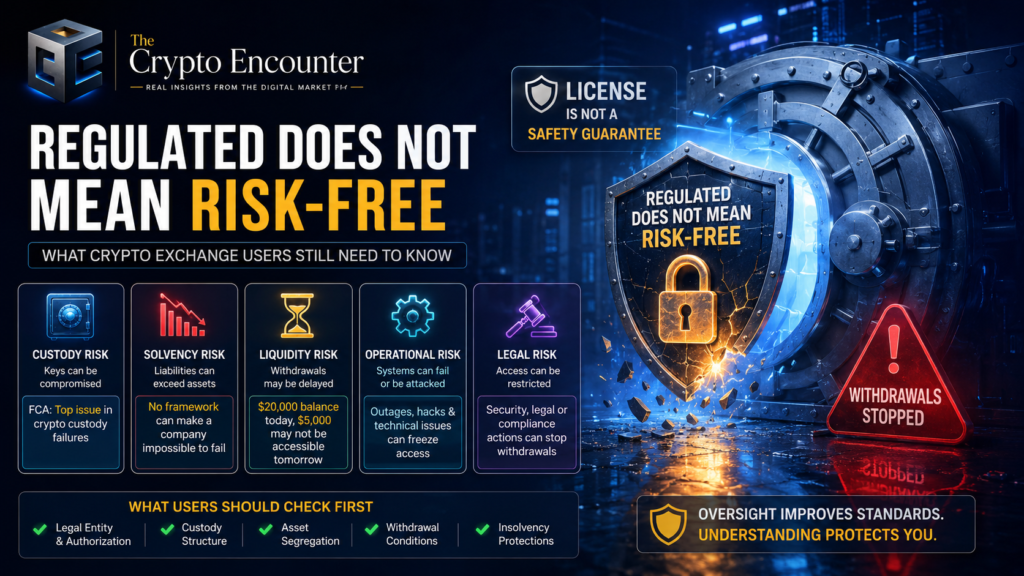
Crypto regulation can make an exchange look safer, but regulation does not automatically eliminate the risks users face. Regulation may impose standards for how an exchange operates, yet it does not guarantee uninterrupted withdrawals, immediate access to assets, or protection from every failure.
As readers exploring The Crypto Encounter can understand, regulated does not mean risk-free when custody, solvency, liquidity, and platform controls remain important. This distinction is easy to overlook because an exchange balance appears accessible on a screen. However, access depends on the platform’s systems, custody arrangements, and legal structure. Understanding these limits can help users assess exchange risks with greater clarity.
The License Is Not a Safety Guarantee
Regulation places a firm or activity inside a legal framework, but the scope of that framework matters. As FINRA explains in its crypto asset guidance, many crypto trading platforms are not registered with the SEC and therefore may not provide the same investor protections associated with registered broker-dealers.
Therefore, users should ask what an authorization covers. Does it cover custody? Does it require segregation? Which entity holds the assets? What happens if the platform becomes insolvent?
Why Regulated Does Not Mean Risk-Free for Exchange Users
An exchange screen can show a crypto balance without revealing the custody structure. As The Crypto Encounter explains in its guide to exchange balances, the displayed amount can be an internal ledger entry while the platform controls blockchain keys.
Consequently, regulated does not mean risk-free when access depends on another company. Users may have legal rights, yet exercising them can depend on withdrawal systems, identity checks, legal orders, technical availability, and platform conditions.
This is why crypto exchange custody deserves attention. Regulation describes rules around a firm. Custody describes who controls assets and how they can be transferred or recovered.
What Happens When Withdrawals Stop
Consider a scenario. You hold $20,000 worth of crypto on a regulated platform and need $5,000 tomorrow. Your balance remains visible, but withdrawals are paused because of a security review or operational incident. Your balance has not necessarily disappeared, but your immediate access has changed.
Liquidity pressure can create problems, while insolvency can force customers into a claims process. The FCA has highlighted custody failures involving hacks, lost private keys, single points of failure, and commingling, as explained in its cryptoasset custody guidance. These risks show why regulatory oversight does not eliminate every custody concern.
Regulation Reduces Risk, But Solvency Still Matters
Rules can require capital, records, safeguarding, and reporting. However, no framework can make a private company impossible to fail.
That is why regulated does not mean risk-free should be treated as a risk-management principle, not an argument against regulation. Good rules can improve customer protections and accountability. Still, users need to understand what happens when the firm experiences financial stress.
The trading and savings capital guide explains why money needed for future security should be assessed differently from funds intentionally exposed to trading risk.
The Hidden Meaning Behind “Your Assets Are Safe”
“Safe” might refer to cold storage, insurance, compliance, segregation, cybersecurity, or legal ownership. These are not interchangeable.
Cold storage may reduce online attack exposure, but it does not prove that an exchange can satisfy every customer. Segregation may improve legal protection, but it does not guarantee instant withdrawals.
Similarly, crypto exchange custody creates operational dependencies that users rarely see. Key-management procedures, wallet permissions, reconciliation, withdrawal approvals, third-party custodians, and internal ledgers all matter. The SEC also identifies custody, cybersecurity, operational, liquidity, and legal risks as relevant considerations for crypto-related products.
Readers can explore crypto security coverage and the wallet separation guide for practical security risks.
A Regulated Exchange Still Has Multiple Failure Points
To understand, regulated does not mean risk-free; separate the risks.
| Risk | What Can Go Wrong | What Rules May Address |
| Custody | Keys are compromised | Safeguarding |
| Solvency | Liabilities exceed assets | Prudential rules |
| Liquidity | Withdrawals are delayed | Risk management |
| Operations | Systems fail | Governance |
| Legal | Access is restricted | Compliance |
This is why crypto exchange custody cannot be judged by reputation alone. A large platform can experience an outage or cyberattack.
The Real Test Comes When Something Goes Wrong
A platform’s normal-day performance tells only part of the story. The most revealing test is how it responds to a shock, cyber incident, liquidity squeeze, or failure.
That is when regulation does not mean risk-free becomes most important.

Users should know whether assets are segregated, who controls the keys, what can stop withdrawals, and how claims would be handled if the firm failed.
The Crypto Encounter’s stablecoin custody analysis provides another useful example of how financial assets can depend on issuers, banks, custodians, redemption systems, and compliance controls.
Conclusion
Regulated does not mean risk-free is a useful way to think about exchange custody without dismissing regulation. Oversight can improve standards, accountability, disclosures, and safeguarding. However, exposure still depends on custody, solvency, liquidity, operations, cybersecurity, and legal access.
Ultimately, crypto exchange custody is a relationship of dependence. An exchange can provide convenience and market access while leaving the user exposed to risks outside the blockchain itself. Therefore, the strongest protection is understanding exactly what regulation covers and what it does not.
FAQs
Does regulated mean my crypto is guaranteed safe?
No. Oversight does not guarantee that an exchange will never fail, suffer an attack, freeze withdrawals, or become insolvent.
Is crypto exchange custody the same as self-custody?
No. The provider generally controls private keys in custody; the user controls them in self-custody.
Can a regulated exchange freeze withdrawals?
Yes. Security, legal, compliance, or technical conditions can restrict withdrawals.
Does regulation protect every crypto asset?
Not necessarily. Protection depends on jurisdiction, entity, product, custody arrangement, and applicable rules.
What should users check first?
Check the legal entity, authorization, custody structure, segregation, withdrawal conditions, and insolvency protections.
Disclaimer
This article is for informational and educational purposes only and does not constitute financial, investment, legal, tax, accounting, or trading advice. Crypto assets and exchange custody involve risks including volatility, insolvency, liquidity problems, cyberattacks, withdrawal restrictions, regulatory action, and loss of access. Readers should review platform terms, regulator records, custody arrangements, and applicable protections before making decisions. Regulation does not guarantee asset recovery, uninterrupted access, or protection from losses. Consider qualified professional advice for individual circumstances before acting.