

Stablecoins have become one of crypto’s most practical tools. They can move dollar-like value across borders in minutes, help families send remittances, give businesses another payment rail, and let users hold digital dollars without taking Bitcoin-style price risk. However, those same qualities help explain why criminals like stablecoins too. Speed, liquidity, global reach, and relatively stable prices can also serve scammers, money launderers, sanctioned actors, and cybercriminals. Yet stablecoins are not invisible cash. Transactions often leave permanent blockchain records, while issuers may freeze tokens or block addresses. Therefore, understanding stablecoins requires looking beyond their $1 price and asking who issues them, what backs them, who can redeem them, and who can stop them from moving.
The Short Answer: Why Criminals Like Stablecoins Too
Criminals like stablecoins for many of the same reasons ordinary users do.
A dollar-linked token can move internationally without waiting for normal banking hours. Its value also tends to fluctuate far less than Bitcoin or Ether. In addition, many exchanges, wallets, trading platforms, and payment services already support major stablecoins.
That combination creates a useful payment instrument.
According to Chainalysis, stablecoins accounted for 84% of illicit cryptocurrency transaction volume in 2025. However, that figure needs context. Chainalysis also estimates that illicit activity remained below 1% of overall attributed crypto transaction volume. In other words, criminal use is significant, but it does not mean most stablecoin activity is criminal.
The Financial Action Task Force, or FATF, reached a similar conclusion in March 2026. It identified price stability, liquidity, interoperability, and peer-to-peer transfers through unhosted wallets as characteristics that can support both legitimate payments and illicit finance.
That dual use is the central issue.
Why Stablecoins Work So Well as Digital Dollars
Stablecoins generally aim to maintain a predictable value relative to another asset, most commonly the U.S. dollar.
For a worker sending money home, that stability matters. Receiving $500 worth of a dollar-linked token is very different from receiving a volatile cryptocurrency that could lose a noticeable part of its value before the recipient converts it.
Businesses benefit for similar reasons. A merchant can price goods in dollars while still accepting blockchain-based payments. Likewise, someone living in a country with limited access to dollar accounts may use stablecoins as a digital way to hold dollar-denominated value.
Criminal networks notice the same advantages.
If stolen funds arrive in a volatile cryptocurrency, their purchasing power can change quickly. Converting those funds into stablecoins can reduce that price exposure. Meanwhile, transferring the tokens between wallets can happen across national borders without using a conventional international bank transfer.
Consequently, the attraction does not come from some hidden criminal feature. Stablecoins become useful because they solve ordinary payment problems unusually well.
Why Criminals Like Stablecoins for Moving Money
Traditional cross-border payments often involve banks, payment processors, compliance checks, business hours, and correspondent banking relationships.
Blockchain transfers work differently.
A user with control of a compatible wallet can generally send tokens directly to another blockchain address. As a result, geography becomes less important to the mechanics of the payment.
FATF has highlighted peer-to-peer transactions through unhosted wallets as a particular concern. An unhosted wallet is simply a wallet controlled directly by a user rather than by a regulated exchange or another financial intermediary. When value moves directly between such wallets, no bank or exchange necessarily sits in the middle of that specific transfer to screen it before it happens.
Therefore, criminals like stablecoins partly because they can move value through a payment network that operates continuously and globally.
Still, direct transfer does not mean anonymous transfer.
The Important Catch: Stablecoins Can Leave a Trail
Public blockchains usually maintain transaction histories.
Anyone may be able to see that one address transferred tokens to another address, including the amount and time of the transaction. The blockchain does not automatically reveal the real name behind every address. Nevertheless, investigators can combine blockchain records with exchange records, seized devices, payment information, IP data, or other evidence.
That creates an unusual trade-off for criminals.
Stablecoins may move quickly, yet the transaction trail can remain visible long after the payment takes place.
A 2025 U.S. Justice Department case illustrates that problem. Investigators traced funds from an investment scam to addresses on the Tron blockchain. According to the government, some stolen cryptocurrency had been converted into Tether’s USDT. Tether froze 325,060 USDT associated with the address, and the tokens were later transferred to a law-enforcement-controlled wallet under a federal seizure warrant.
So, while criminals like stablecoins for speed and stability, those benefits do not guarantee successful laundering.
Stablecoins Can Be Frozen Even When a Blockchain Transfer Cannot Be Reversed
This distinction often confuses ordinary users.
A blockchain transaction can be final while the token itself remains controllable by its issuer.
For example, Circle’s current USDC terms state that blockchain transfers are irreversible. However, Circle also reserves the ability to block certain addresses and, under specified circumstances, freeze associated USDC or comply with lawful government orders.
Therefore, two things can be true at once.
You may not be able to cancel a mistaken transfer after sending stablecoins. Yet an issuer may still have technical authority to stop certain tokens from moving later.
That feature can help investigators recover criminal proceeds. However, it also introduces an issuer risk that users should understand.
A token sitting in your self-controlled wallet does not always mean no outside party has influence over the asset.
Why Criminals Like Stablecoins Despite Freeze Risk
Freeze powers make stablecoins less attractive for crime, but they have not removed criminal use.
One reason is timing.
Criminals can move funds through several addresses, chains, exchanges, brokers, or counterparties before investigators identify the activity. Furthermore, cross-chain transactions can complicate monitoring because tokens and value may move across several blockchain environments.
FATF specifically highlighted cross-chain activity and peer-to-peer transactions as areas where enforcement and compliance controls can become harder to apply consistently. The organization has consequently encouraged stronger blockchain-analytics capabilities, information sharing, and technical controls among issuers and regulators.
Another reason involves access. Criminal networks do not need every payment route to remain open forever. They only need enough liquidity and counterparties to keep value moving until they can spend, exchange, or conceal it.
Therefore, issuer controls matter greatly, but they do not automatically eliminate misuse.
A Stable Price Does Not Mean a Stablecoin Is Risk-Free
For everyday users, criminal activity is only one part of the risk.
The word “stable” describes a price objective. It does not promise that every part of the system is safe.
Several separate questions matter.
| Risk | What it means for an everyday user |
|---|---|
| Reserve risk | Are sufficient high-quality assets actually backing the token? |
| Redemption risk | Can eligible users reliably exchange the token for its reference currency? |
| Issuer risk | What happens if the company operating the token fails or faces legal problems? |
| Freeze risk | Can the issuer restrict tokens linked to an address? |
| Platform risk | Is the exchange, wallet, or service holding the tokens trustworthy? |
| Scam risk | Is the person requesting payment actually legitimate? |
| Network risk | Could congestion, technical problems, or the wrong blockchain cause delays or losses? |
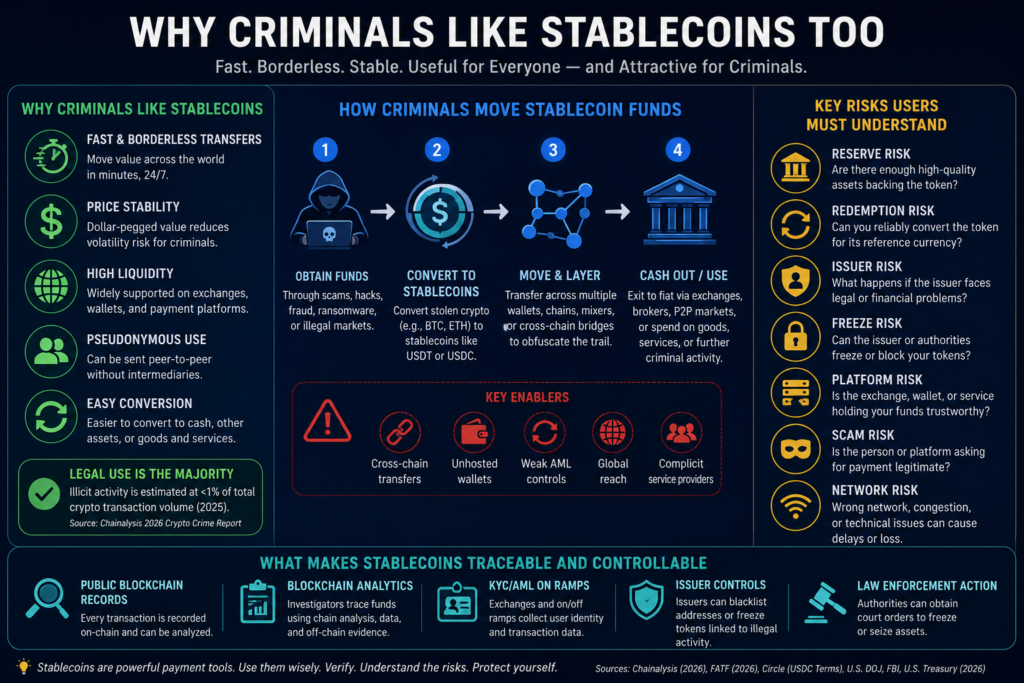
These distinctions matter because stablecoins can trade close to $1 while users still face other forms of risk.
Moreover, the person holding a token may not always have the same redemption relationship with the issuer as a direct institutional customer. Circle, for example, distinguishes between direct Circle Mint users and other USDC holders in its terms, while direct redemption depends on eligibility and account requirements.
Therefore, “one token equals one dollar” should never end the analysis.
Why Stablecoin Reserves and Redemption Matter
A stablecoin ultimately depends on confidence that holders can obtain the value the token promises.
That makes reserves crucial.
For U.S.-regulated payment stablecoins, the GENIUS Act created a federal framework requiring permitted issuers to maintain at least one-to-one reserve backing with specified liquid assets. It also requires public reserve disclosures and redemption procedures. The law took effect after its enactment on July 18, 2025.
Those requirements address a basic consumer question: what stands behind the token?
However, regulation does not turn stablecoins into bank deposits. Users still need to understand the issuer, applicable jurisdiction, redemption terms, platform custody arrangements, and the specific token they hold.
In practice, two dollar-linked tokens can carry different legal, operational, and redemption structures even if both trade near $1.
Stablecoins in Scams: The Payment Can Be Real Even When the Investment Is Fake
One of the most important household risks appears before the money ever reaches a criminal wallet.
A scammer may persuade a victim to buy genuine stablecoins through a legitimate platform. The scammer then instructs the victim to send those tokens to a wallet or fake investment website.
The payment is real.
The supposed investment is not.
The FBI describes cryptocurrency investment fraud as a confidence-based scheme in which criminals gradually build trust and persuade victims to transfer increasing amounts of cryptocurrency into fraudulent investment platforms. Victims may see fake profits on screen but later discover that they cannot withdraw their money.
That distinction matters because stablecoins can create psychological comfort.
Seeing “$10,000 USDT” may feel more familiar than seeing a volatile token balance. However, the stable denomination says nothing about whether the recipient is legitimate.
Therefore, payment protection depends on verifying the destination, not simply choosing a stable asset.
What Stablecoin Users Should Check Before Sending Money
Consumers do not need to become blockchain investigators. Still, a few checks can prevent costly mistakes.
First, confirm the recipient independently. If someone changes payment instructions through WhatsApp, Telegram, email, or social media, verify the request through another trusted channel.
Second, check the blockchain network. The same stablecoin name may appear across multiple networks, and sending tokens to an unsupported destination can create recovery problems.
Third, treat urgent investment requests as a warning sign. Genuine payment technology does not make guaranteed profits genuine.
Fourth, understand custody. Holding stablecoins on an exchange means relying on that platform as well as the token issuer. Holding them in a self-controlled wallet removes some platform risk but creates responsibility for private keys, addresses, and transactions.
Finally, learn the issuer’s reserve, redemption, freeze, and compliance policies before treating a token as a cash substitute.
These steps matter because a stable price protects against one specific problem: price volatility. It does not automatically protect against fraud, operational failure, bad counterparties, or user mistakes.
Regulation Is Increasing Because Stablecoins Now Matter Beyond Crypto Trading
Governments increasingly treat stablecoins as payment infrastructure rather than a niche crypto product.
That shift explains why compliance rules now focus heavily on anti-money-laundering controls, sanctions obligations, reserves, redemption, and issuer capabilities.
This shift also reflects a wider change in how governments approach digital assets. As our analysis of how crypto regulation is becoming the market’s next big filter explains, regulatory rules increasingly influence which crypto businesses and payment systems can operate at scale.
In April 2026, the U.S. Treasury, FinCEN, and OFAC proposed rules to implement anti-money-laundering and sanctions provisions under the GENIUS Act.
Meanwhile, FATF has urged countries to strengthen controls around stablecoin issuers, virtual-asset service providers, unhosted wallets, cross-chain activity, and freeze capabilities.
As stablecoins enter remittances, online commerce, savings, payroll, and international payments, these questions will matter increasingly to people who never consider themselves crypto investors.
Criminals Like Stablecoins Too, but Why That Is Only Half the Story
The simplest explanation for why criminals like stablecoins is also the reason millions of legitimate users find them useful: they combine digital transferability with relatively stable purchasing power.
Yet criminals do not gain perfect anonymity or guaranteed control.
Blockchains can expose transaction histories. Investigators can trace funds. Exchanges can identify customers. Issuers may freeze addresses. Governments can seek seizure orders. Meanwhile, users themselves face reserve, redemption, custody, network, scam, and compliance risks.
Stablecoins therefore sit in an unusual position between internet money and regulated financial infrastructure.
For households, merchants, and remittance users, the practical lesson is straightforward. Do not judge stablecoins only by whether the price stays near $1. Instead, understand who issued the token, what backs it, how redemption works, where you are storing it, whether it can be frozen, and who is asking you to send it.
The Financial Action Task Force’s 2026 stablecoin report specifically identifies peer-to-peer transfers through unhosted wallets, cross-chain activity, and uneven compliance controls as important illicit-finance vulnerabilities associated with stablecoins.
That broader view explains both why criminals like stablecoins and why responsible users should understand the protections and limits that come with them.
FAQs
Why do criminals use stablecoins instead of Bitcoin?
Stablecoins reduce exposure to cryptocurrency price swings while still allowing blockchain-based transfers. Their liquidity and cross-border usability can also make them convenient. However, major stablecoins may include issuer-controlled freezing mechanisms, while public blockchain records can help investigators trace transactions.
Are most stablecoin transactions criminal?
No. Chainalysis estimated that illicit activity represented less than 1% of attributed crypto transaction volume in 2025, although stablecoins accounted for 84% of the illicit volume it identified. The two statistics measure different things and should not be confused.
Can stablecoins be frozen?
Some centrally issued stablecoins can. Circle, for example, states that it can block certain USDC addresses under its policies and may freeze assets in specified circumstances or in response to valid government orders.
Are stablecoins anonymous?
Not necessarily. Public blockchains can expose transfers between addresses. Although a wallet address does not automatically reveal a person’s identity, investigators can combine blockchain records with other information to trace funds and identify participants.
Are stablecoins safe for remittances?
They can provide fast, dollar-denominated transfers, but users still face risks. These include scams, incorrect addresses, custody failures, issuer policies, network mistakes, redemption restrictions, and local regulatory requirements.
What should I check before accepting stablecoin payments?
Check the exact token, issuer, network, wallet compatibility, redemption terms, freeze policies, and the reputation of any exchange or payment processor involved. In addition, verify unfamiliar counterparties before sending money.
Disclaimer
This article is for informational and educational purposes only. It does not provide financial, investment, legal, tax, or accounting advice. Cryptocurrency and digital asset markets involve risk, including possible loss of capital. Readers should conduct their own research before making any financial decision.