


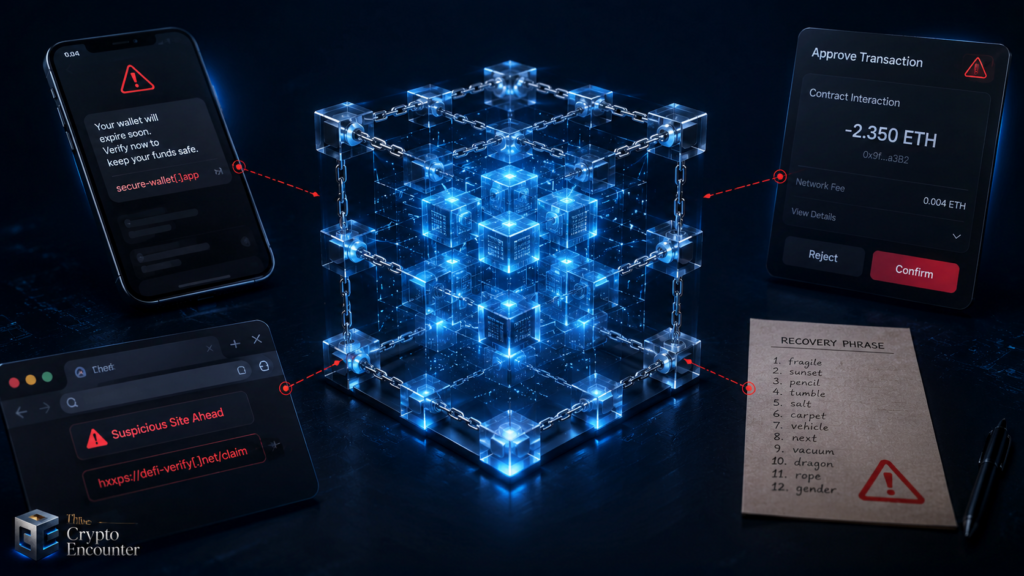
The unhackable blockchain sounds like a complete security guarantee. It suggests that once someone stores money on a blockchain, no criminal can steal it. However, that belief confuses protocol security with user security. A blockchain network may resist unauthorized changes while scammers target wallets, devices, websites, private keys, and human behavior. Therefore, understanding the unhackable blockchain myth matters because most crypto losses do not require an attacker to rewrite the blockchain. Instead, criminals persuade users to reveal secrets, approve harmful transactions, or send funds to fraudulent addresses.
Key Takeaways
- The unhackable blockchain refers mainly to the security of the underlying network.
- It does not automatically protect wallets, exchanges, devices, websites, or users.
- A blockchain can process a fraudulent transaction correctly when a valid private key authorizes it.
- Scammers often target human trust because attacking users can be easier than attacking a blockchain.
- Strong crypto security requires several layers of protection.
What Does the Unhackable Blockchain Actually Mean?
A blockchain stores transaction records across a network of computers. These computers follow shared rules before they accept new transactions.
Major blockchains also use consensus systems to prevent unauthorized changes. Bitcoin, for example, uses proof of work. Ethereum uses proof of stake. Although the systems work differently, both make it difficult for one ordinary participant to rewrite confirmed transaction history.
This technical strength supports part of the unhackable blockchain idea.
A secure blockchain may resist:
- Invalid transactions
- Unauthorized ledger changes
- Certain double-spending attempts
- Manipulation by a single ordinary participant
- Changes to confirmed transaction records
However, the unhackable blockchain does not mean that every product connected to the network has the same level of security.
Wallet applications can contain vulnerabilities. Exchanges can suffer breaches. Websites can display fake information. Smart contracts can include coding flaws. Devices can carry malware. Users can also approve transactions they do not understand.
Therefore, blockchain security covers one part of a much larger system.
A strong vault does not help when someone steals the key.
Why the Unhackable Blockchain Myth Is Dangerous
The unhackable blockchain myth creates false confidence.
Many users assume that blockchain technology will identify fraud, stop scams, or reverse mistakes. In practice, a blockchain mainly checks whether a transaction follows its technical rules.
For example, the network may verify that:
- The correct private key signed the transaction
- The sending wallet has enough funds
- The transaction follows the network’s format
- The destination address exists in a valid format
- The required network fee has been included
The blockchain does not know why the user signed.
It cannot determine whether a scammer created the transaction. It cannot see that a fake support agent pressured the victim. It also cannot know that malware replaced a copied wallet address.
As a result, the unhackable blockchain can record a scam transaction accurately and permanently.
That point creates the central tension. A technically secure system can still produce an unsafe result for the person using it.
The Security Layers Around the Unhackable Blockchain
Crypto security works through several connected layers. Each layer creates different risks.
| Security layer | Main purpose | Common risk |
|---|---|---|
| Blockchain protocol | Validates and records transactions | Consensus attacks or protocol flaws |
| Smart contracts | Automate digital agreements | Coding bugs or excessive permissions |
| Bridges | Move assets between networks | Contract exploits or validator compromise |
| Wallet software | Manages keys and transaction signing | Fake apps, malware, or unsafe backups |
| Exchange platform | Holds and transfers customer assets | Breaches, insolvency, or frozen withdrawals |
| Website interface | Connects users to crypto services | Phishing or malicious front-end code |
| User device | Runs wallets and applications | Spyware, remote access, or clipboard malware |
| Human decision | Approves transactions | Fear, urgency, confusion, or misplaced trust |
The unhackable blockchain describes only one layer in this table.
However, users interact with every layer.
Before a transaction reaches the network, someone may open a phone, launch a wallet, visit a website, connect an account, approve token access, and sign a message. A criminal only needs to compromise one weak point.
Therefore, users should think about crypto security as a chain. Every link matters.
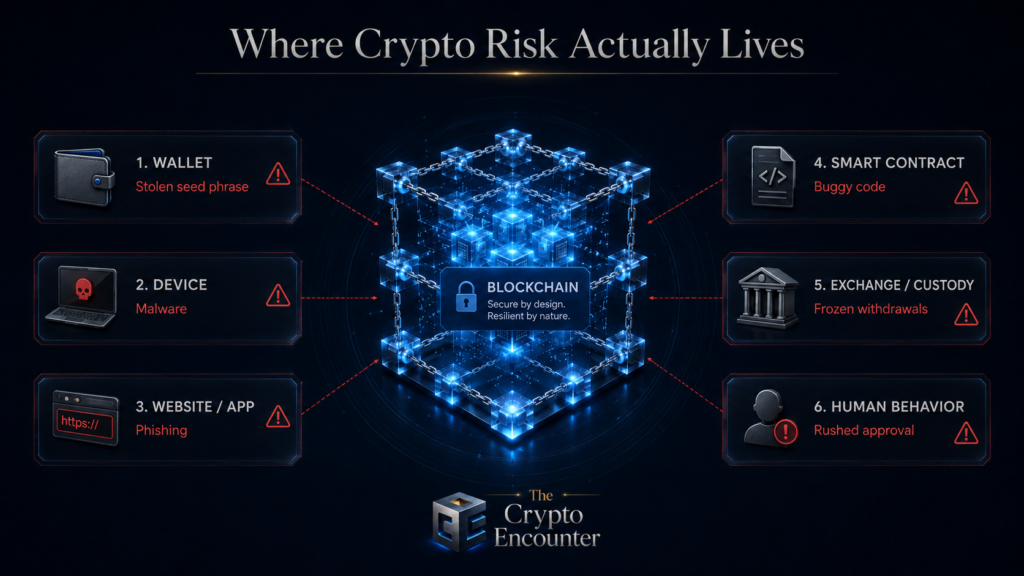
Private Keys Can Bypass the Unhackable Blockchain
A private key proves control over crypto stored at a blockchain address.
Most wallets also provide a recovery phrase. This phrase can restore the private keys if the user loses access to the original device.
Anyone who obtains that recovery phrase may gain control over the wallet.
Readers can explore these crypto password and seed phrase risks in more detail, including how weak storage habits and exposed recovery phrases can compromise otherwise secure wallets.
Consequently, criminals rarely need to defeat the mathematics behind the unhackable blockchain. They can simply steal the information that authorizes transactions.
Common private-key attacks include:
- Fake wallet recovery pages
- Fraudulent customer-support messages
- Malware that searches devices for wallet files
- Cloud backups containing unencrypted seed phrases
- Fake mobile wallet applications
- Remote-access software
- Screen-sharing scams
- Social engineering
A legitimate wallet provider does not need a user’s recovery phrase. Customer-support representatives also do not need it.
Once a scammer gets the phrase, the unhackable blockchain may work against the victim. The network will treat the scammer as the authorized wallet controller because the scammer now has the correct credentials.
The protocol sees a valid signature. It does not see stolen trust.
How Phishing Exploits the Unhackable Blockchain Myth
Phishing attacks copy the identity of a trusted company, exchange, wallet provider, or crypto project.
A message may claim that:
- The user’s wallet requires verification
- An exchange account faces suspension
- A security breach has placed funds at risk
- The user qualifies for an airdrop
- A refund is available
- A transaction failed
- The wallet must be synchronized
The message then directs the person to a fake website.
That website may request a recovery phrase. Alternatively, it may ask the user to connect a wallet and approve a transaction.
At this stage, the unhackable blockchain cannot separate the real website from the fake one. It only receives the final signed instruction.
Phishing succeeds because it targets emotion before technology.
Fear creates urgency. Urgency reduces careful checking. As a result, the victim may act before confirming the message through an official channel.
The safest response is simple. Stop. Close the link. Then visit the official website independently.
Never continue through a link included in an unexpected security message.
Ethereum’s scam-prevention guidance also recommends checking website addresses carefully, using trusted bookmarks, and never entering a recovery phrase into a website.
Blind Signing Turns Approval Into Risk
Crypto wallets ask users to approve transactions before sending them to the blockchain.
However, some wallet prompts contain technical language, shortened addresses, contract data, or unclear permission requests. Users may approve the request without understanding it.
This behavior is known as blind signing.
A signature may authorize:
- A token transfer
- Access to one digital asset
- Unlimited spending permission
- A smart-contract interaction
- An NFT transfer
- A marketplace listing
- A change in wallet permissions
From the network’s perspective, the instruction may be valid.
Therefore, the unhackable blockchain can process a harmful transaction without any technical failure.
Unlimited token approvals create a particularly serious risk. A user may give an application permission to spend tokens at any time. Later, an attacker may compromise that application or its interface.
The attacker can then use the existing permission.
Users should limit approvals whenever possible. They should also review and revoke permissions they no longer need.
The unhackable blockchain can verify a signature. It cannot confirm that the user understood the consequences.
Wrong Addresses Can Create Permanent Losses
Crypto wallet addresses contain long strings of characters.
A sender who enters the wrong address may transfer funds to an unintended recipient. In many cases, the transaction cannot be reversed.
Clipboard malware creates another threat.
When a user copies a wallet address, the malware replaces it with an attacker-controlled address. The fraudulent address then appears when the user pastes it into the wallet.
The unhackable blockchain will still process the transaction if the sender approves it.
The network does not know which address the user intended to use.
Before sending crypto, users should:
- Compare the complete destination address
- Check the address on the signing device
- Confirm the correct blockchain network
- Avoid checking only the first and last characters
- Send a small test payment when practical
- Confirm the address through a second communication channel
A short verification process may prevent an irreversible mistake.
Devices Remain Vulnerable Around the Unhackable Blockchain
Every software wallet depends on a device.
That device may include an operating system, browser, wallet extension, communication app, and internet connection. Each component can introduce risk.
Malware may:
- Record keystrokes
- Steal passwords
- capture recovery phrases
- Replace copied addresses
- Modify browser sessions
- Install fake wallet extensions
- Display altered transaction information
- Give an attacker remote access
A hardware wallet can reduce some risks because it keeps private keys away from an ordinary internet-connected device.
However, a hardware wallet does not make the unhackable blockchain promise complete.
The owner can still:
- Approve a malicious transaction
- Expose the recovery phrase
- Purchase a tampered device
- Misread a destination address
- Lose the backup
- Trust fake customer support
Technology can reduce risk. It cannot replace careful behavior.
Exchanges Add Custody Risk
Centralized exchanges often control the private keys connected to customer assets.
Users see account balances, but the exchange manages the underlying wallets. This structure creates convenience. However, it also creates counterparty risk.
An exchange may:
- Suffer a security breach
- Freeze withdrawals
- Face insolvency
- Mismanage customer funds
- Experience an internal control failure
- Lock an account
- Become subject to regulatory action
None of these events necessarily breaks the blockchain.
Instead, they show why the unhackable blockchain should not be confused with safe custody.
The network may continue operating while customers lose access to their funds through a separate business.
Before using an exchange, users should examine its withdrawal rules, custody practices, account security tools, regulatory status, and insurance claims.
They should also consider whether the platform needs to hold assets that they are not actively trading.
Smart Contracts Can Fail Without Breaking the Blockchain
Smart contracts are programs that run on blockchains.
They can manage tokens, lending platforms, trading protocols, games, bridges, and other digital services. Once deployed, these programs follow their code.
However, code can contain mistakes.
A smart contract may include:
- Incorrect access controls
- Pricing errors
- Unsafe upgrade mechanisms
- Reentrancy vulnerabilities
- Faulty calculations
- Excessive administrator privileges
- Weak external data dependencies
An attacker may exploit one of these flaws while the underlying blockchain continues working normally.
In that case, the unhackable blockchain records the exploit rather than preventing it.
Users should therefore distinguish between blockchain security and application security. A project built on a respected network does not automatically inherit perfect safety.
The network validates the contract’s execution. It does not guarantee that the contract’s design protects users.
Human Behavior Remains the Main Target
Scammers often prefer manipulating people because human behavior can be easier to exploit than cryptography.
This is also why criminals often steal crypto without hacking the blockchain, choosing phishing, impersonation, malware, and social engineering instead.
Common pressure tactics include:
- Urgency
- Fear
- Authority
- Secrecy
- Greed
- Sympathy
- Romantic trust
- Fear of missing out
A scammer may claim to represent an exchange, bank, government agency, employer, wallet company, celebrity, or investment platform.
The story may change. However, the demand often stays the same.
Act immediately. Keep the conversation secret. Send crypto. Share information. Approve the transaction.
These demands should trigger caution.
The unhackable blockchain cannot protect someone who follows a convincing but fraudulent instruction.
Before acting, users should contact the organization through an independently verified website, phone number, or application. They should not use the contact information provided by the suspicious person.
Scammers rely on speed. Verification removes that advantage.
Practical Unhackable Blockchain Safety Checklist
No checklist can create a completely unhackable blockchain experience. Still, careful habits can reduce common risks.
Before sending funds or approving a transaction:
- Confirm the website address through an independent source.
- Read every wallet prompt before approving it.
- Never enter a recovery phrase into a website.
- Never share private keys with customer support.
- Verify the full destination address.
- Confirm the correct blockchain network.
- Limit token approvals whenever possible.
- Revoke permissions that you no longer need.
- Keep wallet software and devices updated.
- Use strong, unique passwords.
- Enable multifactor authentication on connected accounts.
- Separate long-term holdings from everyday transaction funds.
- Send a small test transaction when practical.
- Avoid remote-access requests from unexpected callers.
- Treat urgency and guaranteed returns as warning signs.
- Use official support channels.
These steps protect the areas that the unhackable blockchain cannot control.
What to Do After a Wallet Compromise
Act quickly if you believe someone has compromised your wallet.
First, disconnect from suspicious websites and applications. Next, use a clean device to secure your email, exchange, and cloud accounts.
Then consider the following steps:
- Move unaffected assets to a newly created wallet
- Create a new recovery phrase
- Revoke suspicious token permissions
- Save transaction hashes
- Record wallet addresses
- Preserve emails and messages
- Take screenshots
- Notify the relevant exchange or wallet provider
- Report the incident to local law enforcement
- Contact the appropriate consumer-protection authority
- Warn contacts if an attacker has taken over your accounts
Users should also avoid fake recovery services.
A second scammer may contact the victim and promise to recover the stolen crypto for an upfront payment. These services often target people who already feel desperate.
The unhackable blockchain may preserve the transaction history. However, a permanent record does not guarantee recovery.
The Unhackable Blockchain Is a Layer, Not a Safety Promise
The unhackable blockchain myth begins with a real technical achievement.
Major blockchain networks can make unauthorized ledger changes extremely difficult. However, users still depend on wallets, websites, devices, exchanges, smart contracts, private keys, and personal judgment.
One weak layer can expose the entire experience.
A valid signature may result from stolen credentials. A confirmed transfer may go to the wrong address. A smart contract may execute flawed code. An exchange may block withdrawals while the blockchain remains available.
Therefore, users should never treat the unhackable blockchain as personal immunity.
Protect recovery phrases. Verify addresses. Read approvals. Limit permissions. Question urgent requests. Keep devices secure. Most importantly, remember that a technically valid crypto transaction can still result from fraud, manipulation, or error.
Frequently Asked Questions
Is an unhackable blockchain actually possible?
No digital system should receive an absolute security guarantee. Major blockchains may strongly resist unauthorized ledger changes, but wallets, applications, devices, smart contracts, and users can still face serious risks.
Can someone steal crypto without hacking the blockchain?
Yes. Criminals can steal private keys, compromise devices, create phishing websites, exploit smart contracts, impersonate customer support, or trick users into approving malicious transactions.
Does a hardware wallet make crypto completely safe?
No. A hardware wallet may reduce private-key exposure. However, users can still approve harmful transactions, expose recovery phrases, lose backups, or purchase tampered devices.
Can a fraudulent crypto transaction be reversed?
Usually, no. Most blockchain transactions do not include a standard chargeback mechanism. Recovery may depend on the recipient, an exchange, investigators, or law enforcement.
Why do scammers prefer cryptocurrency?
Crypto transfers can move quickly across borders. They can also be difficult to reverse. In addition, scammers exploit confusion surrounding wallets, private keys, smart contracts, and transaction approvals.
What is the best protection against crypto scams?
Pause before acting. Verify unexpected requests independently. Protect recovery phrases. Inspect transaction details. Avoid suspicious links. Reject guaranteed-return claims and urgent demands for payment.
Disclaimer
This article is for informational and educational purposes only. It does not provide financial, investment, legal, tax, cybersecurity, or accounting advice. Cryptocurrency and digital asset activities involve significant risks, including scams, technical failures, loss of private keys, irreversible transactions, and possible loss of capital. Readers should independently verify information, use trusted security practices, and conduct their own research before making any financial or security-related decision.