

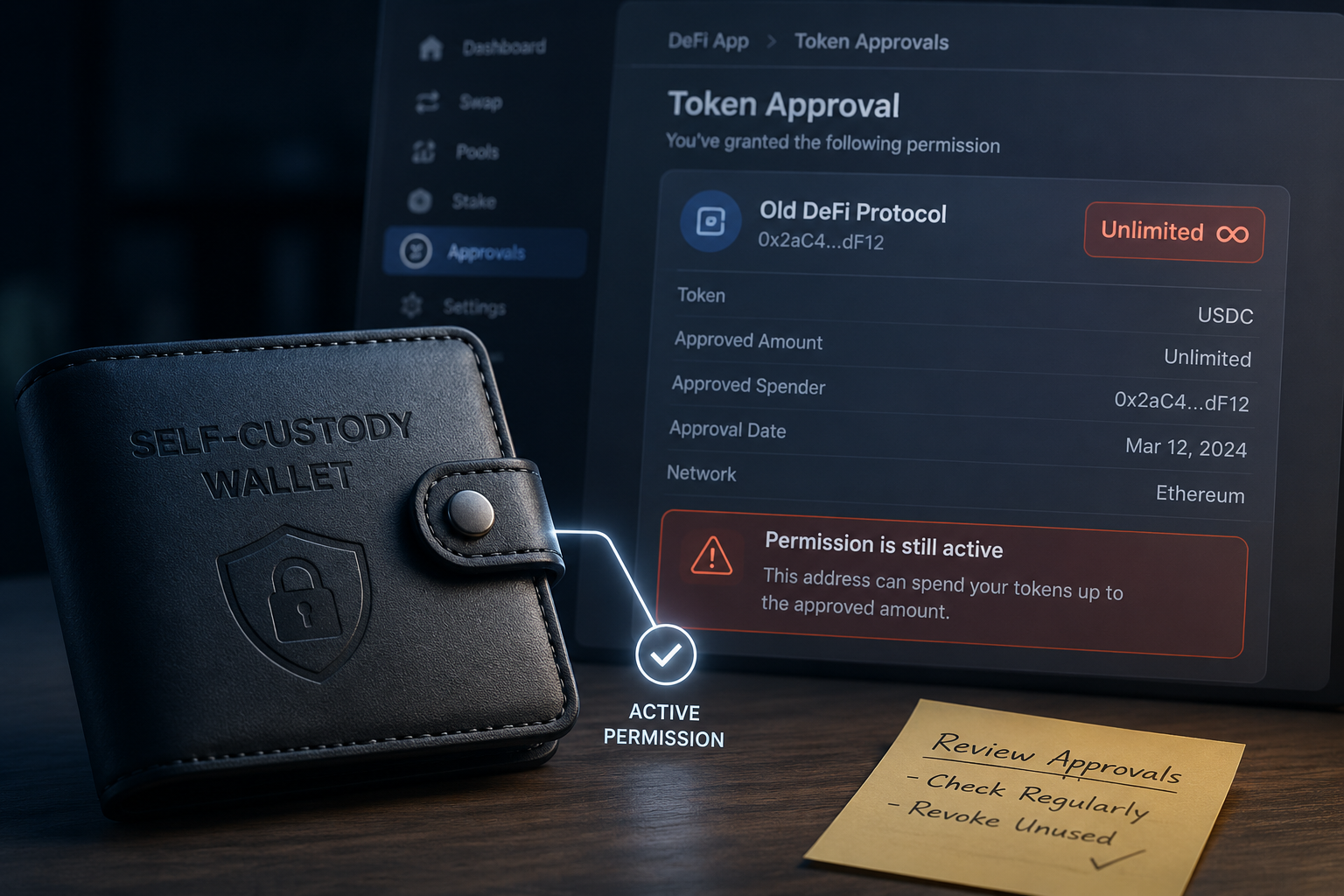
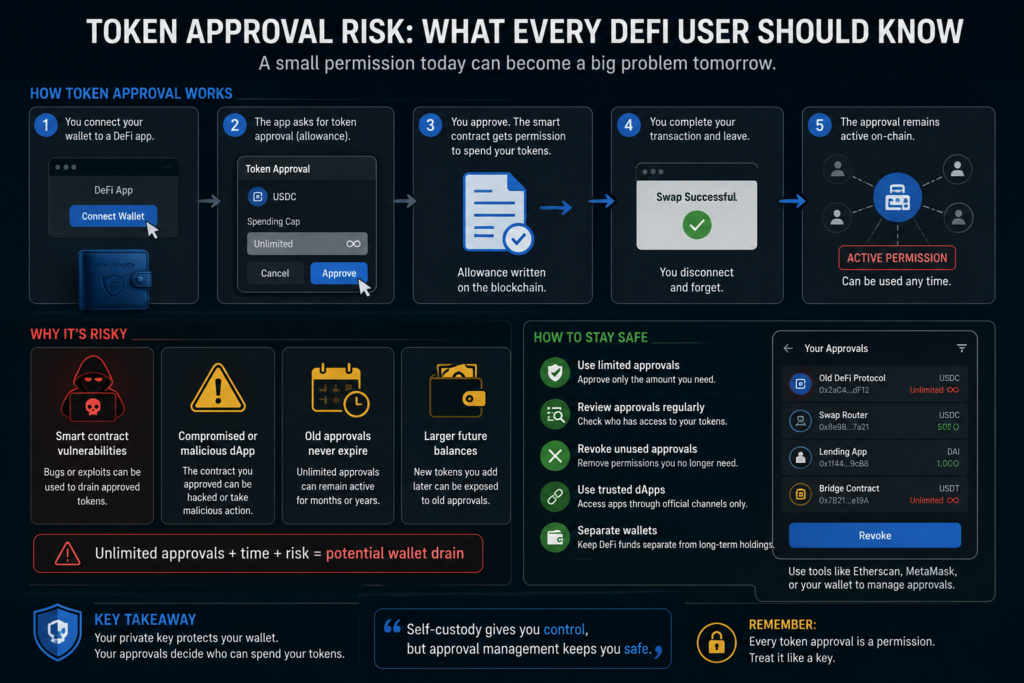
A token approval can outlive the DeFi trade that caused you to sign it. You may approve a decentralized exchange, bridge, or lending app to spend a token, complete one transaction, disconnect your wallet, and never visit the site again. Yet that token approval may still exist on-chain. If the approved spender later becomes malicious, compromised, or vulnerable, the old permission can expose the approved tokens in your wallet.
That is the uncomfortable trade-off behind self-custody. A decentralized exchange does not hold your assets like a centralized exchange. However, decentralized apps often need permission to move tokens on your behalf. Therefore, control stays with you, but responsibility also shifts toward you.
The important question is no longer only, “Who holds my crypto?” It is also, “Who still has permission to spend it?”
Key Facts About Token Approval Risk
| Question | Plain-English Answer |
|---|---|
| What is a token approval? | Permission for a specific address or smart contract to spend a specified ERC-20 token from your wallet. |
| Does it give away your private key? | No. It grants spending authority over the approved token, not your private key. |
| Can it stay active after a swap? | Yes. A standard allowance can remain active until it changes or gets used according to the token contract’s rules. |
| Does disconnecting a dapp remove it? | No. Disconnecting a website does not automatically revoke an on-chain allowance. |
| Why are unlimited approvals risky? | They can expose a much larger token balance than the amount involved in your original transaction. |
| Can you revoke an approval? | Yes. However, revocation requires an on-chain transaction and normally costs a network fee. |
The ERC-20 standard specifically allows an account to authorize another address to spend tokens on its behalf through the approve, allowance, and transferFrom functions.
What Is a Token Approval?
A token approval is an on-chain permission.
Under the official ERC-20 token standard, the approve function lets a token holder authorize a spender to withdraw tokens up to a specified amount, while allowance records how much that spender can still use.
Under the ERC-20 standard, a token owner can authorize a “spender” to transfer a certain amount of that token. The spender may be a decentralized exchange router, lending protocol, bridge, staking contract, or another smart contract.
For example, suppose you hold 1,000 USDC and want to swap 100 USDC on a DEX. Before the protocol can move the USDC needed for the trade, it may ask for a token approval.
If you approve exactly 100 USDC, you limit the allowance to that amount.
However, if you grant an effectively unlimited token approval, the contract may receive authority over far more than the 100 USDC involved in that trade.
That difference matters.
The token approval exists in the token contract’s on-chain records. It is not simply a permission stored by your browser or wallet interface. As a result, closing the website does not make the allowance disappear.
Why a Forgotten Token Approval Can Become a Future Risk
The most dangerous feature of an old allowance is persistence.
Many users mentally connect a token approval with one swap. Technically, however, the permission can survive after that swap ends.
Consider a simple example.
You connect to a DeFi app while your wallet contains only 50 USDC. The app requests an effectively unlimited token approval, and you accept.
You complete the transaction. Then you stop using the protocol.
Six months later, you transfer 8,000 USDC into the same wallet.
If that original allowance remains active, the potential exposure may now include the newer balance. MetaMask warns that large spending caps can remain valid on-chain and that effectively unlimited permissions can create a drain risk when a fraudulent dapp or compromised legitimate dapp can use them.
Therefore, the balance you held when you approved the contract does not necessarily define your future exposure.
The allowance sets the spending ceiling. Meanwhile, your later token balance determines how much value is actually available.
That creates a form of delayed risk.
A decision that looked harmless when your wallet contained $50 can matter very differently after you move thousands of dollars into it.
A Token Approval Does Not Mean Someone Has Your Private Key
This distinction matters because the phrase “wallet drain” can create the wrong mental picture.
A malicious token approval does not normally reveal your seed phrase or private key.
Instead, you have already authorized a particular spender to move a particular token, within the approved allowance. ERC-20 uses transferFrom to let an approved spender perform that transfer.
For example, approving USDC does not automatically authorize the same contract to spend your DAI.
Likewise, a standard ERC-20 token approval does not itself grant access to native ETH because ETH is not an ERC-20 token.
However, the narrower scope should not create false comfort.
If your wallet contains $20,000 in USDC and an attacker gains control of a spender with an unlimited USDC allowance, losing “only the approved token” can still mean a severe financial loss.
A stolen seed phrase creates broad account-control risk. A malicious approval creates delegated spending risk.
Both can hurt you, but they work differently.
The LI.FI Exploit Shows How Old Approval Risk Becomes Real
This danger has already caused real losses.
On July 16, 2024, cross-chain infrastructure provider LI.FI reported a security breach after a vulnerability appeared in a newly deployed smart-contract facet. According to LI.FI’s incident report, the attacker gained unauthorized access to self-custodial wallets that had given infinite approval to the affected contract.
LI.FI said the incident affected 153 wallets on Ethereum and Arbitrum. The company estimated losses at about $11.6 million, including USDC, USDT, and DAI.
The users had not surrendered their private keys to a centralized exchange.
Nevertheless, an existing token approval created a path between their assets and a vulnerable smart contract.
Moreover, LI.FI had reported another approval-related exploit in March 2022. Its post-mortem said an attacker stole roughly $600,000 from 29 wallets and took tokens according to the infinite allowances those users had previously granted.
The lesson extends beyond one protocol.
Self-custody removes one type of intermediary. It does not remove smart-contract risk, software risk, or delegated permission risk.
That broader distinction also matters when thinking about crypto exchange risk and self-custody. Moving assets away from a custodian changes who controls them, but it does not eliminate every route to loss.
Why Disconnecting a Wallet Does Not Revoke a Token Approval
This is one of the easiest mistakes to make.
Connecting a wallet to a dapp and approving token spending are separate actions.
A normal wallet connection may allow a website to see your public address, read balances, and request transactions.
A token approval goes further. It creates a spending allowance on-chain.
Consequently, pressing “Disconnect” does not necessarily remove that permission.
MetaMask explicitly states that disconnecting a wallet from a dapp does not revoke existing token approvals. The approved dapp or contract may still retain the ability to access approved tokens until the user changes the allowance.
Uniswap makes the same operational distinction. Its support documentation tells users to revoke unwanted approvals through an approval checker and notes that revocation requires a network transaction.
So, think of the two actions separately:
Disconnecting ends the website connection.
Revoking changes the on-chain spending permission.
One does not automatically perform the other.
What an Unlimited Token Approval Actually Allows
An unlimited token approval does not instantly transfer every token in your wallet.
Instead, it creates an extremely high spending ceiling.
Dapps have historically used large allowances partly for convenience. A user can interact repeatedly without paying for a fresh approval before every transaction.
However, convenience increases the size and duration of the permission.
MetaMask recommends avoiding unlimited allowances as the safest approach. It also advises users who choose them for trusted applications to review and revoke them regularly.
Suppose you want to deposit 500 USDC into a lending protocol.
A limited token approval of 500 USDC gives the protocol enough authority for that intended action.
An effectively unlimited allowance creates far greater capacity.
Nothing harmful has to happen immediately. The risk can remain dormant.
Later, a contract vulnerability, malicious upgrade, compromised integration, or deceptive transaction flow may turn that dormant permission into an active loss route.
Smart Contract Risk Can Change After You Approve
Users usually judge a protocol at one moment in time.
Yet software does not always stay identical.
A DeFi application may add modules, change routing logic, upgrade contracts, or rely on external components. Meanwhile, attackers may discover previously unknown vulnerabilities.
Therefore, a token approval can connect yesterday’s decision with tomorrow’s security problem.
The July 2024 LI.FI incident offers a clear example. LI.FI said the attack followed the deployment of a new contract facet, and wallets with infinite approvals became exposed through the vulnerability.
That time gap is crucial.
You can protect your recovery phrase perfectly, use a hardware wallet, and avoid obvious phishing links. Still, a previous permission may create a separate route to your tokens.
For a broader explanation of why technical security and personal safety can diverge, The Crypto Encounter’s coverage of the crypto security gap between experts and ordinary users explains how self-custody shifts more operational responsibility onto the individual.
Why a Non-Custodial DEX Can Still Put Funds at Risk
“Non-custodial” describes who holds the assets. It does not mean risk-free.
A DEX can let you keep tokens in your wallet until a transaction executes. That removes the permanent custody relationship common on centralized exchanges.
Nevertheless, trading through decentralized infrastructure introduces other dependencies.
You may rely on:
- Smart-contract code
- Token allowances
- Liquidity pools
- Routing contracts
- Bridges
- Oracle systems
- Wallet interfaces
- Front-end security
- Your own transaction decisions
Liquidity creates another distinction. A pool may contain enough assets to complete your trade, yet strong liquidity says nothing about whether an old token approval remains safe.
Likewise, high yield does not prove contract safety.
A DeFi protocol can offer attractive rates while users still carry smart-contract, liquidation, oracle, liquidity, permission, or governance risks.
Therefore, “I control my keys” answers only one security question.
DeFi users also need to ask what authority they have delegated.
How to Reduce Token Approval Risk Without Abandoning DeFi
You do not need to avoid every smart contract to reduce approval risk. Instead, use permissions more deliberately.
First, prefer limited allowances when the wallet and application support them.
If you plan to swap 200 USDC, an approval close to the required amount limits the spender’s authority compared with an unlimited token approval. MetaMask identifies avoiding unlimited allowances as the safer choice.
Next, review existing approvals.
MetaMask Portfolio lets users view and revoke spending caps on supported networks. Etherscan also provides a Token Approval Checker for reviewing and revoking allowances.
Then, revoke permissions that you no longer need.
Because token allowances live on-chain, revocation requires another on-chain transaction. Consequently, users normally pay the applicable gas fee.
Also, verify the spender before approving anything.
A professional-looking interface does not prove that the underlying contract address is legitimate. Therefore, access dapps through known official channels and read wallet prompts carefully.
Finally, consider separating active DeFi funds from long-term holdings.
A wallet used for frequent swaps, bridges, liquidity farming, and experimental protocols naturally accumulates more interactions. A separate wallet for long-term holdings can reduce the amount exposed if your active wallet carries an unsafe token approval.
This reflects the wider self-custody principle discussed in Why Crypto Has No Undo Button: direct control also means users assume more responsibility for transaction and wallet security.
Why Revoking a Token Approval Cannot Reverse a Drain
Revocation helps prevent future use of an allowance. It cannot reverse an earlier transfer.
Once an attacker has already moved tokens, cancelling the token approval does not retrieve them.
However, quick action can still protect funds that remain.
MetaMask advises users who believe they granted a malicious approval to revoke access quickly. If the wallet has already been drained, recovery may be difficult or impossible, but removing the permission can prevent further use of the allowance.
Consider another example.
An attacker removes 500 USDC from your wallet while an effectively unlimited allowance remains active.
You notice the transaction but assume the danger has passed.
Later, you deposit another 2,000 USDC into the same address.
If the malicious allowance still exists, that new balance may also become available to the spender.
Therefore, investigating the permission itself matters after a suspicious transfer.
New Approval Designs Are Trying to Reduce Persistent Risk
Developers have started building permission models that can reduce long-lived allowances.
Uniswap’s Permit2 system includes two different mechanisms. SignatureTransfer supports signature-based transfers where permission lasts for the one-time signed action, while AllowanceTransfer can set spending amounts and durations.
Meanwhile, ERC-7674 proposes temporary ERC-20 approvals that operate within the same transaction.
More recently, ERC-8255 was proposed in May 2026 to add expiring token approvals. Its motivation specifically identifies large and unlimited allowances that remain valid until changed as a persistent authorization risk.
These designs show that the industry recognizes the weakness of indefinitely reusable permissions.
Still, better standards cannot replace careful signing.
Users need to understand three things whenever possible: who receives permission, how much that spender can access, and how long the permission can remain useful.
Self-Custody Changes Risk Rather Than Eliminating It
DeFi often promises direct control.
That claim has an important basis. With self-custody, you hold the keys rather than depositing assets with a company that controls withdrawals.
However, holding your keys does not mean you have delegated no authority.
Every active token approval represents a limited transfer of spending power.
Consequently, decentralized finance replaces some corporate custody risk with smart-contract, liquidity, permission, interface, and user-responsibility risks.
That distinction matters especially for ordinary users.
A centralized exchange can fail because the company holding customer assets becomes insolvent, hacked, or unable to process withdrawals.
A self-custodial wallet faces a different failure model. You may lose money because of a malicious signature, compromised contract, exposed recovery phrase, bad address, unsafe bridge, or forgotten permission.
Neither model removes risk.
Instead, each model changes who must manage it.
Conclusion: Treat Every Token Approval as Ongoing Permission
A token approval should not disappear from your security checklist when a swap finishes.
If the allowance stays active, the permission can survive long after you leave the dapp. More importantly, it may expose tokens that enter the wallet later.
Therefore, protecting a self-custodial wallet requires more than guarding a seed phrase.
Limit allowances when practical. Review old permissions. Revoke access you no longer need. Verify contracts before signing. In addition, consider separating high-interaction DeFi funds from long-term holdings.
DeFi gives users more direct control, but that control comes with more direct responsibility.
Ultimately, every token approval should prompt one simple question:
Does this contract still need permission to spend my money?
FAQs
Can a token approval drain my entire wallet?
Not automatically. An ERC-20 token approval normally applies to a particular token and spender, up to the authorized allowance. However, an effectively unlimited approval can expose the full available balance of that approved token if a malicious or compromised spender can use the permission.
Does disconnecting my wallet revoke a token approval?
No. Disconnecting a dapp does not automatically cancel an on-chain token approval. MetaMask explicitly distinguishes wallet connections from token allowances. You need to change or revoke the allowance separately.
How long does a token approval last?
Standard ERC-20 allowances do not include a universal built-in expiry requirement. An allowance can remain until it changes, gets consumed according to the token implementation, or another applicable permission mechanism changes its validity. Newer designs can add temporary or time-limited permissions.
Does a token approval reveal my private key?
No. It does not reveal your seed phrase or private key. Instead, it authorizes a specific spender to move a specified ERC-20 token within the allowance. That narrower permission can still cause major losses if an attacker gains the ability to use it.
Should I revoke every approval after every DeFi transaction?
There is no universal rule that fits every user because network fees and usage patterns differ. However, old, unnecessary, unknown, or unlimited approvals increase exposure. MetaMask recommends regularly reviewing permissions and removing ones you no longer want.
Disclaimer
This article is for informational and educational purposes only. It does not provide financial, investment, legal, tax, or accounting advice. Cryptocurrency and digital asset markets involve risk, including possible loss of capital. Readers should conduct their own research before making any financial decision.