


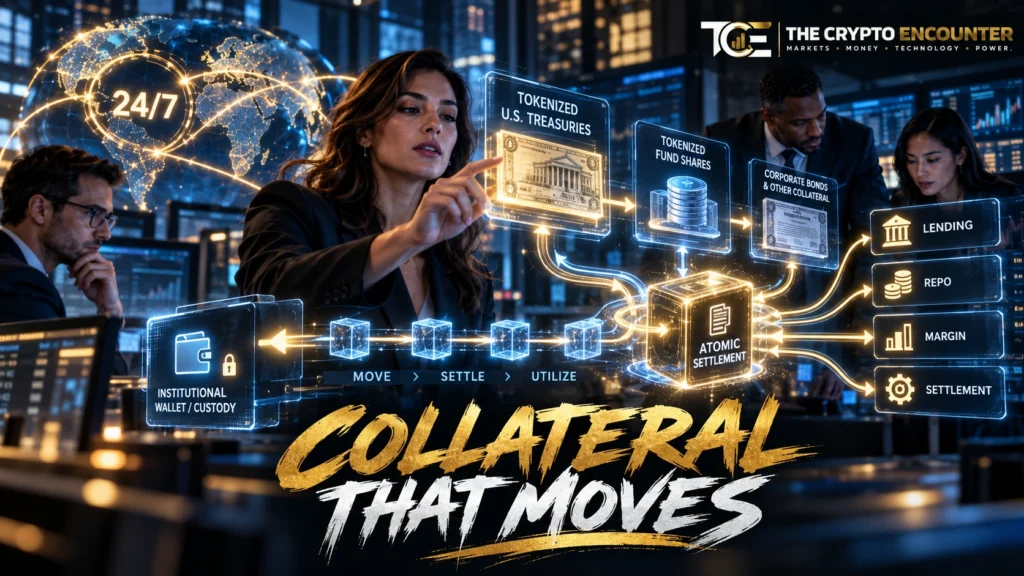
A tokenized Treasury sitting in a wallet is interesting. A tokenized Treasury that can move at 3 a.m., satisfy a margin call, settle against digital cash, support a repo transaction, remain invested while being pledged, and automatically return to its owner when an obligation is discharged is something much more consequential.
That is where the tokenization story is beginning to change.
For years, much of the conversation around real-world assets focused on whether traditional financial instruments could be represented on blockchains. The industry celebrated tokenized bonds, Treasury products, money market funds, private credit, equities, and fund interests because financial assets that once lived only inside conventional databases could now exist on digital rails.
That first step mattered. It demonstrated that regulated assets could coexist with blockchain infrastructure.
The larger opportunity begins after issuance.
What happens when the asset can actually move?
If a Treasury security, money market fund share, bond, fund interest, or other eligible financial asset can travel between counterparties around the clock, settle simultaneously with another asset, satisfy programmable eligibility rules, plug into lending and derivatives workflows, and become available precisely when liquidity is needed, tokenization changes more than the asset’s format.
It changes the asset’s economic usefulness.
This is the emerging idea behind tokenized collateral mobility, and it may prove more important to institutional finance than many of the tokenization narratives that came before it.
The scale of the opportunity becomes clearer when viewed against the existing collateral system. According to the International Swaps and Derivatives Association’s year-end 2025 margin survey, leading derivatives market participants collected about $1.6 trillion of initial and variation margin for non-cleared derivatives. Another $423.5 billion of initial margin was posted by market participants to major central counterparties for cleared interest-rate and credit-default-swap transactions.
Those figures cover only part of the financial system’s collateral universe.
Government securities, cash, money market instruments, equities, corporate securities, fund interests, and other assets are constantly being pledged, substituted, financed, margined, custodied, recalled, and transferred across banks, clearing houses, asset managers, exchanges, brokers, funds, and market infrastructures.
Much of that machinery still depends on different ledgers, settlement windows, custodians, cut-off times, reconciliation processes, and operational handoffs.
Tokenization creates the possibility that collateral could become substantially more dynamic.
That possibility helps explain why the next phase of the real-world asset market is increasingly focused on what tokenized assets can do, rather than how many dollars of assets have been tokenized. The Crypto Encounter’s earlier analysis of the growth of real-world asset tokenization identified the same transition: institutional attention is shifting from putting assets on blockchains toward making those assets useful inside collateral, settlement, credit, and liquidity workflows.
Why Collateral Matters So Much To Modern Finance
Collateral is one of the hidden operating systems of global finance.
Most people rarely see it. They see stock prices, bond yields, interest rates, bank transfers, investment funds, and crypto markets. Behind those visible products sits an enormous network of assets used to secure obligations and reduce counterparty risk.
A derivatives dealer may need to post margin against a trading position.
A hedge fund may pledge Treasury securities to obtain financing.
A bank may use high-quality securities in a repo transaction to borrow cash overnight or intraday.
A clearing member may need additional collateral because market volatility has increased.
An asset manager may hold eligible securities but still need to move them through custodians and settlement systems before they can satisfy a margin call somewhere else.
Collateral therefore performs two jobs at once.
It protects the party receiving it if the counterparty fails, and it determines how efficiently the party posting it can use its balance sheet.
The quality of collateral matters. So does its location.
A Treasury security may be one of the most liquid and creditworthy assets in the world, yet that does not automatically mean it can appear in the right account, at the right custodian, in the right jurisdiction, during the right settlement window, at the exact moment another institution needs it.
That distinction is central to the tokenization thesis.
An institution may already own excellent collateral. Its problem can still be mobility.
The Existing System Often Treats Collateral As A Location Problem
Traditional finance has become extraordinarily efficient at processing huge volumes of transactions, but the infrastructure evolved over decades across separate markets.
Assets may sit in different custody accounts.
Collateral rules vary by counterparty.
Settlement systems operate according to their own calendars.
Market infrastructures have different cut-off times.
Cash and securities may move on different rails.
Legal entities within the same financial group may not be able to treat assets as one freely deployable pool.
Cross-border movement can introduce additional intermediaries, time zones, and legal requirements.
Operational teams therefore spend substantial effort answering questions that sound simple but are not.
- What collateral do we have?
- Where is it held?
- Who legally owns it?
- Is it eligible for this obligation?
- What is its current value?
- What haircut applies?
- Can it be moved before today’s cut-off?
- Can another asset be substituted instead?
- What happens if the market moves before settlement completes?
These are partly financial questions and partly infrastructure questions.
Blockchain does not eliminate the financial ones. A risky asset does not become safe because it has been tokenized. A security that is ineligible collateral does not become eligible because it can move quickly.
What digital ledgers can change is the infrastructure around identification, ownership, transfer, automation, and settlement.
This is why the broader payments debate matters. The Crypto Encounter’s examination of why banks are adding tokens and new digital rails to legacy payment systems showed that many financial inefficiencies come from systems that were built for a world of sequential processes and separate databases.
Collateral management suffers from many of the same structural constraints.
Tokenizing The Asset Is Only The First Step
There is an important difference between a tokenized asset and useful tokenized collateral.
A financial institution can create a blockchain representation of a Treasury security without solving collateral mobility.
The token still needs legally enforceable ownership rights.
The underlying asset must be correctly custodied.
Transfer restrictions must be respected.
Counterparties need confidence in the ownership record.
Pricing and valuation data must be reliable.
The asset must be eligible under the relevant collateral agreement.
Settlement finality must be clear.
Custody, sanctions screening, know-your-customer requirements, and regulatory obligations still apply.
There is also a major architectural distinction between digitally native assets and digital representations of assets that continue to live on conventional infrastructure.
Digital Twins Can Improve Mobility Without Replacing The Underlying System
In one model, the traditional asset remains in an existing custody or securities-depository environment while a token represents rights or ownership associated with that asset.
The token can improve visibility and facilitate instructions while the underlying instrument remains anchored to the legacy system.
This approach can be easier for institutions because it does not require every existing market process to migrate at once.
It also means the token may remain dependent on off-chain records, synchronization, and the institutions maintaining the underlying security.
Digitally Native Assets Push More Of The Lifecycle Onchain
A more ambitious model places issuance, ownership records, transfer, and potentially servicing directly on distributed-ledger infrastructure.
That can reduce the gap between the token and the legally recognized asset record.
It can also make programmability more powerful because the digital system is not merely representing an asset whose authoritative record lives elsewhere.
The practical financial industry is likely to use both models for years.
The important question is not whether an asset uses the purest possible blockchain architecture. The question is whether its legal and operational design allows institutions to mobilize it safely and efficiently.
Collateral Mobility Changes The Value Proposition
The central promise of tokenized collateral can be reduced to one operational improvement: an eligible asset may become easier to deploy where it is needed.
DTCC has made this argument unusually explicit. Its 2026 research on collateral infrastructure for tokenized capital markets describes a model in which tokenized traditional assets can move more quickly across platforms, jurisdictions, and time zones. DTCC argues that more precise collateral movement could reduce liquidity buffers, improve balance-sheet efficiency, and support more dynamic funding.
The shift sounds technical, but its economic consequences can be substantial.
If an institution currently keeps additional liquid assets available because collateral cannot reliably be moved at short notice, faster infrastructure could reduce the size of that precautionary buffer.
If financing can occur for minutes or hours instead of being structured around overnight windows, the institution may avoid paying for funding it does not need for an entire day.
If collateral ownership can transfer without requiring the underlying security to be physically moved between every relevant ledger, settlement can become faster.
If eligibility rules are programmable, the system can reject unsuitable collateral before the transaction completes.
If the asset can remain invested while serving as collateral, the opportunity cost of posting margin may decline.
These are not crypto-native problems.
They are old capital-markets problems being reconsidered through digital infrastructure.
Atomic Settlement Changes How Transactions Fit Together
One of tokenization’s most important capabilities is atomic settlement.
In practical terms, atomic settlement means multiple legs of a transaction are designed to complete together or not complete at all.
Consider a simple securities transaction.
One participant delivers an asset.
The other delivers payment.
If these transfers occur through separate processes, one side may complete before the other. Traditional financial market infrastructures already use mechanisms such as delivery-versus-payment to reduce that risk.
Tokenization can make this synchronization programmable across a broader range of transactions and assets.
A smart contract could be instructed to transfer a tokenized Treasury security only if the corresponding digital cash leg settles successfully.
A collateral substitution could release the old asset only when the replacement collateral has been received.
A repo transaction could transfer cash and securities according to one coordinated set of conditions.
A margin call could execute once eligibility, valuation, ownership, and counterparty conditions have been satisfied.
Atomicity therefore matters because it allows financial actions that previously occurred as separate operational steps to become one coordinated transaction.
It does not remove every risk.
The token could still be legally defective.
The settlement asset could fail.
The smart contract could contain an error.
The valuation feed could be wrong.
A participant could lose access to signing keys.
A network could become unavailable.
The benefit is narrower and more useful: properly designed atomic settlement can reduce the risk created when one leg of a transaction completes while the other does not.
Twenty Four Hour Mobility Could Change Margin Management
Markets increasingly operate beyond the hours of the financial infrastructure that supports them.
Crypto trades continuously.
Foreign-exchange markets span global time zones.
Futures and derivatives markets react quickly to geopolitical events.
Weekend developments can reshape risk before some traditional securities systems reopen.
Yet institutions may hold much of their best collateral inside infrastructures that are not designed for continuous transfer.
This creates an important mismatch.
Risk can move faster than collateral.
Tokenized collateral aims to reduce that gap.
If eligible assets can be transferred near real time and outside conventional settlement windows, an institution facing a margin requirement may have more ways to respond without waiting for another market or intermediary to open.
That could be particularly valuable during volatility.
Collateral calls often increase precisely when firms are under the greatest liquidity pressure. A portfolio may lose value. Margin requirements rise. Firms need cash or eligible securities. Everyone attempts to source liquidity at the same time.
The problem can become self-reinforcing when institutions sell assets simply because the right collateral cannot be mobilized quickly enough.
Faster movement does not create new wealth, but it may allow existing high-quality assets to be used more efficiently.
Intraday Repo Could Become A Much Bigger Part Of Liquidity Management
Repo markets are one of the clearest examples of why collateral mobility matters.
A repurchase agreement is economically similar to secured borrowing. One party provides securities and receives cash, with an agreement to reverse the transaction later.
Traditional repo is already one of the most important financing mechanisms in global markets.
Tokenization can compress the time unit.
Instead of financing collateral for an entire day or overnight period because infrastructure is organized around those windows, institutions could increasingly arrange funding for the hours in which it is actually required.
DTCC’s 2026 analysis argues that intraday repo enabled by digital ledgers could materially reduce funding costs and dependence on daylight overdrafts and overnight liquidity.
The broader concept is powerful.
A financial institution may experience a temporary cash requirement at 11 a.m. and no longer need that funding at 2 p.m.
With sufficiently liquid tokenized collateral, automated valuation, reliable settlement money, and counterparties willing to transact, financing can become more closely matched to the actual duration of the liquidity need.
That makes collateral less static.
It begins behaving more like an active liquidity-management tool.
Yield Bearing Collateral Creates Another Layer Of Efficiency
Traditional margin frequently carries an opportunity cost.
An institution that posts cash as collateral may lose the ability to deploy that cash elsewhere.
Tokenized money market funds and tokenized Treasury products create a different possibility.
An investor may hold a yield-bearing financial asset and pledge it rather than converting the position into idle cash first.
This is one reason tokenized funds have become so strategically important.
J.P. Morgan’s Tokenized Collateral Network was designed around the ability to transfer collateral ownership while the underlying asset remains invested, initially using money market fund interests. Franklin Templeton has also expanded the use of tokenized money market fund shares as off-exchange institutional collateral.
The Crypto Encounter previously examined why credit and collateral are becoming strategic battlegrounds across crypto and DeFi. Tokenized traditional assets extend that competition into institutional markets.
The asset is no longer useful only because it appreciates, pays interest, or preserves capital.
Its liquidity value begins to matter too.
Treasuries Are A Natural Starting Point
U.S. Treasuries have become one of the most important gateways into institutional tokenization for a simple reason: the financial system already understands them.
They are widely used as high-quality liquid assets.
They support repo markets.
They serve as collateral across numerous financial relationships.
They have deep markets and established legal frameworks.
Tokenizing a Treasury therefore does not require institutions to accept a completely new form of economic risk.
The innovation is primarily in how ownership, transfer, and settlement are represented and executed.
This makes Treasuries a far easier institutional bridge than trying to convince conservative financial firms that volatile crypto assets should become their primary collateral base.
Tokenized Treasury funds have already reached billion-dollar scale. The next phase asks whether those instruments can circulate efficiently through institutional financing, derivatives, exchange, and payment environments.
The Collateral Story Extends Beyond Treasuries
Treasuries are the easiest example, but the logic can extend further.
Money Market Fund Shares
Tokenized money market funds can combine yield, relatively stable value, institutional familiarity, and blockchain transferability.
They are particularly attractive for trading firms that would otherwise hold large stablecoin or cash balances while waiting to deploy capital.
Fund Interests
Private funds and other investment vehicles can potentially become more portable if ownership interests are represented digitally and transfer restrictions are encoded properly.
The challenge is that fund interests can involve complex valuation schedules, investor eligibility rules, lockups, and legal agreements.
Tokenization cannot erase those restrictions. It can potentially make them easier to enforce and administer.
Corporate And Sovereign Bonds
Tokenized bonds could become useful across collateral pools where credit quality, liquidity, duration, and legal eligibility permit their use.
Programmable servicing could also connect coupon payments and lifecycle events to the same digital infrastructure.
Equities And ETFs
Equities and exchange-traded funds are already used as collateral in parts of the financial system, usually with larger haircuts than government securities.
Tokenized versions could improve movement and automation, although volatility and eligibility constraints remain.
Crypto Assets
Bitcoin, Ether, stablecoins, and other digital assets already function as collateral across crypto lending and derivatives markets.
The institutional tokenization story increasingly connects this existing crypto collateral universe with regulated securities and fund products.
That convergence could become more important than the distinction between traditional finance and DeFi.
The Settlement Asset Matters As Much As The Collateral
A tokenized Treasury cannot settle atomically against nothing.
The other leg of the transaction needs a credible form of money.
This creates one of the biggest unresolved questions in tokenized finance.
What should be used as the settlement asset?
Possibilities include stablecoins, tokenized commercial bank deposits, central-bank money connected to DLT infrastructure, and other regulated digital-cash instruments.
Each model has different implications.
Stablecoins already provide around-the-clock blockchain liquidity and have demonstrated that dollar-denominated value can move globally with extraordinary speed. The Crypto Encounter’s guide to whether stablecoins can replace traditional bank transfers explains why speed alone does not make them identical to bank money.
Reserve structure also matters. Our analysis of who actually holds the dollars behind stablecoins shows that apparently simple onchain money often depends on banks, custodians, Treasury markets, money market funds, and redemption infrastructure.
Tokenized bank deposits provide another approach. The claim remains against a regulated commercial bank while blockchain technology provides programmability and transfer functionality.
Central banks are also moving closer to tokenized markets.
The European Central Bank announced that qualifying marketable assets issued using DLT-based services would become eligible as Eurosystem collateral from March 30, 2026. The Eurosystem is also studying how assets issued and settled entirely on DLT could eventually fit into its collateral framework.
This matters because institutional tokenization becomes substantially more powerful when both the asset and the money used to settle it can operate on compatible digital rails.
Collateral Mobility Could Connect Traditional Markets And DeFi
The boundary between institutional tokenization and decentralized finance is becoming harder to define.
A tokenized Treasury may be issued by a regulated asset manager.
It may be held by an institutional custodian.
Its ownership record may exist on a blockchain.
It may be pledged as collateral to support a trading position.
A smart contract may enforce transfer conditions.
Settlement may occur against a stablecoin or tokenized bank deposit.
The economic product remains traditional. The infrastructure begins to resemble DeFi.
This is institutional DeFi in the most meaningful sense: regulated financial assets adopting capabilities that crypto markets have demonstrated for years, including composability, programmable collateral, onchain settlement, and continuous transfer.
The Crypto Encounter’s coverage of the connection between crypto collateral, credit, and traditional payment rails provides a consumer-facing version of the same structural trend. Once assets can secure credit without being sold, the relationship between ownership and liquidity changes.
Atomic Settlement Does Not Mean Zero Liquidity Needs
This is one of the most important caveats in the tokenized-collateral thesis.
Faster settlement can reduce settlement exposure, but it can also change how much liquidity participants need and when they need it.
Traditional systems sometimes net many obligations before final settlement.
If every transaction instead settles immediately and individually, participants may need cash or collateral earlier.
A system that removes a two-day settlement delay can reduce counterparty exposure while simultaneously reducing the time available to source liquidity.
That trade-off matters enormously.
Tokenization therefore does not automatically mean institutions should operate with minimal liquidity buffers.
The strongest design combines faster collateral mobility with prudent liquidity management, netting where appropriate, reliable funding markets, and mechanisms that continue to work during stress.
Efficiency during normal markets is not enough.
Collateral infrastructure must perform when markets are moving violently and many firms need the same assets at once.
Twenty Four Hour Transferability Is Not The Same As Twenty Four Hour Liquidity
A token can move at any hour and still be difficult to sell.
This distinction will become increasingly important as tokenized securities markets expand.
Blockchain availability does not guarantee buyers.
It does not guarantee a continuously updated net asset value.
It does not guarantee that the fund administrator is processing subscriptions and redemptions.
It does not guarantee that an underlying Treasury market is open.
It does not guarantee that a custodian can complete an off-chain action during the weekend.
It does not guarantee that the asset remains eligible collateral after its price changes.
Institutions therefore need to distinguish four different concepts:
- Transferability means the token can technically move
- Settlement availability means the infrastructure can finalize the transfer
- Market liquidity means another participant is willing to trade at a reasonable price
- Redemption liquidity means the holder can convert the token into the underlying asset or cash according to the product’s terms
Tokenization can improve the first two without automatically solving the last two.
Collateral Eligibility Still Depends On Risk
Financial institutions do not accept collateral simply because it is transferable.
The receiver cares about what happens if the counterparty defaults.
Can the collateral be sold?
How quickly?
At what discount?
How volatile is the asset?
Is there concentration risk?
Does the receiving institution have legal authority to hold it?
What jurisdiction governs enforcement?
Can the token be frozen?
Does the holder have a direct claim on the underlying security?
These questions determine collateral eligibility and haircuts.
A tokenized Treasury may qualify for a relatively favorable haircut because of the underlying security’s quality and liquidity.
A tokenized private-credit position may require a much larger haircut because the underlying asset is less liquid and harder to value.
A tokenized equity can move instantly while still losing 20 percent of its value during a market shock.
Technology accelerates movement. It does not repeal risk management.
Programmable Collateral Could Automate Eligibility And Substitution
One of the more interesting institutional applications of smart contracts involves rules rather than speed.
Collateral agreements contain detailed requirements.
Counterparties may specify eligible asset classes, minimum credit quality, concentration limits, currency requirements, maturity limits, issuer restrictions, haircuts, and substitution rights.
Traditional systems often require several platforms and operational teams to interpret and enforce these conditions.
A properly designed tokenized-collateral system can make some of those rules machine-readable.
A transaction could automatically reject an asset that no longer meets eligibility requirements.
A collateral pool could identify which securities are cheapest to deliver while respecting contractual constraints.
A margin engine could calculate an obligation, identify available assets, apply the correct haircut, and initiate transfer.
A borrower could substitute collateral without waiting for a chain of manual messages among counterparties, custodians, and agents.
This is where programmability becomes economically meaningful.
The smart contract is not valuable because it is novel. It is valuable if it removes operational latency without weakening legal control.
A Single Asset Could Serve Multiple Financial Workflows
The most ambitious vision for tokenized collateral involves composability.
Imagine an institutional investor holding a tokenized government money market fund.
The asset earns yield while sitting in the investor’s wallet or custody account.
The investor pledges part of the position as collateral for a derivatives trade.
A temporary liquidity need appears later in the day.
The remaining eligible position supports an intraday repo transaction.
The cash received is used to settle another trade.
When the repo unwinds, collateral is automatically returned.
A margin requirement declines, releasing another portion of the fund position.
Each action is recorded and synchronized through connected digital infrastructure.
No one needs to recreate the economic asset each time it enters a new workflow.
This is the deeper meaning of collateral mobility.
The same asset can become more financially productive because infrastructure allows it to interact with more obligations.
Interoperability Is The Hard Part
Financial institutions are unlikely to place every asset, payment, and transaction on one blockchain.
Different networks optimize for different requirements.
Some institutions need privacy.
Some prefer public networks.
Others require permissioned environments.
Different jurisdictions may authorize different infrastructures.
Existing central securities depositories and custodians are not disappearing.
The future is therefore likely to be multichain and hybrid.
That creates an interoperability challenge.
A tokenized Treasury on one network may need to secure an obligation recorded on another.
A bank’s tokenized deposit may need to settle a security issued on a public blockchain.
A custodian may need to prove that an underlying security is immobilized without revealing sensitive client information.
Assets may need to move between networks without creating duplicate claims.
Crypto’s experience provides a warning here. The Crypto Encounter’s investigation into why blockchain bridges became such attractive targets for hackers shows how dangerous interoperability can become when large pools of assets depend on fragile cross-chain mechanisms.
Institutional collateral systems cannot simply recreate those risks at a larger scale.
Legal Finality Matters More Than Blockchain Finality
One of the easiest mistakes in tokenization is to assume that a confirmed blockchain transaction settles every legal question.
It does not.
Institutions need to know whether transferring the token transfers legally enforceable ownership or merely changes a technological record.
They need to know what happens during bankruptcy.
They need clear rights to seize collateral after default.
They need certainty around perfection of security interests.
They need rules governing mistaken transfers, sanctions orders, court injunctions, forks, key loss, and network outages.
The token’s code cannot unilaterally determine all of those outcomes.
This is particularly important when the token represents an off-chain security.
If the blockchain record says one thing and the legally authoritative shareholder register says another, the system needs a defined way to resolve the conflict.
Institutional adoption will therefore depend on technology and legal architecture evolving together.
Custody Changes Rather Than Disappears
Tokenization is sometimes described as removing intermediaries.
Collateral markets suggest a different outcome.
Institutions still need custody.
They still need asset servicing.
They still need legal agreements.
They still need valuation and risk controls.
They still need settlement assurance.
The difference is that some functions may become more automated and some intermediaries may interact through shared infrastructure rather than separate databases.
The distinction between an account balance and direct control also remains important. The Crypto Encounter’s explanation of why an exchange balance is different from direct asset control illustrates a broader principle that also applies to tokenized securities: the interface a user sees does not necessarily reveal who holds the underlying asset or who has final authority over transfer.
Tokenized collateral needs that chain of control to be explicit.
Market Stress Will Be The Real Test
The strongest argument for tokenized collateral is that it can improve liquidity management during stress.
The most serious risk is that market participants may come to depend on that efficiency too heavily.
Imagine institutions reducing liquidity buffers because collateral can supposedly move instantly.
That works during normal conditions.
Then a major market shock hits.
Collateral values fall.
Haircuts increase.
Margin calls rise.
Multiple firms attempt to source the same high-quality assets.
Networks become congested.
Liquidity providers pull back.
Price feeds become volatile.
A key custodian imposes additional controls.
The institution discovers that technical transferability did not guarantee economic liquidity.
This is why collateral mobility should be treated as an efficiency tool rather than an excuse for fragile balance sheets.
The best-case outcome is that institutions can use existing liquidity more intelligently.
The dangerous outcome would be an assumption that liquidity no longer needs to be held because it can always be created instantly.
Stablecoin Risk Still Matters To Tokenized Collateral
If stablecoins become an important settlement asset for tokenized collateral, weaknesses in stablecoin architecture can migrate into institutional workflows.
The history of stablecoin de-pegging demonstrates how quickly confidence and liquidity can become connected.
The Crypto Encounter’s analysis of what happens when a stablecoin loses its peg showed that collateral and reserve risks can spread between supposedly separate digital instruments.
This does not mean stablecoins are unsuitable for institutional settlement.
It means their reserve quality, redemption mechanics, legal structure, concentration risk, and banking dependencies become part of the collateral system’s risk model.
The same applies to tokenized deposits and other forms of digital money.
The collateral leg cannot be analyzed independently from the cash leg.
Tokenization Could Reduce Some Banking Costs And Create Others
Collateral mobility may reduce operational costs, funding costs, reconciliation work, and idle liquidity.
It can also shift economics elsewhere in the system.
Banks may need new infrastructure.
Custodians may need blockchain connectivity.
Compliance systems must support continuous transaction monitoring.
Cybersecurity requirements can increase.
Institutions may need redundant networks and signing controls.
Legal teams must update collateral agreements.
Risk models must account for digital settlement assets and smart-contract dependencies.
Tokenization therefore does not make finance free.
It reallocates costs toward different infrastructure.
A similar redistribution is already visible in stablecoins. The Crypto Encounter’s examination of how stablecoins could affect bank funding economics shows that efficiency gains in one part of the system can create new costs in another.
Why Central Banks Are Starting To Matter More
Institutional tokenization becomes far more credible when central banks and major market infrastructures begin integrating DLT-based assets into existing frameworks.
The ECB’s collateral decision is significant for that reason.
The Eurosystem did not declare that blockchain assets should receive special treatment.
It brought qualifying DLT-issued marketable assets into the existing collateral framework while maintaining eligibility and risk requirements.
That is an important model for institutional adoption.
The asset does not become acceptable simply because it is tokenized.
Tokenization becomes another technological form through which an otherwise eligible financial instrument can operate.
This approach may ultimately matter more than creating entirely separate regulatory universes for digital and traditional finance.
Collateral Mobility Could Become Tokenization’s Institutional Killer Application
The phrase “killer application” is often overused in crypto.
Collateral mobility deserves consideration because the problem already exists at enormous scale.
Institutions already hold the assets.
They already post margin.
They already conduct repo.
They already manage liquidity buffers.
They already spend money reconciling different systems.
They already face settlement cut-offs.
They already struggle to mobilize collateral across legal entities, jurisdictions, custodians, and markets.
No new speculative demand needs to be invented.
The business case depends on improving an existing financial function.
That distinguishes tokenized collateral from many earlier blockchain propositions.
The question is not whether consumers will buy a new token.
The question is whether banks, asset managers, clearing firms, hedge funds, exchanges, custodians, and market infrastructures can use assets they already own more efficiently.
What Success Would Actually Look Like
The success of tokenized collateral should not be measured only by the dollar value of assets represented on blockchains.
Better indicators would include:
- How much tokenized collateral is actively pledged rather than sitting idle
- How quickly collateral can be substituted
- How much intraday funding occurs using tokenized assets
- Whether institutions can reduce unnecessary liquidity buffers without increasing fragility
- How many networks and custodians can interoperate safely
- Whether settlement failures decline
- Whether collateral remains productive while pledged
- How much manual reconciliation is removed
- Whether legal enforceability works during real defaults
- Whether systems remain resilient during periods of extreme volatility
These measures focus on utility.
That is the direction institutional tokenization now needs to take.
The Crypto Encounter Take
Tokenization has spent years proving that financial assets can be represented on blockchains.
That achievement is becoming less interesting by itself.
The more consequential question is what those assets can do after they arrive.
A Treasury that merely exists as a token is a new recordkeeping format.
A Treasury that can earn yield, move at any hour, satisfy a margin call, support an intraday repo, settle simultaneously against digital money, interact with other financial applications, and return automatically when an obligation ends has acquired new operational capabilities.
The economic asset has not changed.
Its financial range has.
This is why collateral mobility may become one of tokenization’s defining institutional use cases.
The existing collateral system is already enormous, already critical to financial stability, and already burdened by fragmentation. Institutions do not need to be persuaded that collateral matters. They need better ways to identify it, value it, move it, pledge it, substitute it, finance it, and recover it.
Tokenization can potentially compress many of those actions into shared, programmable infrastructure.
That possibility also raises serious questions.
Twenty four hour transferability can create timing mismatches with assets and institutions that still operate on traditional schedules.
Atomic settlement can reduce settlement exposure while increasing the need for precisely timed liquidity.
Interoperability can unlock larger collateral pools while creating new technological attack surfaces.
Programmability can reduce manual work while concentrating risk inside code, data feeds, and governance rules.
Faster movement can improve capital efficiency while tempting firms to keep thinner liquidity cushions.
The winners will therefore not be the platforms that simply tokenize the largest amount of assets.
They will be the systems that make those assets genuinely useful without weakening legal certainty, risk controls, settlement finality, privacy, cybersecurity, or market resilience.
The biggest opportunity in tokenization may ultimately be much less glamorous than putting every asset in the world on a blockchain.
It may be making the assets the financial system already owns move better.
Frequently Asked Questions
What Is Tokenized Collateral
Tokenized collateral is a blockchain-based or distributed-ledger representation of an asset that can be pledged to secure a financial obligation. The underlying collateral may include Treasury securities, money market fund shares, bonds, equities, fund interests, stablecoins, or other eligible financial assets. The token can potentially improve ownership tracking, transfer speed, programmability, and settlement while existing legal and risk requirements still apply.
Why Is Collateral Mobility Important
Financial institutions often own high-quality collateral that is difficult to move quickly because assets are spread across custodians, legal entities, settlement systems, jurisdictions, and accounts. Better mobility can help firms meet margin requirements, obtain financing, substitute collateral, and manage liquidity more efficiently.
What Does Atomic Settlement Mean
Atomic settlement means multiple legs of a transaction are designed to complete together or not complete at all. For example, a tokenized security and digital cash payment could be exchanged simultaneously, reducing the risk that one party transfers its asset while the other leg fails.
Can Tokenized Collateral Move Twenty Four Hours A Day
The blockchain record may support continuous transfer, but practical availability depends on the product, network, custodian, legal structure, valuation process, and settlement asset. Twenty four hour token transferability does not automatically mean the underlying market, redemption process, or liquidity is available at all times.
Can A Tokenized Treasury Be Used As Collateral
Potentially yes, if the structure provides legally enforceable rights and the receiving counterparty or market infrastructure treats the asset as eligible collateral. Tokenization does not automatically make a Treasury eligible in every transaction. Existing collateral agreements, haircuts, custody rules, and regulatory requirements remain relevant.
Why Are Tokenized Money Market Funds Important
Tokenized money market funds can provide yield while also offering digital transferability. This creates the possibility that an institution can remain invested while using its fund interest as collateral, reducing the need to hold large idle cash balances solely for margin or trading purposes.
Will Tokenized Collateral Replace Stablecoins
No. The two can serve different functions. Tokenized Treasuries and funds may act as yield-bearing collateral or investments, while stablecoins can provide a liquid digital settlement asset. In many institutional workflows they may complement each other rather than compete directly.
What Are The Main Risks Of Tokenized Collateral
Risks include legal uncertainty, custody failures, smart-contract vulnerabilities, incorrect pricing data, network outages, cross-chain security problems, liquidity shortages, settlement-asset risk, concentration, key management failures, regulatory restrictions, and uncertainty about enforceability during default or insolvency.
Could Tokenized Collateral Reduce Funding Costs
It may. Faster collateral movement and intraday financing can help institutions align funding more closely with actual liquidity needs. The savings depend on the institution’s balance sheet, collateral inventory, regulatory requirements, funding structure, technology costs, and the liquidity of the relevant tokenized assets.
Does Tokenization Remove Banks And Custodians
Usually not. Institutional tokenization often changes how intermediaries work rather than eliminating them. Banks, custodians, central securities depositories, transfer agents, clearing houses, fund administrators, and compliance providers can remain important while shared digital infrastructure reduces some reconciliation and transfer friction.
Disclaimer
This article is provided for informational and educational purposes only. It does not constitute financial, investment, legal, tax, accounting, trading, or regulatory advice. Tokenized securities, digital assets, stablecoins, collateral arrangements, DeFi protocols, money market funds, and other financial instruments involve risks that vary by product and jurisdiction. Eligibility, settlement rights, custody arrangements, liquidity, collateral treatment, and legal enforceability can differ materially between structures. Readers and institutions should independently verify relevant information and consult qualified financial, legal, compliance, tax, or risk professionals before making decisions.