


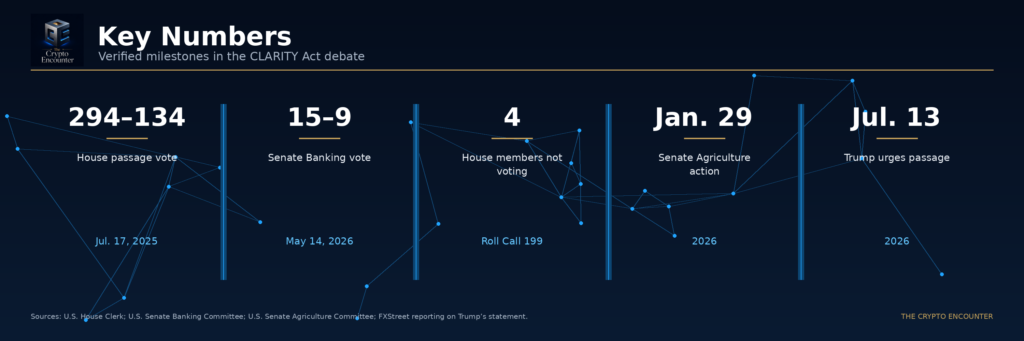
President Donald Trump has urged the Senate to pass the Digital Asset Market Clarity Act, adding White House pressure to a bill that has cleared committee but not the full chamber. Trump appealed on July 13, 2026, in honor of Senator Lindsey Graham, who died two days earlier at age 71. Lawmakers are seeking further action before the August recess, although no official final-vote date has been confirmed.
The immediate story is Trump’s intervention. The larger issue is who will control the next stage of U.S. crypto finance. The Senate proposal would shape how authority is divided between the Securities and Exchange Commission and the Commodity Futures Trading Commission. It could also affect how banks, exchanges, stablecoin companies, brokers, custodians, and token issuers compete for customers.
Why the CLARITY Act Matters
The United States already regulates many activities involving securities, commodities, money transmission, banking, sanctions, and financial crime. However, digital assets can cross several of those legal categories.
The CLARITY Act attempts to create a dedicated federal structure for digital commodities and related intermediaries. Its core purpose is to define the roles of the SEC and CFTC, establish registration pathways, set disclosure duties, and provide rules for certain digital-asset transactions.
That makes the debate larger than the familiar argument over whether Washington is “for” or “against” crypto. Congress is designing the legal architecture that could determine which regulator supervises specific assets, which firms may serve U.S. customers, and what protections those customers receive.
Whatever it may be, crypto regulation is definitely becoming the market’s next big filter.
What Trump Asked the Senate to Do
Trump called on senators to pass the CLARITY Act and tied the measure to U.S. competition with China in digital assets and artificial intelligence. That competitiveness argument reflects the administration’s policy position. It does not establish that the bill will produce greater investment, prevent companies from leaving the country, or ensure U.S. leadership. Those outcomes would depend on the final statute, agency rules, market conditions, and how businesses respond.
The legislative record shows meaningful progress.
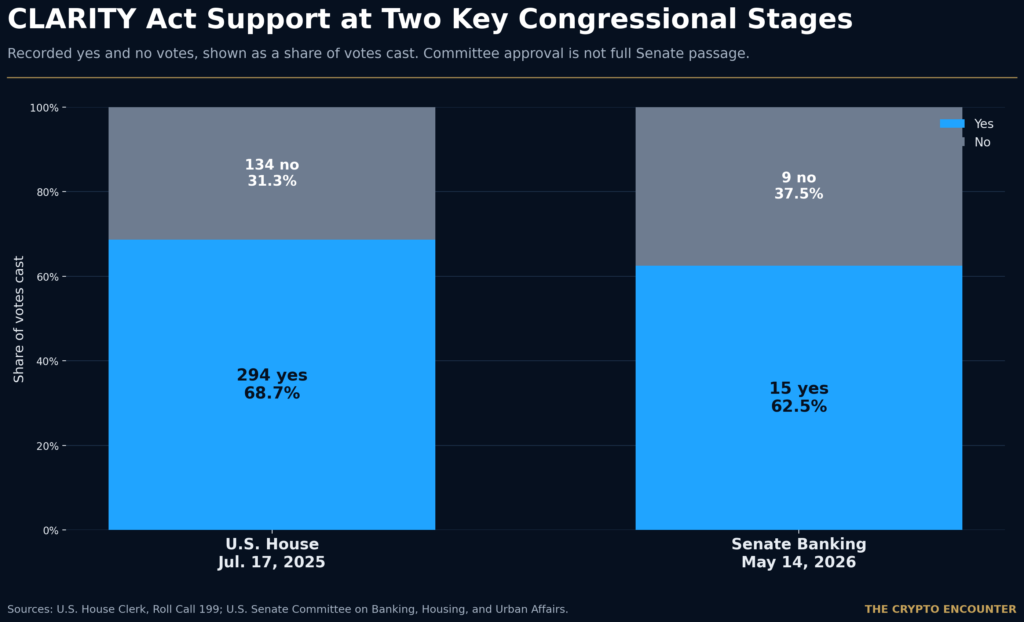
The House passed H.R. 3633 on July 17, 2025, by 294 votes to 134. Seventy-eight Democrats joined all 216 voting Republicans in supporting it.
The Senate Banking Committee then approved an amended version on May 14, 2026, by a 15-9 vote. The committee said the legislation would move to the Senate floor. That committee action did not constitute Senate passage.
Separately, the Senate Agriculture Committee advanced the Digital Commodity Intermediaries Act on January 29, 2026. That measure would give the CFTC authority over spot digital-commodity intermediaries, require customer-asset segregation and disclosures, and direct the SEC and CFTC to coordinate on joint rules.
How Senate leaders combine or coordinate these approaches remains central to the bill’s path.

The SEC-CFTC Split Is About More Than Definitions
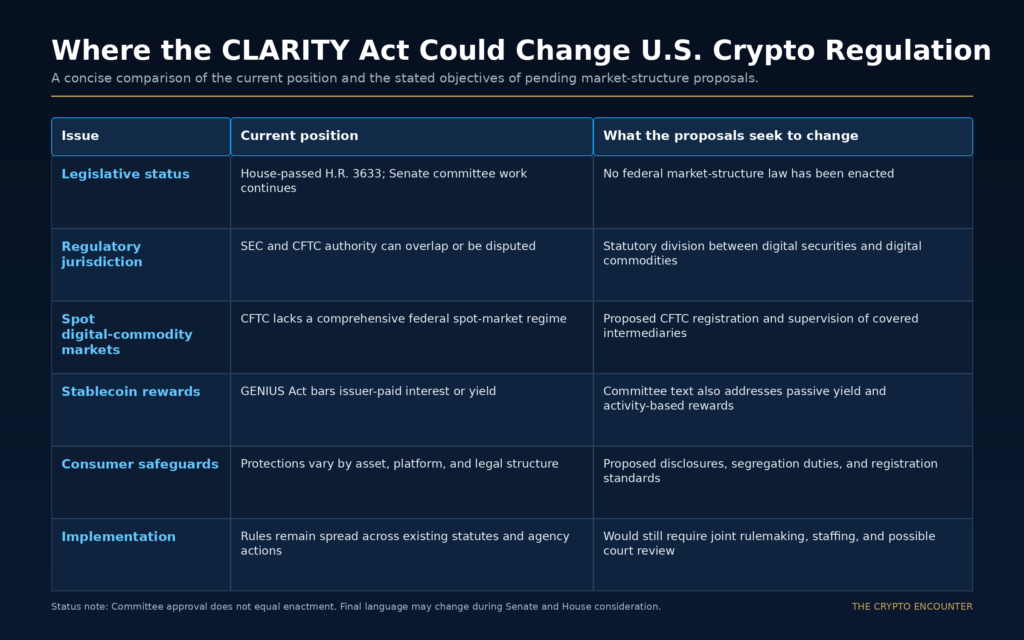
The House legislation and Senate proposals seek to distinguish digital commodities from digital assets that remain subject to securities law.
This distinction affects how assets are offered, sold, listed, traded, and disclosed. It also affects which firms must register with which agency.
Supporters say clearer statutory tests could reduce reliance on enforcement cases and provide businesses with a more predictable compliance path. That is a policy argument, not a guaranteed result.
New legislation can resolve some disputes while creating others. Terms such as decentralization, control, maturity, affiliation, and investment-contract status may still require agency interpretation or court review.
The SEC also has a long-established securities-disclosure and investor-protection mandate. The CFTC has extensive derivatives expertise, but Congress would be giving it a larger role in spot digital-commodity markets. The Agriculture Committee proposal addresses part of that capacity concern by creating a new funding stream for the agency. Whether the final resources prove sufficient would depend on appropriations, staffing, registration volume, and market complexity.

Stablecoin Rewards Have Become a Banking Battle
Stablecoin rewards are among the bill’s most commercially important provisions.
The Senate Banking Committee’s May 2026 section-by-section summary says covered digital-asset service providers and their affiliates could not pay U.S. customers passive, deposit-like interest or yield on payment-stablecoin balances. However, the proposal would permit bona fide rewards tied to activity or transactions under joint SEC, CFTC, and Treasury rules.
That distinction matters because platforms can structure customer incentives in several ways. A passive return for holding a token can resemble interest. A payment rebate, loyalty benefit, or transaction reward may operate differently.
The GENIUS Act, signed into law on July 18, 2025, already prohibits permitted payment stablecoin issuers from paying interest or yield directly to holders. It also requires issuers to back outstanding stablecoins at least one-to-one with specified reserve assets. Yet it does not explicitly resolve every affiliate or third-party arrangement, which is one reason the CLARITY debate has focused on this area.
Banks argue that attractive stablecoin rewards could pull deposits away from traditional accounts. Crypto companies may view broad restrictions as a barrier to competition.
Both positions represent interesting policy arguments.
A White House Council of Economic Advisers model published in April 2026 estimated that eliminating stablecoin yield would raise bank lending by $2.1 billion under its baseline assumptions, equal to 0.02%. The same analysis estimated a net welfare cost of $800 million. These are model outputs, not observed results, and they depend on assumptions about stablecoin growth, reserve composition, and bank behavior.
Stablecoins Are Not Bank Deposits
The competition between stablecoins and banks should not obscure key legal differences.
A permitted issuer’s one-to-one reserves may support redemption. However, reserve backing does not automatically remove operational, custody, liquidity, fraud, or platform risk.
Stablecoin holders may also face exposure to an intermediary that is separate from the issuer. A wallet, exchange, lending platform, or rewards provider can introduce additional counterparty risk.
Most importantly, a stablecoin balance should not be described as an FDIC-insured bank deposit unless a specific product and legal structure provide that protection. Similar-looking returns can sit inside very different regulatory and risk frameworks.
Crypto Companies Do Not Share One Position
The industry often speaks publicly in favor of “clarity,” but firms do not necessarily agree on the details.
An exchange may prioritize asset-listing rules and trading permissions. A stablecoin issuer may focus on reserve, redemption, and distribution rules. A tokenization company may care most about securities market infrastructure. DeFi developers may emphasize software protections, privacy, and non-custodial activity.
Banks also have competing interests. Some may resist stablecoin rewards that could draw deposits away. Others are developing custody, tokenization, blockchain settlement, or tokenized-deposit services.
Therefore, the policy conflict is not simply government against industry. It is also a contest among business models operating across the same financial system.
Risks, Limits, and Unanswered Questions
Several issues remain unresolved.
First, the full Senate has not passed the CLARITY Act. Committee approval is significant, but it is not enactment. Senators may amend the text, delay consideration, or fail to assemble the votes needed to overcome procedural barriers.
Second, the House and Senate versions differ. If the Senate passes an amended bill, the House would need to approve that version, or the chambers would need to reconcile their differences.
Third, agency implementation could take considerable time. The proposals call for SEC-CFTC coordination and multiple rulemakings. Registration standards, disclosures, mixed-asset transactions, stablecoin rewards, and jurisdictional boundaries will require detailed rules.
Fourth, clearer classifications cannot eliminate fraud, hacks, insolvency, custody failures, market manipulation, or misleading advertising.
Finally, political ethics provisions remain under negotiation, according to FXStreet. Their final scope could affect both bipartisan support and public confidence.
What Readers Should Watch Next

The most useful signals will come from the legislative process, not short-term token-price moves.
Readers should monitor:
- any revised Senate text;
- an official floor schedule;
- amendments involving stablecoin rewards and public-official ethics;
- coordination between the Banking and Agriculture Committee frameworks;
- evidence of sufficient bipartisan support;
- House action on any Senate amendments;
- SEC and CFTC implementation timelines;
- funding and staffing plans for expanded supervision.
These developments will show whether Congress is creating a workable federal structure or simply moving the next set of disputes into agency rulemaking and federal court.
Trump’s intervention increases political pressure. It does not decide the outcome. The defining question remains how Congress will distribute authority, responsibility, and commercial opportunity across U.S. digital finance.
Frequently Asked Questions
What is the CLARITY Act?
The Digital Asset Market Clarity Act is proposed U.S. legislation that would establish rules for digital commodities, digital-asset intermediaries, and the division of authority between the SEC and CFTC.
Has the CLARITY Act been passed by Congress?
No. The House passed H.R. 3633 on July 17, 2025. The Senate Banking Committee advanced an amended version on May 14, 2026, but the full Senate has not passed it.
What was the Senate Banking Committee vote?
The committee approved the legislation by 15-9 on May 14, 2026.
Does the bill allow stablecoin yield?
The committee-approved Senate language would prohibit covered providers and affiliates from paying passive, deposit-like yield. It would allow qualifying activity or transaction-based rewards under future joint regulations. The language could still change before enactment. Are stablecoins insured like bank deposits?
Not generally. One-to-one reserve requirements and redemption rights do not automatically provide FDIC deposit insurance. Users must examine the issuer, platform, custody structure, and applicable protections.
What should readers monitor next?
Key signals include revised bill text, an official Senate floor schedule, amendments, bipartisan vote support, House-Senate reconciliation, and the SEC-CFTC rulemaking process.
Disclaimer
This article is for informational and educational purposes only. It does not provide financial, investment, legal, tax, or accounting advice. Cryptocurrency and digital asset markets involve risk, including possible loss of capital. Readers should conduct their own research before making any financial decision.