

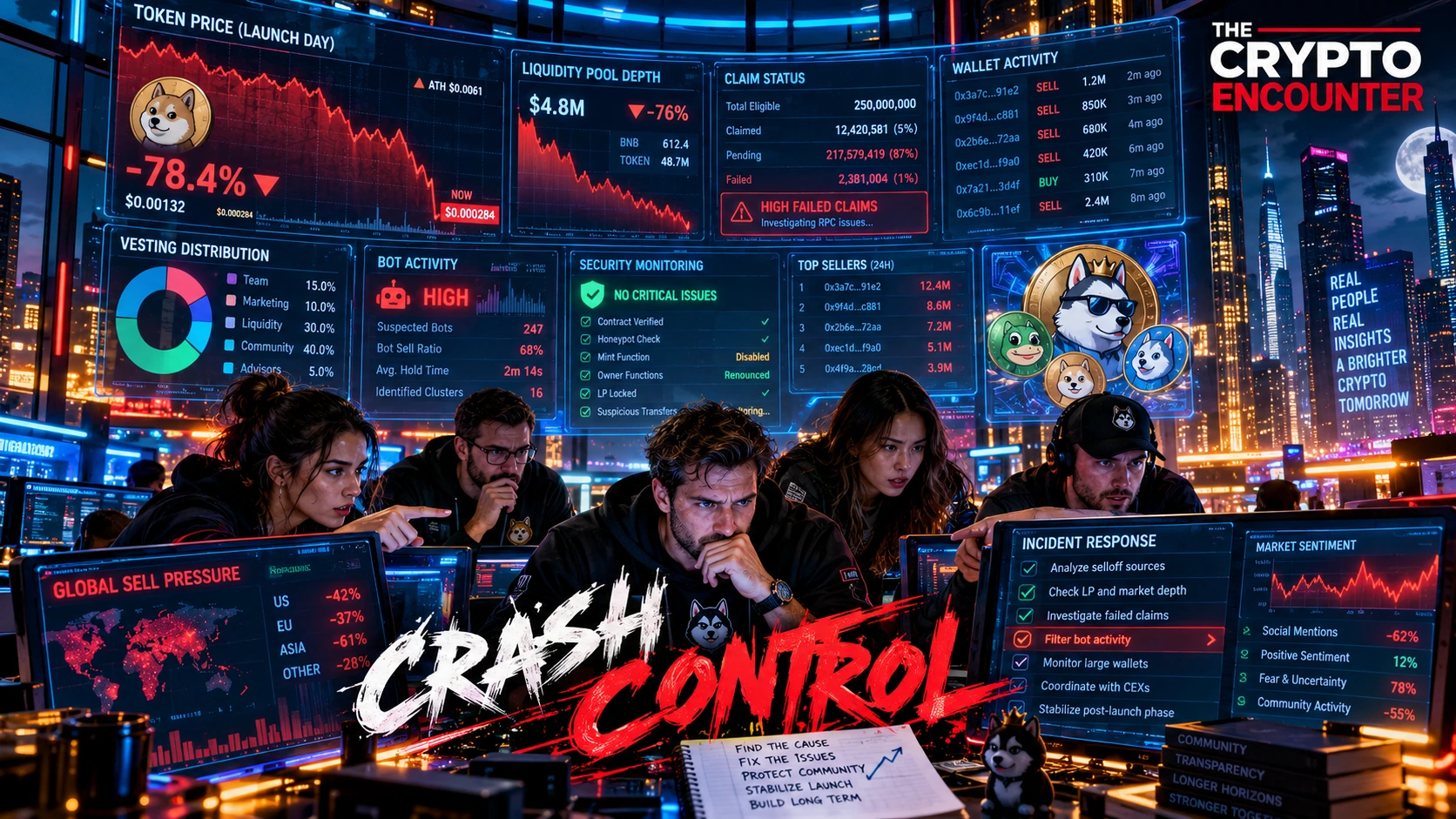
DUBAI, United Arab Emirates, October 2, 2026: A meme coin presale can spend months building a community, raising money, negotiating listings, completing audits and preparing for launch, only to watch the entire project begin unraveling within its first hour of public trading.
The chart plunges. Holders cannot claim tokens. Liquidity looks thinner than expected. Bots dominate the opening blocks. Telegram fills with accusations. Screenshots spread faster than official explanations. Someone notices a large wallet moving tokens. The website starts timing out. A market maker, exchange, developer or liquidity provider stops answering at exactly the wrong moment.
At that point, founders face a dangerous temptation: save the price.
That can be the wrong objective.
A falling token price is sometimes evidence of a broken launch. It can also be genuine price discovery. The project cannot legitimately manufacture demand simply because the open market values the token below its presale or advertised launch price.
The founder’s real job is to determine whether something has actually failed.
Was the initial liquidity too shallow? Was the pool seeded at the wrong ratio? Did unrestricted token unlocks create a supply shock? Are automated traders exploiting predictable transactions? Did the claim system fail? Was the frontend compromised? Did insiders receive tokens earlier than expected? Has the community misunderstood the vesting schedule? Is a bridge, exchange or blockchain congested? Or is the token simply finding a lower market-clearing price than the project hoped for?
Those situations require very different responses.
This guide explains how a meme coin team can prepare for launch-day stress, diagnose a crisis quickly, protect users and treasury assets, repair operational failures and communicate clearly without crossing the line into deceptive or manipulative market activity.
Important: This article is educational. It does not recommend manipulating, supporting or targeting the market price of any crypto asset. Laws governing token offerings, trading, market manipulation, securities, financial promotions and virtual-asset services vary by jurisdiction. Projects should obtain qualified legal, compliance and technical advice relevant to their structure.
What Does a Meme Coin Launch-Day Collapse Actually Mean?
The word “collapse” is usually used too loosely.
A token dropping 30% after launch is not necessarily experiencing the same failure as a token whose liquidity pool was configured incorrectly. A functioning market that discovers an uncomfortable price is different from a broken claim contract that prevents most presale buyers from receiving tokens.
Before a team intervenes, it needs to classify the problem.
| Launch-Day Symptom | Possible Cause | First Question |
|---|---|---|
| Price falls sharply | Price discovery, excessive valuation, thin liquidity, large sellers or poor demand | Is the market functioning correctly? |
| Extreme slippage | Insufficient liquidity or rapidly changing pool balance | How deep is executable liquidity? |
| Price spikes and immediately crashes | Opening-price mismatch, bots, sniping, concentrated supply or shallow pool | Who acquired and sold the early circulating supply? |
| Presale holders cannot claim | Frontend, RPC, contract, allocation or configuration failure | Is the problem on-chain or only in the interface? |
| Unexpected sell pressure | Incorrect vesting, insider unlocks, bot allocations or compromised wallets | Where are the selling tokens coming from? |
| Transactions fail | Network congestion, gas configuration, RPC failure or contract logic | Can successful transactions be reproduced independently? |
| Community panic | Missing information, phishing, rumors or contradictory announcements | What facts are verified right now? |
| Funds move unexpectedly | Treasury operation, compromised key, liquidity deployment or unauthorized transfer | Was the transaction authorized? |
Diagnosis comes before rescue.
The First Rule: Do Not Try to Save the Chart
The chart is the most visible symptom of a launch, so it tends to command everyone’s attention.
Founders watch it. Presale buyers watch it. Influencers screenshot it. Community members narrate every candle. A sharp fall can therefore create enormous pressure to make the chart look better immediately.
That pressure can lead to dangerous decisions.
A team should not respond by creating fake volume, arranging undisclosed wash trading, using related wallets to manufacture demand, publishing invented partnership announcements, concealing treasury purchases, telling influencers to coordinate a pump, resetting a supposedly fixed launch price or falsely claiming that the token is “almost sold out.”
Those actions do not repair the market.
They obscure what the market is telling everyone.
A legitimate rescue focuses on whether the infrastructure, liquidity, distribution, security, disclosures and user experience are working as represented.
If all of those systems are working and genuine sellers simply outnumber genuine buyers, the token may be going through price discovery rather than a technical collapse.
The Seven Launch-Day Failures That Can Destroy a Meme Coin
1. The Opening Valuation Was Too Aggressive
A presale can create its own valuation problem before the token ever reaches a decentralized exchange.
Imagine that the project sells several presale stages at progressively higher prices and promotes a planned launch price above the final stage.
Those prices were determined by the issuer.
The public market was not involved.
At TGE, an independent market finally gets to answer a question the presale could not: what are unrelated buyers and sellers actually willing to pay?
If that answer is significantly below the advertised launch price, the chart can collapse even though every smart contract works perfectly.
This is precisely why price discovery deserves more attention before launch. Uniswap Labs highlighted the problem while introducing its Continuous Clearing Auction infrastructure in 2026:
“Fixed price sales force teams to select arbitrary prices without market input.”
Uniswap’s on-chain auction framework is one example of an alternative model designed around market-driven price discovery and post-auction liquidity rather than simply declaring a price and expecting the market to accept it.
A project does not have to use that specific mechanism. The broader lesson is more important: the opening price needs an economic rationale.
2. The Token Has Too Little Launch Liquidity
Market capitalization and liquidity are different things.
A project can advertise a $50 million fully diluted valuation while launching with only a small amount of executable liquidity.
That creates fragile trading.
Suppose, purely for illustration, that an automated market maker begins with 250 million tokens and $250,000 of stablecoin liquidity, establishing an approximate starting ratio of $0.001 per token.
Under a simplified constant-product model and ignoring fees, a 25-million-token sale into that pool could move the instantaneous pool price to roughly $0.000826.
That is about a 17% decline generated by one trade equal to only 10% of the original token reserve.
The project did not necessarily get hacked.
The pool simply lacked the depth to absorb the order without substantial price impact.
The Crypto Encounter’s guide to DEX slippage and price impact explains why a blockchain transaction can execute exactly as designed while producing a much worse economic result than users expected.
3. Too Much Supply Becomes Tradable at Once
Launch-day liquidity must be evaluated against launch-day circulating supply.
A project can provide what looks like substantial liquidity while simultaneously releasing far more sellable tokens than the pool can absorb.
Potential sources include:
- presale allocations;
- private-round allocations;
- team tokens;
- adviser tokens;
- affiliate rewards;
- airdrop allocations;
- community rewards;
- market-making inventory;
- liquidity allocations.
If the tokenomics document says only 10% of presale holdings unlock at TGE but the claim contract accidentally releases 100%, the project has an operational emergency.
If the documents accurately disclosed a 100% unlock and holders immediately sell, the problem is the economic design rather than a software malfunction.
4. Bots Control the Opening Minutes
Public blockchain launches can attract automated traders that respond far faster than ordinary users.
Some attempt to enter as soon as trading becomes available. Others search for arbitrage opportunities. Certain transaction-ordering strategies can extract value from users trading through public mempools.
Ethereum’s official documentation explains how maximal extractable value, or MEV, can include DEX arbitrage and sandwich trading. In a sandwich transaction, a searcher can trade immediately before and after another user’s swap, worsening that user’s execution.
This matters during a meme coin launch because the first minutes can combine unusually high demand, shallow liquidity, large transactions and inexperienced traders.
The result can be violent price movement that looks like organic demand and collapse even when automated strategies contributed substantially to the path.
5. The Claim System Fails
A claim failure can be more damaging than an early price decline.
If only some presale participants can access tokens, the market begins with unequal distribution.
Imagine that 20% of eligible wallets successfully claim while the other 80% encounter a frontend error.
The first group can trade.
The second group cannot.
The market is now discovering a price using only a fraction of the intended holder base.
When the remaining 80% finally gain access, another wave of supply may hit the market.
A claim problem therefore affects technology, fairness, circulating supply and market structure simultaneously.
6. A Security Incident Becomes a Market Incident
A compromised deployer key, treasury wallet, frontend, DNS account or social-media account can change the entire launch within minutes.
Security failures do not need to attack the blockchain itself.
The Crypto Encounter has repeatedly examined why a secure blockchain does not automatically create a safe crypto experience. A compromised interface can present the wrong contract address while the underlying blockchain continues operating correctly.
During launch day, that distinction becomes critical because thousands of users may be actively looking for claim links, contract addresses and trading instructions.
7. Communication Fails Faster Than Technology
A five-minute outage can become a five-hour reputational crisis if nobody explains it.
Community members fill an information vacuum with theories.
Scammers fill it with fake support accounts.
Influencers fill it with screenshots.
Competitors may amplify the worst interpretation.
A founder who starts improvising explanations can make the situation worse by contradicting the developer, market maker or exchange.
The project’s crisis architecture therefore needs a single source of truth.
The 72-Hour Launch Stress Test
The cheapest launch-day rescue happens before launch day.
Seventy-two hours before TGE, the team should stop treating the launch as a marketing event and begin treating it as an operational event.
Reconcile every token
Start with the supply ledger.
The team should be able to account for:
- total supply;
- presale allocation;
- private allocation;
- team allocation;
- adviser allocation;
- community allocation;
- treasury allocation;
- liquidity allocation;
- burned tokens;
- vesting-contract balances;
- immediately circulating tokens.
The total needs to reconcile mathematically.
Model the first sellers
Do not model only the happy scenario.
Ask what happens if 5%, 10%, 20% or 30% of unlocked presale tokens are sold during the first hour.
Run those amounts through the planned liquidity structure.
Measure price impact.
If a perfectly plausible amount of selling destroys the market, the problem existed before launch.
Rehearse claiming from fresh wallets
Test the actual production flow with wallets that were not involved in development.
Confirm:
- correct blockchain;
- correct contract;
- gas requirements;
- allocation;
- vesting calculation;
- claim amount;
- transaction confirmation;
- dashboard update;
- block explorer visibility.
Test the website under launch traffic
A site that handles 200 simultaneous users during testing may behave very differently when tens of thousands arrive within minutes.
Stress-test the application, APIs, RPC providers, database, CDN and authentication components.
Lock critical communications
Publish the official contract address, official domain, correct blockchain and legitimate support channels in advance where operationally appropriate.
Users should not have to ask a stranger in Telegram for the token contract.
The Launch-Day War Room Needs Named Owners
A founder should not personally handle every problem.
A launch team needs named decision owners before the opening block.
| Function | Launch-Day Responsibility |
|---|---|
| Launch commander | Coordinates decisions and escalation |
| Blockchain lead | Contracts, transactions, claims and deployment |
| Security lead | Wallets, access, exploits and incident containment |
| Liquidity lead | Pool status, depth, market infrastructure and reconciliations |
| Treasury lead | Authorized project fund movements |
| Compliance/legal lead | Material changes, disclosures and jurisdiction issues |
| Community lead | Official updates and support coordination |
| Data lead | On-chain and platform evidence |
The person posting on X should not independently decide what caused a smart-contract failure.
The developer should not independently promise refunds.
The market operator should not independently change tokenomics.
First 15 Minutes: Diagnose Before Acting
The first fifteen minutes should be used to establish facts, not defend the project publicly.
Check the blockchain
Confirm:
- token contract address;
- pool address;
- current reserves;
- circulating supply;
- largest transfers;
- claim transactions;
- administrative transactions;
- treasury movements;
- vesting-contract behavior.
Check the frontend separately
If the website says claims are failing, test whether the contract itself is failing.
A broken frontend is a different problem from a broken contract.
Check liquidity before checking the price
Determine the actual reserves and trading depth.
A 40% decline in a $50,000 pool tells a different story from the same percentage decline in a market containing millions of dollars of executable liquidity.
Check who is selling
Do not start with assumptions.
Trace the actual token flows.
Is sell pressure coming from thousands of presale holders?
One private-sale wallet?
An unlocked team wallet?
An automated trader?
A compromised address?
The answer changes the rescue plan.
First 15 Minutes: What the Team Should Not Do
Panic creates expensive blockchain transactions.
Avoid moving treasury funds between unfamiliar wallets simply because social media is demanding action.
Avoid sending funds to an address pasted into a group chat.
Avoid increasing token allowances casually.
Avoid asking one founder to control deployment, treasury, liquidity and communications simultaneously.
The Crypto Encounter’s DeFi wallet separation rule explains why wallets exposed to routine interactions should not automatically control the organization’s most valuable reserves.
First Hour: Separate Market Stress From System Failure
At the end of the first diagnostic period, classify the incident into one of three buckets.
Category A: The market works, but the price is falling
Trading functions.
Claims function.
The contract behaves correctly.
Supply matches disclosures.
Liquidity exists.
There is simply more selling than buying.
This is primarily a market event.
The project should resist the urge to disguise it as a technical emergency.
Category B: Market infrastructure is malfunctioning
Examples include:
- incorrect liquidity configuration;
- wrong pool;
- claim failures;
- wrong vesting release;
- website failure;
- RPC failure;
- exchange integration issue;
- incorrect token metadata;
- bridge problem.
This requires technical remediation and transparent communication.
Category C: Security or integrity is compromised
Examples include:
- unauthorized minting;
- private-key compromise;
- malicious contract behavior;
- treasury theft;
- frontend compromise;
- unauthorized token transfers;
- DNS hijacking;
- fake official announcements.
This requires immediate containment.
Should a Project Add More Liquidity During a Crash?
Sometimes additional liquidity can improve market depth.
That does not mean every falling token should receive emergency treasury liquidity.
The team first needs to understand why the pool is shallow and whether additional liquidity was contemplated within its treasury and launch policies.
If additional project-owned liquidity is legitimate and permitted, execution should be documented and disclosed appropriately rather than disguised as unrelated market demand.
Adding liquidity changes the market’s ability to absorb trades.
It does not create genuine demand.
This is an important distinction.
Liquidity can reduce price impact
A deeper pool generally allows larger orders to execute with less movement.
That can make trading more functional.
Liquidity cannot force holders to stay
If holders continue selling, the additional liquidity can simply provide a larger pool into which they sell.
The project can therefore spend treasury assets without solving the underlying demand problem.
Liquidity provision creates its own risk
Assets deployed into an automated market maker remain exposed to changing pool composition and relative prices. The Crypto Encounter’s guide to impermanent loss and liquidity-provider risk explains why liquidity should not be treated as a passive savings balance.
When Adding Liquidity Is the Wrong Rescue
More liquidity may be inappropriate when:
- the token contract may be compromised;
- unauthorized minting remains possible;
- the pool configuration is still uncertain;
- there is a major unexplained insider transfer;
- the treasury wallet may be compromised;
- launch terms prohibit the proposed action;
- legal or regulatory implications have not been reviewed;
- the team is effectively trying to manufacture a particular market price.
Pouring additional treasury capital into an unresolved exploit can increase the amount available to attackers.
What If the Token Launch Price Was Simply Too High?
This can be the hardest conclusion for a founder to accept.
The market may simply disagree with the presale valuation.
If that happens, a legitimate response is not to pretend that the lower price is impossible.
The project can instead explain:
- circulating supply;
- vesting;
- treasury holdings;
- liquidity;
- actual product status;
- development roadmap;
- material risks.
Then the market decides.
A sustainable project needs to survive a token price that disappoints the founders.
How to Handle a Claim Failure Without Creating a Second Crisis
If claiming fails, the objective is fairness and correct distribution rather than speed at any cost.
Step 1: Determine whether allocations remain safe
Confirm whether tokens remain in the intended distribution or vesting contract.
Step 2: Determine whether the error is on-chain
A frontend can be repaired more easily than an immutable contract containing incorrect state.
Step 3: Publish a status message
Tell users:
- what is affected;
- what is not affected;
- whether allocations remain recorded;
- whether users should stop interacting;
- where the next official update will appear.
Step 4: Extend the claim window where appropriate
Users should not lose allocations because the project’s infrastructure failed during a short deadline.
Step 5: Warn about fake claim pages
A real claim outage creates ideal conditions for impersonators.
The Crypto Encounter’s analysis of AI-powered crypto impersonation and scam bots illustrates why convincing fake support can appear almost immediately around confusion and urgency.
How to Handle a Vesting Error
A vesting mistake can create a sudden supply shock.
If more tokens became transferable than public documentation promised, the team needs to establish exactly which addresses received excess availability.
Do not quietly change the documentation to match what happened.
Preserve the historical version.
Determine:
- what the published schedule promised;
- what the contract actually executed;
- which allocation groups were affected;
- whether excess tokens moved;
- whether remediation is technically possible;
- what rights holders have;
- whether the error requires direct notification.
If tokens have already been transferred to independent wallets, technical reversibility may be limited or nonexistent.
How to Handle Bots, Snipers and MEV
The worst time to design an anti-bot strategy is after public trading begins.
Measures that change transfer behavior after launch can create additional problems, particularly when buyers did not know those controls existed.
A stronger design addresses opening-market mechanics beforehand through mechanisms such as transparent price discovery, appropriate liquidity depth, clearly disclosed transfer rules and launch infrastructure designed to reduce speed advantages.
Once the market is live, teams should avoid improvising hidden taxes, undisclosed blacklists or selective transfer restrictions merely to punish addresses they dislike.
Those controls can damage trust and may create additional legal or technical questions.
For users, loose slippage settings can make volatile opening trades particularly expensive. As The Crypto Encounter’s DEX slippage analysis explains, increasing tolerance simply to force a transaction through can expose the trader to a significantly worse execution price.
What If the Smart Contract Is Actually Compromised?
A confirmed contract exploit changes priorities immediately.
The price chart becomes secondary.
The priorities become:
- containment;
- asset protection;
- evidence preservation;
- user protection;
- technical diagnosis;
- communication;
- recovery planning.
If a properly designed and disclosed emergency pause mechanism exists, authorized operators may be able to use it according to the project’s governance and legal framework.
If no such capability exists, the team should not pretend that it can freeze an immutable system.
The response may instead involve interfaces, exchanges, liquidity providers, infrastructure providers and direct user warnings.
Never deploy an unaudited emergency contract casually
A rushed replacement can introduce new vulnerabilities.
Every emergency deployment should still receive independent technical scrutiny proportionate to the risk.
Protect the Treasury While Everyone Is Distracted
A launch crisis creates a perfect environment for social engineering.
The finance team receives messages saying:
“Send liquidity here immediately.”
“The developer needs access.”
“The exchange changed its wallet.”
“Sign this transaction to fix the pool.”
“Connect the treasury wallet so we can troubleshoot.”
The greater the urgency, the stronger verification should become.
Use known communication channels.
Verify destination addresses independently.
Require the normal approval threshold.
Do not downgrade multisignature controls because the market is moving quickly.
The Crypto Encounter’s crypto safety checklist is written primarily for users, but its central principle applies equally to project teams: urgency should increase verification rather than reduce it.
Do Not Keep the Entire Launch Treasury on an Exchange
A centralized exchange may be necessary for parts of a launch, particularly when preparing a listing or converting assets.
That does not make it an ideal repository for the entire treasury.
The Crypto Encounter explains why an exchange balance differs from direct on-chain control. Exchange access depends on the platform’s systems, custody arrangements, withdrawals, compliance controls and operational availability.
A listing-day account review or withdrawal restriction can therefore become a project-level liquidity problem if the team concentrated all operational assets on one platform.
Regulatory status does not eliminate those dependencies either. Our analysis of why regulated crypto exchanges remain exposed to custody, liquidity and operational risks provides the wider context.
How to Communicate During the First Hour
A crisis update should be short, factual and timestamped.
It should not speculate.
A useful structure is:
Status: We are investigating an issue affecting token claims.
Confirmed: Presale allocations remain recorded and the distribution contract retains the expected token balance.
User action: Do not use claim links sent by private message. Use only the official domain.
Next update: We will publish another verified update at 14:30 UTC or earlier if material information becomes available.
Notice what this format does not say.
It does not promise a price recovery.
It does not blame hackers before an exploit is confirmed.
It does not tell holders to buy.
It does not say “everything is fine” when the team does not yet know that.
Do Not Let Ten People Become Ten Official Sources
A founder posts one explanation.
The Telegram administrator posts another.
A developer says something different in Discord.
An influencer says the issue has been fixed.
The official X account says engineers are still investigating.
At that point, the communications failure becomes measurable.
Establish one canonical status page or official announcement channel.
All moderators and representatives should link back to it.
Why Overconfidence Becomes Especially Dangerous During TGE
Months of preparation can create a false assumption that the team understands every possible failure.
Launch day quickly disproves that.
The Crypto Encounter’s analysis of confidence versus overconfidence in crypto applies to project operators as much as individual users.
When evidence contradicts the launch plan, change the diagnosis.
Do not force reality to match the plan.
Emergency Communications Can Have Legal Consequences
Founders should remember that crisis marketing is still marketing.
If a team suddenly promises future development, guarantees a recovery, announces a buyback, changes economic rights or makes new claims about what management will do to produce value, those statements may carry legal significance depending on the jurisdiction and token structure.
The U.S. Securities and Exchange Commission’s September 2026 crypto-asset FAQ specifically notes that whether promotional and marketing communications constitute representations or promises of essential managerial efforts depends on the facts and circumstances.
A frantic Telegram post should therefore not create promises the legal documents never made.
What If the Exchange Listing Is Delayed?
A centralized exchange delay can create confusion when marketing has conditioned holders to expect trading at an exact time.
First determine the status precisely.
There is a difference between:
- token deposits delayed;
- trading delayed;
- withdrawals delayed;
- technical integration incomplete;
- listing suspended;
- listing canceled.
Do not describe one as another.
If DEX trading is already live while the centralized listing is delayed, users should understand that the two markets may develop different liquidity and pricing conditions.
What If a Large Presale Wallet Starts Dumping?
Do not immediately accuse the wallet of being an insider.
Trace it.
Compare the address against:
- presale records;
- private-sale allocations;
- team allocations;
- treasury wallets;
- market-making inventory;
- vesting contracts;
- known exchange addresses.
If it is a legitimate participant acting within the published terms, the project may have no basis for preventing the sale.
If it is a team wallet that should have been locked, the project has a different and much more serious disclosure problem.
What If the Project Needs to Delay Trading?
A delay before public trading can be preferable to launching a market known to be technically broken.
Once unrestricted trading has begun, trying to reverse the launch becomes far more difficult.
If the project knows before activation that:
- claims are incorrect;
- pool balances are wrong;
- contracts contain a critical vulnerability;
- vesting is misconfigured;
- the wrong token is being listed;
- a core signer is compromised;
then proceeding purely because marketing promised a particular minute can compound the damage.
A delay will disappoint people.
A preventable exploit can destroy the project.
A Practical Launch-Day Decision Tree
| If This Happens | Primary Response | Do Not |
|---|---|---|
| Price falls but everything functions | Verify supply, liquidity and disclosures; allow price discovery | Manufacture volume or secretly prop up the chart |
| Liquidity is shallower than planned | Reconcile pool funding and approved liquidity plan | Blindly deploy treasury assets |
| Claim frontend fails | Protect allocations, fix interface, extend access as appropriate | Tell users to use unofficial links |
| Claim contract fails | Stop unsafe interactions and conduct technical review | Rush unaudited replacement code |
| Unexpected unlock occurs | Trace allocations and disclose material error | Rewrite historical tokenomics |
| Frontend or domain compromised | Warn users immediately and isolate compromised infrastructure | Assume the smart contract is automatically compromised too |
| Treasury wallet compromised | Activate incident response and protect unaffected assets | Expose additional wallets to the same environment |
| Exchange listing delayed | State the exact affected service and current status | Call discussions a confirmed launch |
| Rumor spreads | Publish evidence-based clarification | Fight anonymous users individually |
The First Six Hours: Move From Crisis Response to Evidence
By this stage, the project should be able to produce a verified launch dashboard internally.
It should contain:
- current circulating supply;
- tokens claimed;
- tokens still locked;
- number of claiming wallets;
- pool reserves;
- trading volume;
- largest token transfers;
- treasury balances;
- liquidity ownership;
- contract status;
- website status;
- exchange status;
- known incidents.
Facts reduce the amount of crisis management that depends on emotion.
The First 24 Hours: Publish the Numbers That Matter
A transparent launch-day report can be far more valuable than another promotional post.
Depending on what is appropriate and safe to disclose, a project can report:
- total tokens distributed;
- circulating supply;
- vesting status;
- liquidity status;
- verified contract addresses;
- claim participation;
- known technical issues;
- resolved technical issues;
- material treasury activity;
- next operational milestone.
If something went wrong, say so.
Credibility is easier to rebuild after admitting a verifiable mistake than after the community discovers that the project concealed it.
How to Measure Whether the Rescue Is Working
Do not use token price as the only recovery KPI.
| Metric | What It Shows |
|---|---|
| Claim success rate | Whether participants can access allocations |
| Failed transaction rate | Technical reliability |
| Liquidity depth | Market capacity |
| Price impact at defined trade sizes | Practical tradability |
| Circulating supply reconciliation | Distribution accuracy |
| Unexplained wallet movements | Operational or security risk |
| Support backlog | User-impact severity |
| Website uptime | Frontend availability |
| Confirmed security incidents | System integrity |
| Community misinformation rate | Communications effectiveness |
A project can recover operationally even while the token remains below its original launch price.
That distinction matters.
What Founders Should Never Do to “Save” a Meme Coin
Some rescue tactics can damage a project more than the original collapse.
Do not fake trading volume
Volume should represent genuine market activity.
Do not use undisclosed related wallets to manufacture demand
Treasury activity should not masquerade as unrelated community buying.
Do not secretly change vesting
Token distribution affects every holder.
Do not invent an exchange listing
A discussion, application or technical integration is not necessarily a confirmed listing.
Do not blame “FUD” for every legitimate question
Questions about liquidity, insider allocations, treasury transfers and contract privileges deserve factual answers.
Do not delete the original documentation
Maintain version history when corrections are required.
Do not expose treasury keys to emergency tools
Crisis conditions make phishing especially dangerous.
Do not guarantee recovery
No founder controls the future market price.
A Founder Cannot Rescue a Project Nobody Trusts
Launch-day recovery ultimately depends on credibility.
That credibility may have been built months earlier through accurate fundraising figures, verifiable founders, consistent tokenomics, documented vesting, audited code, identifiable entities and realistic communication.
A professional website cannot manufacture those things after a crisis begins.
The Crypto Encounter’s investigation into AI-generated token teams and synthetic founder identities illustrates how easily superficial credibility can now be created.
The stronger defense is evidence that existed before the emergency.
Why a Good Launch Has Multiple Layers of Redundancy
The entire project should not depend on one:
- RPC provider;
- developer;
- private key;
- market maker;
- exchange;
- social account;
- server;
- domain administrator;
- treasury wallet;
- person who understands the deployment.
Redundancy does not mean giving everybody administrative access.
It means ensuring that the organization can continue safely if one dependency fails.
The Postmortem Begins While the Launch Is Still Fresh
Within the first few days, record exactly what happened.
Preserve:
- transaction hashes;
- deployment records;
- contract versions;
- server logs;
- status updates;
- screenshots;
- support tickets;
- exchange communications;
- treasury approvals;
- incident timelines;
- internal decisions.
Do not rely on everyone’s memory a month later.
The Questions a Proper Launch-Day Postmortem Should Answer
- What happened?
- When did it begin?
- How was it detected?
- Which users were affected?
- Which assets were affected?
- Was money lost?
- Was any vulnerability exploited?
- Did public documentation match actual behavior?
- What decisions reduced the damage?
- What decisions increased it?
- What controls failed?
- What will change before the next major release?
The postmortem should distinguish confirmed facts from unresolved questions.
The Strongest Meme Coin Rescue Starts Before the Presale Ends
The most important conclusion is uncomfortable because it gives founders less control than launch marketing suggests.
You cannot guarantee a successful token price.
You can design a more resilient launch.
You can enter TGE with realistic valuation assumptions, enough liquidity for plausible trading activity, enforceable vesting, reconciled allocations, protected treasury wallets, tested contracts, hardened infrastructure, clear user instructions and a functioning incident-response team.
You can know exactly who has authority to act.
You can prepare users for claims before scammers prepare fake ones.
You can test the system under failure conditions.
You can tell the truth when something breaks.
Those things do not guarantee that the market will value the token where founders hoped.
They can prevent a disappointing chart from becoming an existential operational crisis.
Frequently Asked Questions About Meme Coin Launch-Day Collapse
Why do meme coins often fall immediately after launch?
Possible causes include aggressive presale valuation, early holders taking profits, shallow liquidity, excessive initial circulating supply, bot activity, uneven token distribution and ordinary market price discovery. A falling price does not by itself prove that the launch failed technically.
Can a meme coin recover after a bad launch?
It can, but no recovery is guaranteed. The prospects depend on the cause of the failure. A frontend outage may be repairable relatively quickly. A broken token economy, compromised contract, depleted treasury or severe loss of trust can be much harder to overcome.
Should the team buy its own token if the price crashes?
Treasury transactions can create legal, governance, disclosure and market-integrity questions. A project should not use undisclosed purchases to create a false impression of independent demand. Any treasury action should follow the project’s documented authority, applicable law and professional advice.
Does adding more liquidity stop a token from crashing?
Not necessarily. Additional liquidity can reduce price impact and improve market depth, but it cannot create genuine buying demand. If holders continue selling, additional liquidity may simply provide greater capacity for those sales.
What is more important on launch day, market cap or liquidity?
They measure different things. Market capitalization is based on token price multiplied by circulating supply, while liquidity reflects the assets available to facilitate trading. A token can have a large quoted market capitalization and still have shallow executable liquidity.
Can bots cause a meme coin to crash?
Automated trading can influence the opening market, especially when liquidity is shallow and trading begins abruptly. Bots may compete for early transactions, arbitrage price differences or exploit transaction ordering. However, not every launch-day decline should be attributed to bots without on-chain evidence.
What should a project do if presale holders cannot claim tokens?
The team should first determine whether the problem exists in the contract or frontend, confirm that allocations remain safe, warn users against unofficial claim pages and publish a verified status update. The objective should be accurate and fair distribution rather than rushing an unsafe fix.
Should a project pause trading after a launch problem?
That depends on the system architecture, authority, disclosures, problem and applicable law. Some contracts include legitimate emergency controls, while others are intentionally immutable. A team should not claim it can pause a system when it cannot, nor introduce undisclosed controls after users have already participated.
What is the most dangerous launch-day mistake?
Responding before understanding the problem is among the most damaging. A team that mistakes normal price discovery for a technical crisis may waste treasury funds, introduce new risks or make misleading promises. A genuine exploit treated as ordinary volatility can be even worse.
How much liquidity should a meme coin have at launch?
There is no universal percentage or dollar amount. The required depth depends on circulating supply, expected trade sizes, valuation, anticipated selling, market design, blockchain, pool structure and treasury resources. Teams should model realistic stress scenarios rather than choosing liquidity solely for marketing purposes.
How should founders prepare for launch-day phishing?
Publish official domains, contract addresses and support channels clearly. Warn users that administrators will not request seed phrases or private keys. Secure domain, DNS, email and social accounts before launch. During any outage, repeat that users should not follow claim or recovery links sent through private messages.
What if everything works but the token still trades below the presale price?
Then the market may simply be valuing the token below the presale price. Founders cannot guarantee an open-market valuation. The appropriate response is transparent information, continued execution and realistic expectations rather than artificial trading activity designed to force the chart toward a predetermined level.
The Bottom Line
The first hours after a meme coin goes live can expose every weakness that months of presale marketing managed to hide.
Liquidity becomes measurable.
Vesting becomes visible.
Token distribution becomes real.
Smart contracts meet actual users.
Market makers meet actual sellers.
Community enthusiasm meets price discovery.
Security procedures meet real attackers.
Promises meet blockchain evidence.
A founder cannot control all of those outcomes.
The project can control how prepared it is for them.
A strong rescue therefore begins by asking the right question.
Not, “How do we get the price back up?”
Ask what actually failed.
If liquidity failed, repair market infrastructure responsibly.
If claiming failed, protect allocations and restore access.
If the contract failed, contain the security risk.
If vesting failed, reconcile supply and disclose the error.
If communication failed, replace speculation with verified facts.
If nothing failed and the market simply chose a lower price, accept that price discovery is doing exactly what a market is supposed to do.
The meme coin projects most capable of surviving a bad first day will not necessarily be the ones with the strongest opening chart.
They will be the ones whose systems, treasury, governance and credibility still function when the chart does not.
This article is provided for informational and educational purposes only. It does not constitute financial, investment, legal, tax, accounting, trading or regulatory advice. It does not recommend price-support activity, token purchases, market intervention or participation in any crypto presale. Crypto assets can experience extreme volatility and total loss. Token issuers should obtain qualified legal, compliance, cybersecurity and financial advice appropriate to their circumstances and jurisdiction.