


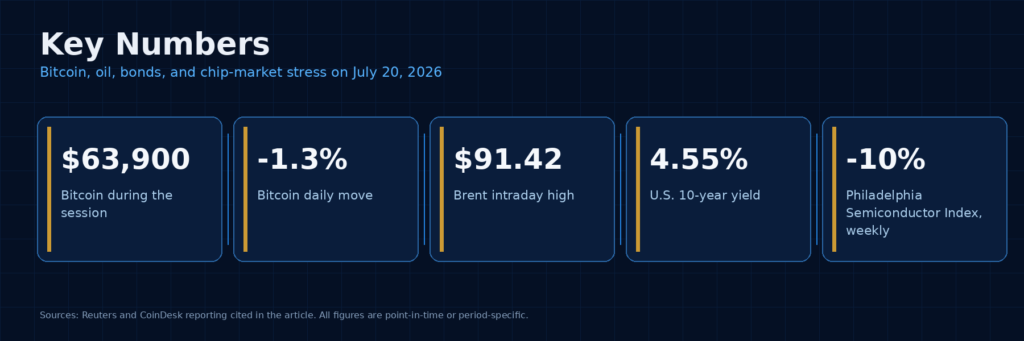
Bitcoin fell below $64,000 on Monday, July 20, as investors weighed an early spike in oil prices, escalating U.S.-Iran hostilities, and continued weakness in global semiconductor shares. Bitcoin traded near $63,900 during the European morning, down about 1.3% on the day but still approximately 2% higher over seven days. Ether, BNB, XRP, Dogecoin, and Hyperliquid’s HYPE also traded lower.
The move matters because the main pressure did not originate inside the crypto industry. Instead, Bitcoin moved alongside a broader reassessment of inflation, interest rates, and risk exposure. That does not prove Bitcoin has become a conventional technology asset. It does show that macroeconomic shocks can affect digital assets through many of the same portfolio and liquidity channels that influence equities, bonds, and commodities.
Oil Spike Revives Inflation Concerns
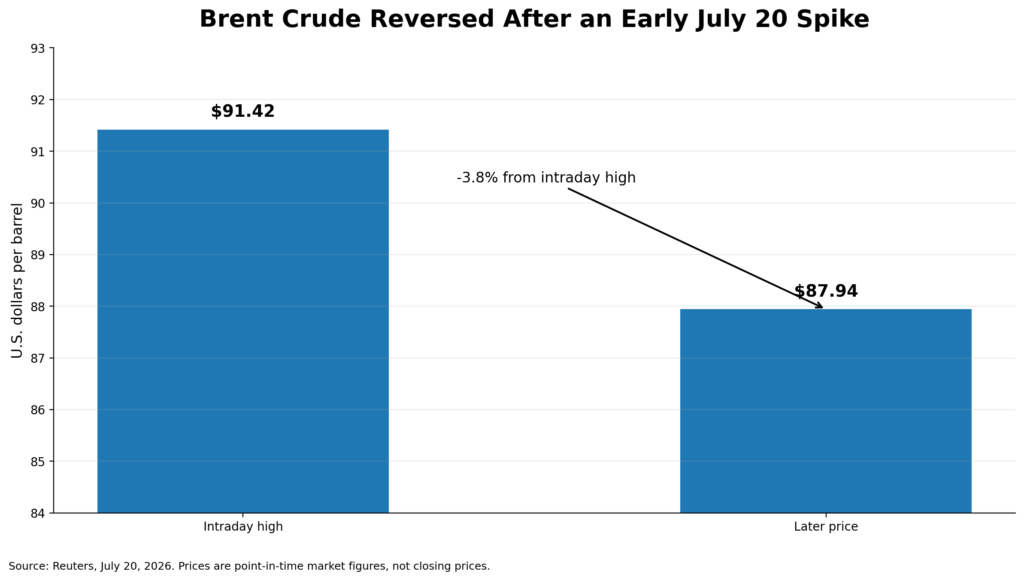
Brent crude briefly reached a one-month high of $91.42 per barrel on July 20 as the conflict between the United States and Iran intensified and shipping through the Strait of Hormuz remained disrupted. The strait is a critical route for global energy supplies, so even limited interruptions can prompt traders to add a geopolitical risk premium to oil prices.
However, the early surge did not hold. Brent later fell to around $87.94 after Iran’s foreign ministry indicated that Tehran could consider fresh negotiations if proposals aligned with the country’s interests. That reversal is important because it shows how quickly markets are repricing both escalation risk and the possibility of diplomacy.
The inflation concern remains more nuanced than a simple oil-price headline suggests. A short-lived increase in crude does not automatically lead to persistent consumer inflation. Duration matters, as do refining costs, shipping conditions, currency moves, and the extent to which companies pass higher energy expenses to customers.
Still, Reuters reported that the oil and gas rally unsettled bond markets. The U.S. 10-year Treasury yield traded near 4.55%, while the 30-year yield moved above 5%. Higher yields can pressure assets whose valuations depend heavily on future growth, abundant liquidity, or investor tolerance for volatility.
For Bitcoin, that creates an indirect transmission channel. If markets expect inflation to remain elevated, investors may price in tighter financial conditions or fewer opportunities for monetary easing. That does not guarantee lower cryptocurrency prices. It does, however, make speculative and high-volatility assets more sensitive to incoming economic data.
U.S.-Iran Conflict Adds a Geopolitical Risk Premium
The oil move followed a widening exchange of attacks between the United States and Iran. Reuters reported strikes involving military assets and infrastructure across the Gulf region, alongside continued concerns about commercial shipping and water supplies. Both sides also signaled some openness to talks, leaving markets to assess competing risks of escalation and diplomacy.
Crypto markets do not have a single, predictable response to geopolitical conflict. Bitcoin has sometimes risen during periods of monetary or banking stress. At other times, traders have sold it with equities as they reduced exposure to volatile assets.
Monday’s decline fit the second pattern.
The evidence does not establish that the conflict alone caused Bitcoin to fall. Markets rarely move for one reason. Oil, bond yields, chip-stock losses, derivatives positioning, and routine profit-taking may all have contributed. The most defensible conclusion is that the geopolitical backdrop made investors less willing to add risk while other markets were already under pressure.
AI Stock Rout Keeps Risk Appetite Fragile
The second major influence came from the semiconductor sector.
Global equities fell on Friday, July 17, after chip shares declined for a third consecutive session. Reuters linked the selloff to reduced enthusiasm for crowded artificial intelligence trades following the release of a large AI model by China’s Moonshot AI. The Philadelphia Semiconductor Index lost approximately 10% over the week, showing how quickly sentiment weakened in a sector that had carried high expectations.
Asian markets remained under pressure on Monday. South Korea’s chip-heavy equity market fell sharply, although the reported intraday decline varied as the session developed. Meanwhile, U.S. equity futures pointed modestly higher, suggesting that investors were not uniformly retreating from technology stocks.
The relationship between AI stocks and Bitcoin is indirect. Bitcoin does not depend on semiconductor earnings or AI capital spending. Still, both can be affected when investors reduce allocations to volatile or momentum-driven trades.
This distinction matters. The article’s thesis is not that Bitcoin is an AI asset. It is that a sharp loss of confidence in a major risk-taking theme can spread through portfolios and affect other liquid assets.
Crypto Markets Follow the Broader Risk-Off Tone
CoinDesk reported Bitcoin near $63,900, Ether near $1,850, BNB at approximately $564, and XRP close to $1.09 during the July 20 session. Dogecoin lost about 1.4%, while HYPE traded near $60 and remained one of the weaker large-cap tokens over the week.
Those figures require time context. Cryptocurrency prices trade continuously and had already changed later in the day. CoinDesk’s live page subsequently showed Bitcoin above $64,000, while other market-data services displayed slightly different prices because of exchange selection and update timing.
The broad decline supports the view that traders were responding to a market-wide shift rather than a Bitcoin-specific technical problem. However, it would be too strong to say that macro conditions were the only cause.
The cited reports did not identify a major exchange failure, protocol exploit, or new regulatory enforcement action as the primary catalyst. That is narrower and more defensible than claiming no crypto-native event occurred anywhere in the market.
ETF Flows Offer Support, but Not a Clear Recovery Signal
U.S.-listed spot Bitcoin ETFs posted approximately $75.7 million in net inflows for the week ended July 17. That followed roughly $197.4 million in the previous week, bringing combined two-week inflows to about $273 million.
The positive flows ended a difficult stretch. Before the two-week recovery, the funds had recorded eight consecutive weeks of withdrawals totaling more than $8 billion, according to data cited by CoinDesk. In that context, $273 million represents an improvement, but not a decisive return of institutional demand.
ETF flows also require careful interpretation.
A daily or weekly inflow does not reveal every investor’s strategy. Purchases may represent long-term allocation, short-term arbitrage, basis trades, rebalancing, or hedged exposure. Therefore, ETF demand should be treated as one indicator of market participation, not proof that institutions have turned bullish.
The launch of spot Bitcoin ETFs has nevertheless made Bitcoin easier to hold through traditional brokerage accounts and regulated investment products. That access can deepen Bitcoin’s links to broader portfolio decisions, particularly when investors are adjusting exposure across several asset classes.
Bitcoin’s Macro Role Is Growing, but It Remains Unsettled
Monday’s trading supports a broader analytical point: Bitcoin increasingly reacts to global liquidity, bond yields, commodity shocks, and equity sentiment.
That conclusion should not be overstated.
Bitcoin’s correlations with stocks, gold, the dollar, and interest rates vary over time. Its price still responds to crypto-native factors, including network activity, regulation, exchange liquidity, miner behavior, stablecoin conditions, and leverage in derivatives markets.
The current episode is best viewed as evidence of integration, not convergence. Bitcoin participates more directly in global markets than it did before regulated spot ETFs and larger institutional trading channels emerged. Yet it has not become interchangeable with an equity index, commodity, or conventional safe-haven asset.
| Market signal | Verified development | Why it matters for Bitcoin | Important limitation |
|---|---|---|---|
| Oil and geopolitics | Brent reached $91.42 before easing to $87.94 on July 20. | Higher energy costs can lift inflation expectations and reduce demand for volatile assets. | A brief oil spike does not prove inflation will stay higher. |
| Bond market | The U.S. 10-year Treasury yield traded near 4.55%. | Higher yields can tighten financial conditions. | Yields reflect several macro forces. |
| AI and chip stocks | The Philadelphia Semiconductor Index fell about 10% during the week. | Weakness in a major growth sector can reduce appetite for risk assets. | Bitcoin has no direct operational link to chip earnings. |
| Crypto market | Bitcoin traded near $63,900 during the reported session. | The move reflected broader macro pressure. | Prices change continuously. |
| ETF demand | Spot Bitcoin ETFs posted positive inflows after a prolonged outflow period. | ETF flows indicate regulated investment demand. | Flows may reflect arbitrage, hedging, or portfolio rebalancing. |
Risks, Limits, and Unanswered Questions
The first uncertainty is geopolitical. Markets received both escalation headlines and tentative diplomatic signals on July 20. A further disruption to Gulf shipping could renew pressure on energy prices. Progress toward negotiations could have the opposite effect.
Second, the inflation impact remains unclear. Brent’s move above $91 was brief, and prices later reversed. It would take a more sustained energy shock to draw firm conclusions about consumer inflation or Federal Reserve policy.
Third, the AI selloff may prove temporary. U.S. equity futures rose during part of Monday’s session, and upcoming earnings from major technology companies could either restore confidence or deepen concerns about valuations and spending.
Finally, crypto-market structure can amplify moves that begin elsewhere. Leverage, thin liquidity during certain trading hours, and automated liquidations can turn a modest macro reaction into a larger price swing.
What Markets Should Watch Next
The most useful framework is not a Bitcoin price target. It is a set of conditions that can show whether the pressure is easing or spreading.
Brent crude and Gulf shipping
Traders should track whether Brent remains below its July 20 intraday peak or returns above $90. Shipping activity through the Strait of Hormuz will remain central to the supply-risk debate.
Treasury yields and inflation expectations
The 10-year and 30-year Treasury yields can indicate whether markets see the energy shock as temporary or more persistent. A continued rise in long-term yields could weigh on several risk-sensitive asset classes.
Semiconductor earnings and equity breadth
Upcoming results from large technology and chip companies will test whether the AI selloff reflects temporary positioning or a deeper reassessment of earnings expectations.
Spot Bitcoin ETF flows
A few positive sessions would not establish a durable recovery. Investors should compare new inflows with the more than $8 billion withdrawn during the preceding eight-week outflow streak.
Crypto-native market conditions
Funding rates, open interest, stablecoin liquidity, exchange balances, and liquidation data can help separate macro selling from leverage-driven stress within crypto markets.
The Bigger Picture
Bitcoin’s fall below $64,000 was important because the strongest identifiable pressures came from outside the crypto industry.
An oil spike revived inflation concerns. U.S.-Iran hostilities increased geopolitical uncertainty. A semiconductor selloff weakened appetite for high-volatility trades. Bitcoin then moved lower with other risk-sensitive assets.
None of those factors offers a reliable price forecast. Together, however, they show why cryptocurrency coverage can no longer stop at blockchain news. Bitcoin now trades within a larger financial system shaped by commodities, bond yields, institutional flows, and global portfolio decisions.
The next signal will not come from one chart alone. It will emerge from whether oil stabilizes, diplomacy advances, chip stocks recover, bond yields ease, and ETF flows strengthen enough to offset the market’s recent withdrawals.
Frequently Asked Questions
Why did Bitcoin fall below $64,000?
Bitcoin declined as oil prices briefly surged, U.S.-Iran tensions intensified, and semiconductor stocks remained under pressure. These developments weakened broader risk appetite. The available evidence does not show that one factor alone caused the move.
Did Brent crude remain above $91?
No. Brent reached an intraday high of $91.42 on July 20 but later fell to about $87.94 after Iranian comments raised the possibility of renewed negotiations.
Were Bitcoin ETF flows positive?
Yes. U.S.-listed spot Bitcoin ETFs received about $75.7 million in net inflows during the week ended July 17. Combined inflows over two weeks were approximately $273 million. However, that followed more than $8 billion in withdrawals over the previous eight weeks.
Does the AI stock selloff directly affect Bitcoin?
There is no direct operational link. However, a sharp decline in major technology trades can reduce investor appetite for other volatile assets. The relationship is based on market positioning and sentiment, not shared fundamentals.
Is Bitcoin now fully correlated with technology stocks?
No. Bitcoin’s correlations with equities and other assets change over time. Monday’s session showed sensitivity to the same macro pressures, but one period of shared weakness does not establish a permanent relationship.
What should readers watch next?
The most relevant indicators include Brent crude, Strait of Hormuz shipping, Treasury yields, inflation expectations, semiconductor earnings, spot Bitcoin ETF flows, and crypto derivatives conditions.
Disclaimer
This article is for informational and educational purposes only. It does not provide financial, investment, legal, tax, or accounting advice. Cryptocurrency and digital asset markets involve risk, including possible loss of capital. Readers should conduct their own research before making any financial decision.