

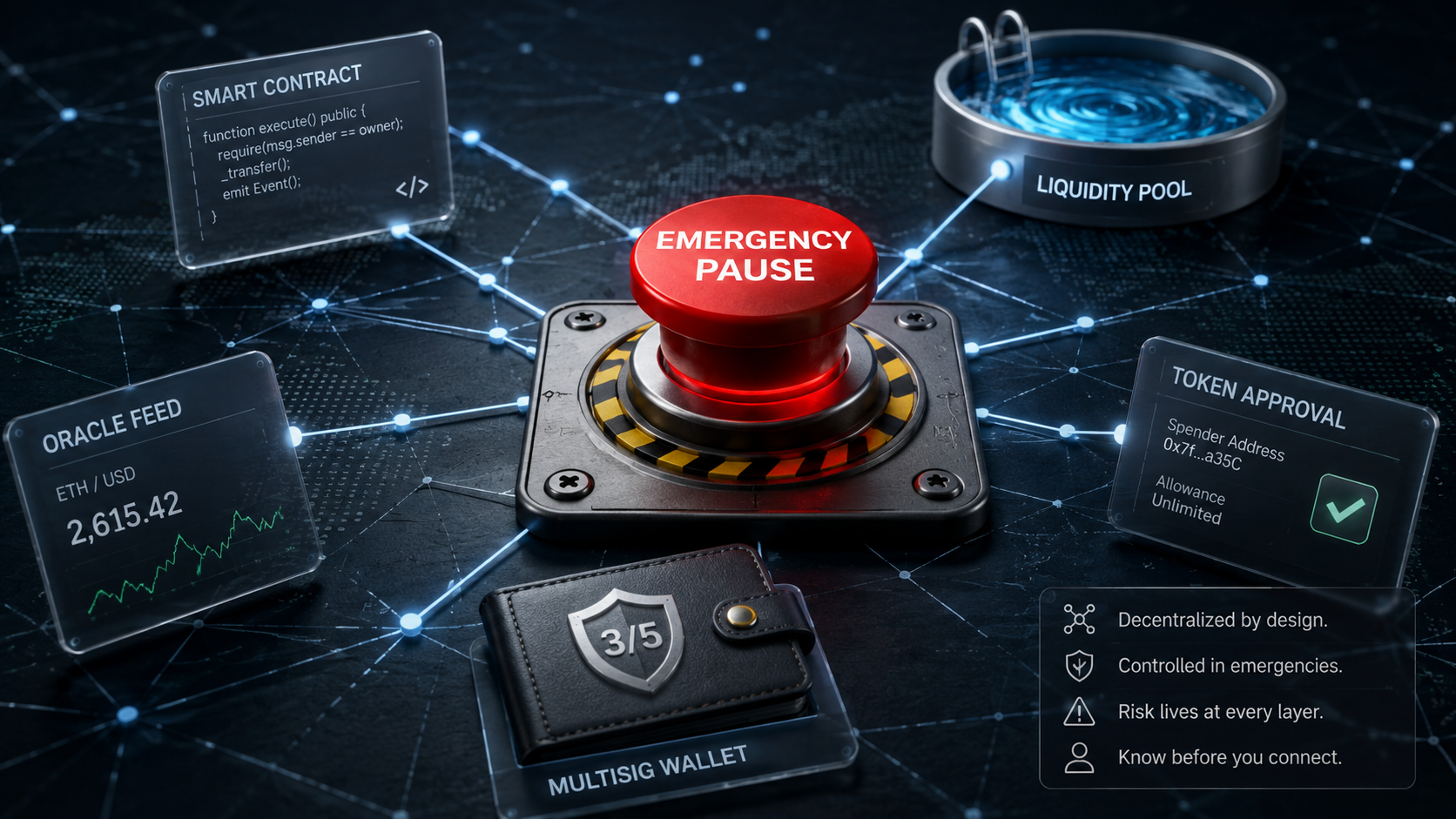
Decentralization is one of DeFi’s strongest promises. You keep control of your wallet, smart contracts replace many corporate intermediaries, and transactions can settle without asking a bank or exchange for permission. Yet decentralization does not remove risk. Instead, it changes where risk sits. A protocol can be non-custodial while still depending on upgrade keys, emergency guardians, price oracles, token approvals, thin liquidity, and users who must sign every critical transaction correctly. Therefore, the real test of decentralization often arrives when something goes wrong. At that point, the key question becomes simple: who can stop the system, change its rules, or protect users from further damage?
That is where the emergency button becomes revealing. Some DeFi systems deliberately give a multisig, guardian, or governance process limited powers to pause functions during a crisis. Those controls may reduce damage. However, they also show why decentralization is rarely a simple yes-or-no property.
Key Facts
| Question | Plain-English answer |
|---|---|
| Does decentralization through self-custody eliminate platform risk? | No. Users may control their keys while still depending on protocol code, oracles, liquidity, governance, and interfaces. |
| What is an emergency button? | A permission that allows designated actors to pause or restrict certain protocol functions during a serious incident. |
| Is a pause function automatically bad for decentralization? | No. It can limit damage, but users should know who controls it, what it can stop, and how that authority can change. |
| Can a smart contract approval remain active after you leave a platform? | Yes. Standard token approvals can remain active until changed or revoked. |
| Can decentralized lending liquidate users automatically? | Yes. Protocol rules can make a position eligible for permissionless liquidation when collateral falls below required thresholds. |
Decentralization Is Not the Same as Having No Control Points
The easiest way to misunderstand DeFi is to treat decentralization as a single switch.
In practice, several forms of control can exist at the same time. A user may hold the private keys to a wallet, which gives that user custody. Meanwhile, a protocol may use upgradeable contracts. Governance may change parameters. A multisig may pause selected functions. An oracle may determine the price used for loans. A website may provide the main interface. Finally, liquidity providers may determine whether users can exit at a reasonable price.
Therefore, decentralization needs to be examined layer by layer.
Custody decentralization asks who controls assets before a transaction. Governance decentralization asks who can change protocol rules. Operational decentralization asks who can react during emergencies. Infrastructure decentralization examines whether frontends, oracles, bridges, sequencers, or other services create concentrated dependencies.
A protocol can perform differently across every layer of decentralization.
That distinction also explains why “non-custodial” is useful but incomplete. Aave describes its protocol as open-source, self-executing smart contracts deployed on permissionless public blockchains. At the same time, Aave governance documentation describes emergency roles designed to react quickly when serious risks appear.
Both facts can coexist. After all, custody and emergency control address different problems. As a result, decentralization in custody does not automatically guarantee decentralization in governance, infrastructure, or crisis response.
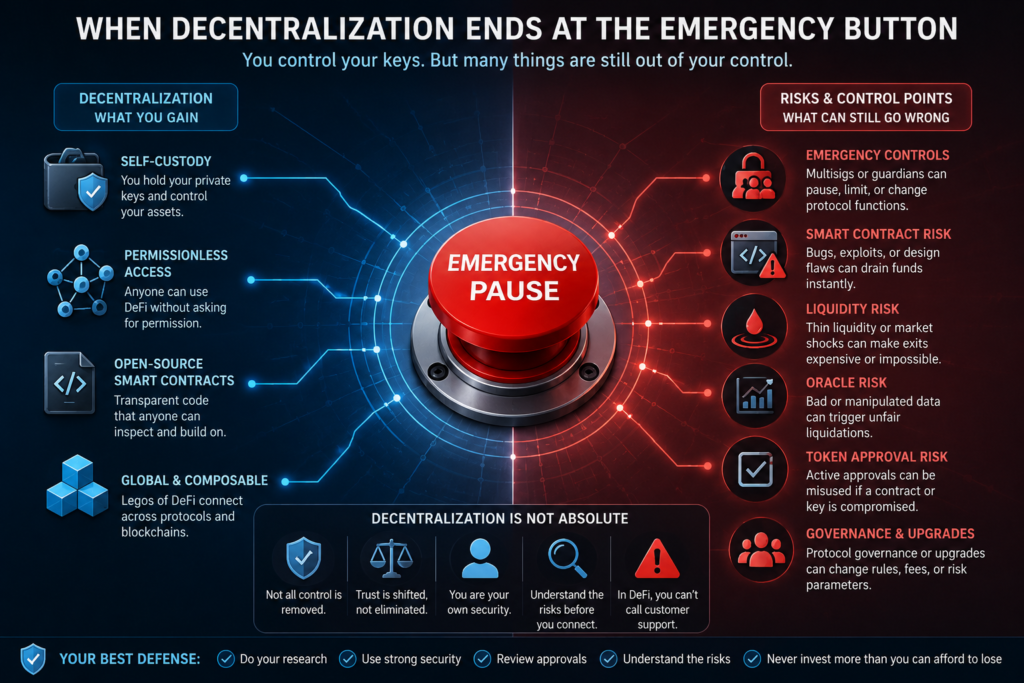
Where Decentralization Meets the Emergency Button
An emergency button usually means a smart contract permission that can pause specific actions.
Compound III provides a clear example. Its documentation states that a Pause Guardian can pause supply, transfers, withdrawals, absorption, and collateral-buying functions. The protocol allows the Governor and Pause Guardian to trigger those pause controls, while COMP token holders designate the Pause Guardian address held by a community multisig.
Compound v2 used a narrower model. Its Pause Guardian could disable selected functions, including minting, borrowing, transfers, and liquidations. However, the guardian could not unpause those functions or stop users from redeeming assets or repaying debt.
Aave also illustrates this tension between safety and decentralization. Its governance documentation describes a Protocol Emergency Guardian holding the EMERGENCY_ADMIN role through a 5-of-9 multisig structure. Separate governance discussions show that emergency permissions can be intentionally narrower than ordinary governance authority.
These mechanisms complicate simplistic claims about decentralization. Still, a pause function does not automatically prove that a protocol is secretly centralized.
Instead, users should examine the design.
Who controls the emergency authority? How many signatures are needed? Which functions can be stopped? Can users still repay debt or withdraw? Can governance replace the guardian? How quickly can the authority expand?
Those questions reveal the practical limits of decentralization far better than a marketing label.
A fire alarm does not own the building. Yet whoever can lock every exit deserves scrutiny.
Smart Contract Risk Survives Decentralization
Removing a corporate custodian does not remove software risk.
Smart contracts execute programmed rules. Consequently, a vulnerability in those rules may give an attacker a path to exploit the same automation that normally makes a decentralized system useful.
Ethereum’s developer documentation treats access control as a critical smart contract security issue because sensitive functions need restrictions that prevent unauthorized accounts from calling them.
The 2023 Euler Finance exploit demonstrates the stakes. Euler later said an attacker exploited a vulnerability involving its donateToReserves logic and drained about $197 million in assets. Euler subsequently carried out an extensive recovery effort, and the attacker returned the stolen assets.
A technical incident analysis by Omniscia identified a missing account-health check around the donateToReserves mechanism as the vulnerability involved in the exploit.
The broader lesson goes beyond Euler.
Decentralization can reduce the risk that a company employee simply transfers customer assets from a centralized account. However, decentralization can replace that threat with contract logic that attackers can inspect and probe continuously.
Furthermore, smart contract audits reduce uncertainty rather than eliminating it. Code can survive reviews and still contain an exploitable interaction.
For that reason, users should treat smart contract exposure as its own risk category. Custody decentralization protects against one class of failure. It does not provide immunity from code failure.
Decentralization Cannot Guarantee Liquidity When Everyone Wants Out
A token balance can appear safely on-chain while becoming difficult to sell at a reasonable price.
Liquidity describes how much buying or selling a market can absorb before the price changes significantly. In DeFi, liquidity affects swaps, stablecoin exits, leveraged positions, lending withdrawals, and liquidations.
Aave’s 2026 risk framework explicitly treats liquidity as a structural property rather than a simple point-in-time number. The framework also notes that effective liquidations depend on genuine secondary-market depth and that concentration among liquidity providers can create dependency on a small number of actors.
Therefore, liquidity creates another boundary around decentralization.
Nobody needs to freeze a wallet for an exit to become expensive. If market depth disappears, slippage can widen sharply. Likewise, lending pools may not always hold enough immediately available assets for every supplier to withdraw simultaneously.
Aave’s user documentation explains that suppliers can withdraw their assets as long as sufficient unborrowed liquidity remains available in the pool.
Consequently, two statements that sound similar are actually very different:
“I control my keys.”
“I can exit my position at the price I expect.”
Decentralization can strengthen the first statement while market conditions undermine the second.
Token Approvals Move Responsibility Toward the User
DeFi also changes the meaning of permission.
Many decentralized applications require users to approve a smart contract before it can spend a token. An approval can authorize a precise amount. Alternatively, it can grant a much larger allowance.
Ethereum’s official guidance on revoking smart contract access warns that unlimited token permissions can remain active even after users withdraw funds or disconnect their wallets. Standard permissions also do not automatically expire simply because someone disconnected a wallet from a website.
This is one of the clearest examples of decentralization moving responsibility from an institution toward the individual.
Disconnecting a wallet does not necessarily revoke the underlying blockchain permission. Ethereum.org specifically distinguishes disconnecting a wallet from cancelling a token allowance and recommends limiting permissions and periodically revoking unnecessary approvals.
In other words, decentralization makes the user part of the security model.
That can be empowering. However, it can also be unforgiving.
Blockchain transactions generally lack the central reversal mechanism that consumers may expect from conventional payment systems. Ethereum.org warns that completed Ethereum transactions cannot simply be reversed by a support team.
Meanwhile, developers continue to explore safer permission models. The draft ERC-8255 proposal, published in May 2026, would introduce expiring token approvals so ordinary authorizations can end after a bounded period. Its stated motivation includes reducing the long-lived risk created by oversized or unlimited allowances. Because ERC-8255 remains a draft proposal, users should not assume standard ERC-20 approvals already work this way.
Here again, decentralization provides control while demanding greater attention from the person holding that control.
High Yield Can Hide Several Layers of Decentralization Risk
High advertised yield can attract attention before users inspect the machinery producing it.
Yield may come from borrower interest, trading fees, token incentives, leverage, liquidity provision, or several mechanisms working together. Therefore, decentralization does not make a high yield safer merely because no centralized exchange holds the deposit.
Consider a hypothetical user who deposits a stablecoin into a yield vault.
The vault routes that capital into a lending market. The lending market depends on a price oracle. Borrowers use collateral. Liquidators need adequate market depth. The vault interacts with smart contracts. Meanwhile, the user may have granted token approvals to enter the strategy.
On the screen, the experience might look like one deposit and one percentage yield.
Underneath, several layers of decentralization risk are stacked together.
Those risks can become especially visible during market stress, as our analysis of why DeFi can fall harder than Bitcoin shows.
Smart contract risk can interact with oracle risk. Oracle problems can contribute to incorrect or destabilizing liquidations. Thin liquidity can make those liquidations harder to execute efficiently. A broad token approval can expose more assets than the user intended. Finally, emergency governance may pause part of the system while contributors investigate a threat.
Aave’s current risk framework reflects this wider view. It states that smart-contract-only analysis is no longer sufficient and examines liquidity, oracles, bridges, access control, and other dependencies as part of protocol risk assessment.
So the headline yield is only one number.
The more important question is what risks the capital must travel through before that yield reaches the user.
Liquidation Is Automated Control, Not a Customer-Service Decision
Borrowing protocols introduce another form of responsibility under decentralization.
On Aave, a borrower’s health factor measures the safety of a collateralized position. If the health factor drops below 1, the position becomes eligible for liquidation. Aave states that liquidation is permissionless, which means network participants can execute it when the protocol’s conditions are met.
That mechanism represents decentralization working as designed.
No loan officer needs to approve the liquidation. A collections department does not need to contact the borrower first. Instead, software evaluates the position against predefined rules.
However, automation also removes discretion.
A user who misunderstands collateral volatility, oracle pricing, leverage, or liquidation thresholds may lose collateral even though the protocol works exactly as intended.
Therefore, decentralization introduces what could be called rule risk.
Users need to understand not only whether a smart contract is secure, but also what that contract has permission to do when market conditions change.
A flawless contract can still execute an outcome the user deeply dislikes.
Oracle Risk Shows Why Decentralization Depends on External Information
A smart contract cannot independently know the dollar price of ETH, a stablecoin, or another asset.
Instead, many DeFi applications depend on price feeds or oracle systems to bring market information on-chain.
That dependence creates another important limit to decentralization. The protocol may execute automatically, yet the quality of its decisions depends partly on the information it receives.
Aave’s 2026 risk framework explicitly links oracle stability with market liquidity and warns that weak or manipulable market inputs can create serious problems for collateral valuation and liquidation. It also considers internal asset oracles, redemption pricing, exchange-rate accounting, and backing attestations because failures in those systems can propagate into a lending market.
As a result, decentralization at the transaction layer does not make external data perfect.
Users should ask where a protocol gets its prices, how those prices react during volatility, and what happens if a feed becomes stale or unreliable.
The Real Test of Decentralization Is Who Can Change the Rules
The emergency button becomes most useful as a diagnostic tool.
Before using a protocol, readers can ask five practical questions:
- Who can pause deposits, withdrawals, borrowing, swaps, or liquidations?
- Who can upgrade smart contracts or replace core components?
- Does an emergency action require one key, a multisig, or a governance process?
- Can users still exit or repay while emergency controls remain active?
- How can emergency authority be removed, expanded, or replaced?
Those questions reveal more than the word decentralization alone.
A protocol with transparent and narrowly defined emergency controls may carry less governance risk than a supposedly immutable project whose users unknowingly depend on privileged contracts or centralized infrastructure.
Conversely, a project can promote decentralization while a small group of signers retains broad operational authority.
The goal is not to demand that every emergency power disappear.
Instead, readers should understand the trade-off.
More decentralization can reduce unilateral authority. Meanwhile, stronger emergency powers may improve reaction speed during an exploit. Good system design attempts to minimize required trust without leaving the protocol unable to respond when a serious vulnerability appears.
A Practical Decentralization Risk Check Before Connecting Your Wallet
Ordinary users do not need to audit Solidity to ask better questions.
First, examine custody. Determine whether assets remain inside your wallet, move into a protocol contract, or become represented by another token.
Next, investigate contract control. Look for upgradeability, guardians, multisigs, timelocks, governance authority, and pause permissions.
Then, review approvals. Ethereum.org recommends limiting smart contract spending permissions to what is necessary rather than granting unlimited access and reviewing old allowances regularly.
Afterward, inspect liquidity. A displayed token price means little if exiting a meaningful position would create severe slippage.
Also, understand oracle and liquidation rules before borrowing or adding leverage.
Finally, ask what decentralization actually means for that specific application. Does it describe custody, governance, infrastructure, execution, or all four?
This process cannot eliminate risk. However, it can make the boundaries of decentralization visible before the user commits capital.
Conclusion: Decentralization Changes Who Carries the Failure
Decentralization can remove important forms of corporate custody and gatekeeping. It can also make financial systems more transparent, programmable, and open to direct user participation.
Still, decentralization does not eliminate trust, control, or financial loss. Instead, it redistributes them.
The emergency button exposes that reality.
A guardian may hold limited pause powers. Governance may control upgrades. Oracles may determine collateral values. Liquidity providers may affect exit quality. Smart contracts may contain vulnerabilities. Token approvals may remain active. Meanwhile, users must protect keys, understand permissions, monitor leveraged positions, and accept that settled blockchain transactions may offer no simple reversal mechanism.
For general users, the useful question is therefore not simply whether a DeFi protocol has decentralization.
Ask where decentralization begins, where it stops, who retains emergency authority, and who carries the financial consequences at every boundary.
That answer tells you far more about the real risk than the label “decentralized” ever could.
FAQs
Does decentralization mean nobody can pause a DeFi protocol?
No. Some protocols deliberately grant limited emergency permissions to guardians, multisigs, or governance-controlled addresses. Compound and Aave both document forms of emergency authority, although their exact designs differ.
Is an emergency pause proof that decentralization has failed?
Not automatically. A narrow emergency role can act as a safety mechanism. The important questions involve who controls the role, what it can do, how many approvals it requires, and whether governance can review or replace that authority.
Can I lose money in DeFi while keeping my private keys?
Yes. Self-custody protects against certain custody failures, but decentralization cannot remove smart contract bugs, liquidation exposure, token approval risk, oracle problems, liquidity shortages, bridge risk, or governance risk.
Why are unlimited token approvals risky?
They can authorize a contract to spend far more tokens than one transaction requires. Because ordinary approvals may remain active until revoked, a compromised or malicious spender can create continuing risk.
Does a high DeFi yield automatically mean greater risk?
Not automatically. However, every yield has a source. Users should identify whether returns come from lending demand, trading fees, incentives, leverage, liquidity provision, or another mechanism and then evaluate the associated dependencies.
What should I check before using a DEX or DeFi protocol?
Review smart contract controls, emergency permissions, token approvals, liquidity depth, oracle design, liquidation rules, relevant audits, and the exact transaction your wallet asks you to sign. Most importantly, identify which parts of decentralization the protocol actually provides.
Disclaimer
This article is for informational and educational purposes only. It does not provide financial, investment, legal, tax, or accounting advice. Cryptocurrency and digital asset markets involve risk, including possible loss of capital. Readers should conduct their own research before making any financial decision.