


By Duncan Macduff
A blockchain can process transactions, maintain validators and demonstrate technically impressive applications without answering a much harder commercial question: why would an independent customer choose it once incentives, novelty and testnet subsidies disappear?
That distinction matters even more as artificial intelligence improves.
AI could create new demand for verifiable computation, autonomous agreements, private coordination and machine-to-machine services. At the same time, better AI could make ordinary cloud software cheaper to build, automate and integrate. Both forces can operate simultaneously.
A network can therefore become technically more useful without its native token becoming economically more valuable. It can even solve a legitimate problem while customers ultimately buy the solution from somebody else.
This tension is becoming increasingly important as blockchain architecture intersects with AI, automated payments and programmable financial infrastructure. The Crypto Encounter has examined a similar divide in how banks are adding AI, tokenization and instant payment rails while still depending on legacy systems. New technology does not automatically eliminate the economics, operational dependencies or alternatives surrounding it.
Four developing ecosystems illustrate different versions of the challenge.
GenLayer is exploring AI-assisted adjudication inside smart contracts. Rialo proposes reactive automation and internet-connected execution. Ambient is developing verifiable AI inference around useful computation. Logos is building a modular stack spanning blockchain, private messaging and storage.
Their architectures are different. So are the claims they need to prove.
Rather than trying to identify a future winner, a more useful approach is to ask what evidence would have to exist before an intriguing experiment became a defensible economic proposition.
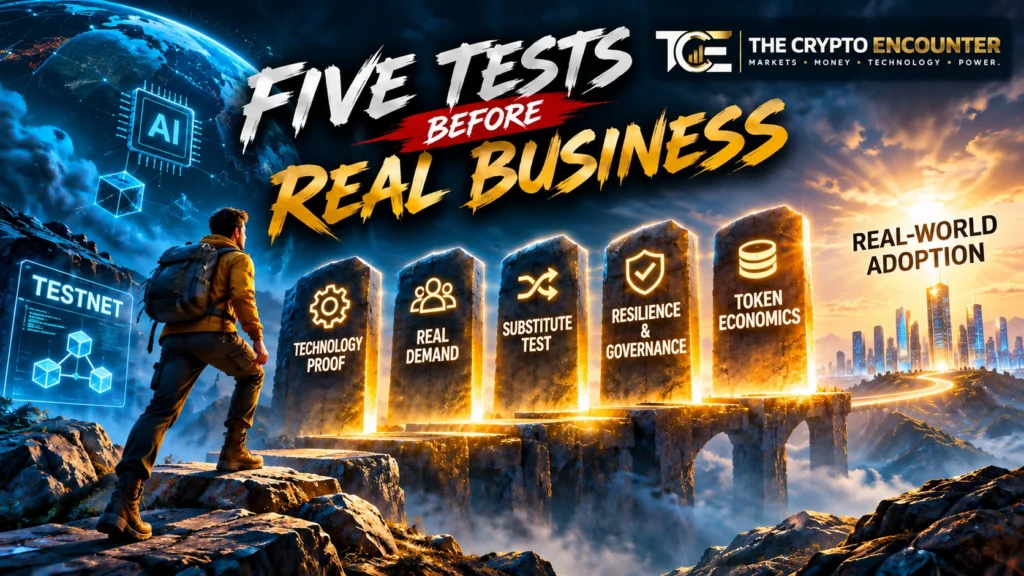
Five tests stand out.
1. Is the Capability Operational, Repeatable and Independently Testable?
A demonstration proves that something can work under particular conditions.
A production service has to prove something harder: that it can continue working when users are impatient, inputs are hostile, systems fail and mistakes have economic consequences.
Public repositories, developer documentation, testnet access and reproducible measurements are meaningful evidence of engineering progress. They are not, on their own, evidence of reliable uptime, durable customer demand, operational support or commercial readiness.
GenLayer’s documentation describes Intelligent Contracts that combine blockchain state with language-model judgment and external information. Its architecture includes GenVM execution, validators, appeals and public testing environments.
That is considerably more substantive than a concept deck.
The next question is whether independent developers can reproduce useful results across adversarial conditions, understand the cost of those results and determine when different AI outputs should be considered equivalent.
Consensus around an AI-generated answer is not automatically proof that the answer is correct.
A strong adversarial test might present the same contractual dispute using paraphrased facts, delayed websites, manipulated source pages and prompt-injection attempts. If results become inconsistent, easily manipulated or economically unaffordable, successful deployment alone does not validate the underlying proposition.
The same principle appears elsewhere in crypto infrastructure. The Crypto Encounter’s reporting on security flaws in AI-agent crypto payments showed why automated systems must be evaluated under hostile conditions rather than judged only by what they can accomplish when everything works as intended.
Rialo presents a different architectural proposition.
Its April 20, 2026 technical paper on reactive transactions describes a model in which defined blockchain conditions can trigger subsequent transactions without depending on a conventional external keeper.
That could simplify some application architectures.
But published architecture and developer environments should not be confused with third-party production evidence. A useful benchmark would take a real workflow and compare Rialo against an established blockchain plus reliable external automation, measuring total setup effort, latency, operating cost, maintenance requirements and failure recovery.
Ambient provides another useful contrast.
It offers an observable AI inference product surface and describes verification mechanisms alongside blockchain infrastructure. That gives researchers something more concrete to examine than a purely hypothetical network.
However, provider-reported user, token or activity figures do not independently establish unique paying customers, retention, sustainable margins or the degree to which demand specifically requires blockchain infrastructure.
Logos takes a broader modular approach involving blockchain, storage and private messaging. Its September 30, 2026 Testnet v0.3 release added features including permissionless proof-of-work onboarding, decentralized sequencing, Logos SQL and additional privacy-oriented capabilities.
The important distinction is straightforward: functioning test infrastructure is evidence of engineering progress. It is not evidence that a resilient production economy already exists.
2. Does Somebody Outside the Incentive Loop Pay for the Result?
Activity and demand are not interchangeable.
A token reward can attract developers, validators, testers and users. It can also purchase an impressive activity statistic.
The stronger evidence is an independent customer with alternatives who repeatedly pays for an outcome at a price capable of supporting sustainable economics.
A rigorous evidence file should therefore distinguish between:
- Testnet transactions
- Incentive-eligible activity
- Trial accounts
- Signed commercial contracts
- Paid invoices
- Repeat usage
- Net revenue
None of these should silently substitute for another.
For AI inference, the meaningful unit might be separately billed requests from unrelated customers. For decentralized adjudication, it could be real disputes resolved at an acceptable cost and error rate. For privacy infrastructure, it might be organizations repeatedly paying to complete communications or transactions that require the network’s specific threat model.
This distinction mirrors a broader problem across digital assets. The Crypto Encounter has repeatedly separated visible activity from the underlying economic relationship, whether examining who actually holds the assets behind stablecoins or looking at whether an apparently successful crypto product transfers meaningful value to the party investors assume will benefit.
For Ambient, the existence of an API and published pricing makes the demand question more concrete: how much inference is actually paid for, by whom, at what delivered cost, and with what retention?
Yet even a customer paying for model output would not automatically prove demand for a native cryptocurrency.
If the same user can obtain the required result through a conventional API contract, secure hardware, cryptographic attestations or another verification architecture, those alternatives belong in the economic comparison.
Projects at an earlier stage may not yet have audited revenue or meaningful commercial usage. That absence is not evidence of fraud, incompetence or inevitable failure.
It is simply a limit on what can responsibly be concluded.
“Promising” can be a hypothesis.
“Commercially validated” requires stronger evidence.
3. What Survives the Substitute Test?
A feature can be useful and still fail to justify a new blockchain.
Cloud workflow engines already schedule tasks, retry failed processes, monitor execution and maintain histories. Existing blockchains can already provide shared settlement. Oracle networks can bring external information into decentralized applications. Conventional databases, APIs and secure hardware can solve many coordination problems without introducing another token.
The decisive question is therefore not:
Can the prototype do this?
It is:
Can users obtain comparable assurance, reliability, privacy and cost from the best available substitute?
That answer changes with the use case.
For GenLayer, centralized arbitration may be cheaper and easier where all parties accept a trusted operator. A distributed validator process becomes more interesting when participants genuinely cannot agree on an arbiter or when censorship resistance materially changes the outcome.
The test should therefore identify who can censor information, how model disagreements are handled, what appeals cost and how errors are discovered.
If one trusted service performs the actual job just as well at materially lower cost, the blockchain premium becomes harder to justify.
For Rialo, moving automation closer to execution could simplify application design. But existing chains plus automation services may already satisfy a substantial portion of demand. The advantage becomes meaningful only when whole-system benchmarks show that integrated automation reduces cost, complexity or failure enough to matter.
For Ambient, verifiable inference may be valuable to customers that need stronger evidence about model provenance or execution. But the correct comparison is not verified inference versus nothing. It is verified inference versus conventional APIs combined with logs, trusted execution environments, cryptographic attestations and other verification mechanisms.
For Logos, private messaging, censorship resistance and local-first coordination may offer legitimate reasons to reduce dependence on centralized intermediaries. Yet every component still faces substitutes, including encrypted messaging, self-hosted storage, existing privacy networks and conventional collaboration tools.
A unified blockchain stack therefore needs to demonstrate that integration itself creates enough additional value to justify the complexity.
This substitute test is especially important when crypto projects introduce tokens. As The Crypto Encounter explains in its full-stack guide to crypto token utility and tokenomics, one of the simplest questions founders can ask is whether the system could work without the token.
If the answer is yes, the burden shifts to explaining what economically meaningful function the token actually performs.
4. Can the Service Survive Real-World Failure and Governance Disputes?
Networks that sell trust must demonstrate what happens when trust is tested.
Average throughput on a good day is not enough.
Useful stress tests include degraded connectivity, compromised nodes, incompatible software versions, manipulated data sources, confused authorizations, extreme workloads, withheld information and disputes over who can change the rules.
An AI adjudication service needs a transparent error and appeal process.
An event-driven blockchain needs clear semantics for duplicate execution, rollback and failure recovery.
An inference system needs independently reproducible information about model identity, request privacy and the limitations of verification.
A privacy stack needs evidence that failure does not unexpectedly expose users or destroy critical data.
The same principle applies throughout decentralized finance. A protocol’s architecture may be sound while another layer still fails. TCE’s analysis of how a DeFi website can betray an otherwise functioning protocol demonstrates why users and companies need to assess the entire operational chain rather than focusing on smart contracts alone.
Wallet permissions create similar dependencies. The DeFi wallet separation rule exists precisely because a system can shift custody away from an intermediary without eliminating frontend, approval and user-security risks.
Negative evidence also matters.
A failed test, public bug report or delayed milestone can reduce confidence in a project. It can also demonstrate that engineering claims are genuinely falsifiable.
The larger credibility problem is a system whose performance, safety and customer metrics cannot be independently checked at all.
That distinction matters for regulated companies as well. As TCE has argued in its analysis of why regulated crypto platforms are not automatically risk-free, formal structure can reduce some risks without eliminating custody, liquidity, cybersecurity or operational failure.
5. Does Economic Value Need to Accrue to the Token?
This is the final test, and it is often the one most easily skipped.
A customer may pay a company for access to a service.
Validators may receive rewards.
A protocol may collect fees.
A network may become increasingly useful.
None of those facts, by themselves, prove that buying or holding its cryptocurrency provides a proportional economic claim on that success.
A serious assessment should map the token’s actual functions. These may include gas, staking, collateral, governance, access, settlement or payment.
It should then trace value separately for:
- Customers
- Network operators
- The company or foundation
- Validators
- Token holders
It should also ask whether users can pay in fiat or stablecoins, whether service providers absorb token costs, whether tokens are continually sold to cover operating expenses and whether the underlying product would remain commercially useful without the asset.
GenLayer’s current economic documentation describes mechanisms involving transaction budgets, validator execution, appeals, staking, rewards and penalties. Those mechanisms explain how a network economy is intended to function.
They still do not independently establish customer demand, liquid-market value or proportional tokenholder benefit.
The same analytical discipline should apply to Ambient, Rialo and Logos.
Technical architecture cannot settle future token economics on its own.
Testnet units should never be treated as proof of a transferable investment asset, and projected utility should not be confused with demonstrated demand.
The strongest falsification exercise is often to remove token speculation from the model entirely.
If the product remains commercially useful without speculative token appreciation, that may be excellent news for customers and potentially for the underlying company.
It does not automatically produce the same conclusion for token investors.
What This Means for Investors
For investors, the five tests provide a way to separate technological progress from economic evidence.
A successful testnet may prove that code works.
A growing validator set may demonstrate participation.
An incentive campaign may demonstrate that people respond to rewards.
A tokenomics document may explain intended supply and demand mechanics.
None of those individually establishes sustainable economic value.
The more useful questions are whether independent customers repeatedly pay for the service, whether the network performs meaningfully better than available substitutes, whether the service remains reliable under stress, and whether economic activity creates unavoidable demand for the token rather than merely revenue for the organization building the product.
This is particularly important as institutional finance becomes more comfortable putting conventional assets on blockchains. TCE’s coverage of Wall Street’s move toward tokenized real-world assets illustrates an important contrast: blockchain adoption can grow rapidly even when economic value accrues primarily to traditional securities, issuers, custodians and infrastructure providers rather than speculative native tokens.
Investors therefore need to separate three questions:
Is the technology useful?
Can somebody build a sustainable business around it?
Does the token capture enough of that value to justify an investment thesis?
Those are related questions, but they are not the same question.
What This Means for Companies and Builders
For companies considering AI-era blockchain infrastructure, the evidence standard should be equally demanding.
Builders should compare the total operating model, not just the headline feature.
A blockchain product may reduce one dependency while introducing validator costs, bridging risk, governance complexity, wallet friction, token volatility, new security assumptions or additional compliance requirements.
Conversely, a decentralized architecture may be justified where censorship resistance, shared state, independent verification or adversarial coordination creates value that conventional systems cannot provide economically.
The relevant business calculation includes:
- Integration cost
- Operating cost
- Latency
- Reliability
- Security assumptions
- Failure recovery
- Governance risk
- Compliance requirements
- Customer willingness to pay
- Availability of simpler substitutes
The lesson is not that blockchain infrastructure should lose to conventional software.
The lesson is that it should have to win the comparison.
What Would Change the Assessment?
Evidence-led analysis should state what observations would change the conclusion.
GenLayer
The case would strengthen through reproducible adversarial adjudication trials, independent integrations, measurable costs and real disputes resolved without unacceptable manipulation or appeal expense.
It would weaken if outcomes remain easy to manipulate, inconsistent under equivalent facts or prohibitively expensive.
Rialo
The argument would strengthen if independent benchmarks demonstrate that integrated automation materially reduces total cost, operational complexity or failure rates compared with established chains plus external automation.
It would weaken if the apparent advantage disappears once maintenance, infrastructure and failure recovery are included.
Ambient
Commercial credibility would increase with independently reconciled paid API usage, retention, repeat customers and evidence that decentralized verification improves price, trust or reliability for customers that actually value those properties.
Self-reported activity totals alone would remain insufficient.
Logos
The case would advance through sustained independent-node operation, integration of its modules under real conditions, measurable user demand and resilience testing outside controlled development environments.
Continued testnet progress remains meaningful engineering evidence, but it is not equivalent to production adoption.
What Investors Should Watch Next
| Signal | Why It Matters |
|---|---|
| Independent production integrations | Shows whether builders outside the core team can use the technology successfully. |
| Paid customer activity | Separates demand from incentives, test usage and ecosystem subsidies. |
| Repeat usage and retention | Tests whether customers continue paying after experimentation ends. |
| Cost comparisons with substitutes | Shows whether decentralization creates enough additional value to justify its complexity. |
| Independent security assessments | Tests claims about resilience, privacy, verification and failure handling. |
| Incident and bug reporting | Reveals how the network responds when assumptions fail. |
| Mainnet and production milestones | Helps distinguish experimental infrastructure from systems exposed to real economic consequences. |
| Token fee and staking flows | Shows whether usage produces economically meaningful native-token demand. |
| Ability to pay without the token | Tests whether token demand is essential or merely an implementation choice. |
AI Raises the Standard Rather Than Lowering It
AI could multiply the demand for machine-scale verification, coordination, autonomous transactions and systems capable of evaluating information that deterministic smart contracts cannot easily interpret.
It could also make conventional alternatives dramatically cheaper and easier to deploy.
That creates an unusual competitive environment.
A blockchain may become more technically capable at exactly the same time that its non-blockchain substitutes become better.
The useful question is therefore not which project sounds most aligned with an AI-driven future.
It is which claims remain defensible after the best alternative improves.
No single milestone establishes an economically valuable token.
The stronger case requires a chain of evidence: functioning technology, differentiated usefulness, independent paying demand, sustainable service economics, real-world resilience and, where an investment token is involved, a transparent mechanism connecting network activity to native-asset demand.
Sometimes the correct conclusion for an early-stage infrastructure project will simply be:
Not yet established.
That is not a verdict on the people building it.
It is the difference between evaluating what technology might become and claiming that it has already become a business.
Frequently Asked Questions
Does a Working Testnet Prove a Blockchain Project Has Product-Market Fit?
No. A working testnet can provide meaningful evidence that technology operates under experimental conditions. Product-market fit requires stronger evidence, including independent users or customers repeatedly choosing and paying for the product when alternatives exist.
Can a Blockchain Be Useful Without Its Token Becoming Valuable?
Yes. Customers can benefit from a service while economic value accrues primarily to a company, infrastructure provider, validator group or another participant. A token investment thesis therefore requires a separate explanation of how usage creates sustained demand for the native asset.
Why Should Blockchain Projects Be Compared With Cloud Services?
Because customers buy outcomes, not architecture. If conventional cloud infrastructure, APIs or established blockchain services provide comparable reliability, verification and cost, a new network must demonstrate why its additional decentralization meaningfully improves the result.
Are Incentivized Testnet Users Evidence of Real Demand?
They are evidence of participation, but not necessarily independent economic demand. Rewards can encourage useful testing, yet commercially validated demand is stronger when customers continue paying after incentives are removed.
What Is the Most Important Tokenomics Question?
One of the most useful questions is whether the product would still work commercially if speculative appreciation of the token were removed from the model. If it would, investors still need to establish why usage necessarily creates sustainable demand for that token.
Disclaimer
This article is for informational and educational purposes only. It does not constitute financial, investment, legal, tax or trading advice. Blockchain infrastructure, testnets, digital assets and early-stage protocols involve significant technical, operational, governance, regulatory and market risks. Technical progress, user activity, token utility and network adoption do not guarantee commercial success or investment returns. Readers should independently verify project documentation, network status, token mechanics and material claims before making financial or business decisions.