


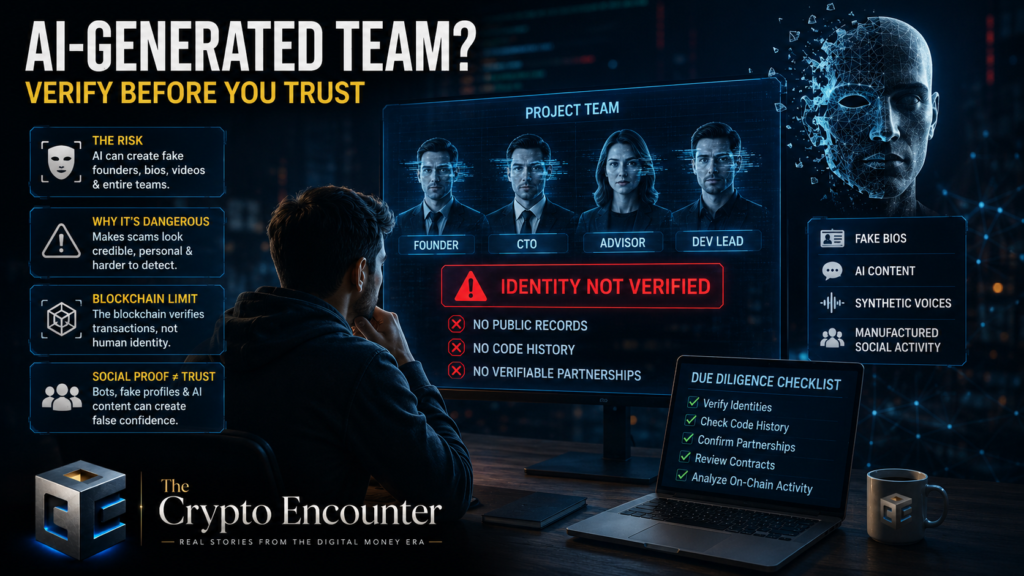
Crypto users are becoming familiar with AI-generated images, videos, voices, and written content, but a more serious problem emerges when the people behind a token may also be synthetic.
The Crypto Encounter examines how an AI-generated crypto team can make a project appear professional, active, and trustworthy without giving users clear evidence that real, accountable people are actually behind it. This article explains the risks, the warning signs, and the practical evidence readers should check before trusting an AI-generated token team.
The Polished Founder Who May Not Exist
An AI-generated crypto team does not automatically mean that a project is fraudulent. Legitimate developers can use artificial intelligence to write code, manage support, create content, and analyze data. The problem begins when AI-generated identities are presented as real founders, developers, advisers, or executives without any independent way to verify them.
A token website may feature professional portraits, detailed biographies, interviews, and active social media profiles. Those materials can look convincing, yet appearance alone does not establish identity. This is why readers should understand the difference between a polished online presence and the kind of evidence discussed in The End of “If It Looks Fake, It Is Fake”: How AI Crypto Scams Defeat Visual Trust.
AI Can Manufacture Credibility At Scale
Generative AI gives dishonest operators the ability to create content much faster than traditional scam operations. A supposed founder can have a biography, profile image, interview clips, posts, comments, and automated responses created with relatively little effort.
The U.S. Federal Trade Commission has warned about AI-enabled impersonation and the risks created when synthetic media makes fraudulent communications more convincing. Its actions on AI impersonation and deceptive practices show why realistic digital identities deserve greater scrutiny.
An AI-generated crypto team can therefore create the appearance of a large organization even when very few people, or no verifiable people, are actually responsible for the public identities.
The Fake Team Problem Goes Beyond Fake Photos
Synthetic portraits are only one part of the risk. An AI-generated token team could also include invented employment histories, fictional academic backgrounds, fabricated technical experience, and automated social media activity.
Consider a project that claims its chief technology officer previously worked for a major technology company. That statement should be checked through sources outside the token website. A profile written by the project itself does not independently confirm employment, qualifications, or identity.
Readers can apply the same evidence-based approach explained in What They Never Told You About the Security of Cryptocurrencies by separating claims from independently verifiable evidence.
Social Media Activity Can Create A False Sense Of Safety
Thousands of followers and constant community activity may look reassuring, but social proof can also be manufactured. AI tools can generate replies, vary writing styles, create profile images, and maintain apparently active conversations.

A supposed community may therefore contain a mixture of real users, automated accounts, coordinated promotion, and synthetic identities. The presence of constant activity does not prove that an AI-generated crypto team has real-world accountability.
The U.S. Securities and Exchange Commission has also warned investors about online investment fraud and deceptive schemes. Its investor guidance on crypto asset fraud emphasizes the importance of independently evaluating claims instead of relying on promotional material.
The Blockchain Cannot Verify A Founder’s Face
Blockchain transparency has limits that ordinary users sometimes overlook. A public blockchain can show that a wallet moved funds or interacted with a smart contract. It cannot automatically prove who controls that wallet in the real world.
That distinction matters when examining an AI-generated token team. A project may have visible contracts and on-chain activity while the identities shown on its website remain impossible to verify.
Understanding this separation between blockchain evidence and personal control is also important when considering The DeFi Wallet Separation Rule. On-chain transparency can provide useful evidence, but it should not be confused with verified human identity.
When One Real Founder Hides A Synthetic Organization
The problem does not always involve an entirely fictional project. A real individual may exist while other executives, developers, advisers, or community managers are synthetic.
In that situation, users need to ask who actually performs the important functions. Who controls the treasury? Who can upgrade the contract? Who manages official accounts? Who has authority over token allocations?
An AI-generated crypto team becomes particularly risky when it makes responsibility difficult to trace. A long team page can create the impression of accountability while hiding the fact that only one unidentified operator controls the project’s assets and decisions.
Real Partnerships Need Independent Confirmation
Projects frequently display partner logos, audit claims, exchange relationships, or technology affiliations to strengthen credibility. Check these claims through the alleged partner’s official communications.
If a token claims a partnership, search for confirmation from the other organization rather than relying on the token’s announcement alone. The same principle applies to security audits. A project should not merely display an auditor’s logo if readers cannot locate the original audit report.
This verification mindset is closely connected to Why KYC Does Not Mean Your Funds Are Protected, which explains why one trust signal should not be mistaken for broader protection.
Why AI Makes The Trust Crisis More Personal
Traditional scams often depended on obvious warning signs such as poor grammar, stolen images, and badly designed websites. AI weakens those visual shortcuts by producing polished material that can adapt to the audience.
A fake team member can appear to answer questions personally. Automated systems can remember previous conversations and tailor messages around a user’s interests. Synthetic voice and video can make a project seem more human.
The National Institute of Standards and Technology provides broader context on AI risk management, including the importance of understanding and managing risks associated with AI systems. For crypto users, the practical lesson is that convincing communication is no longer strong proof of authenticity.
What To Check Before Trusting A Token Team
Start outside the project’s own website. Search for evidence that existed before the token launched. Genuine professional histories may include previous publications, open-source contributions, conference appearances, company records, or independently documented work.
Next, examine whether important claims can be confirmed. Check named partnerships, audit reports, contract addresses, and corporate information where available.
Users should also understand broader custody and control risks through Your Exchange Balance Is Not the Same as Your Crypto. The identity of a token team and the control of project assets are different questions, but both require evidence rather than assumptions.
A Practical Evidence Test For An AI-Generated Crypto Team
Before trusting an AI-generated crypto team, compare each major claim with evidence that comes from an independent source.
| Project Claim | Evidence Worth Checking |
| Founder identity | Independent professional records |
| Developer experience | Public code or technical history |
| Company existence | Official registration records |
| Partnership | Confirmation from the named partner |
| Security audit | Original auditor report |
| Treasury management | Publicly disclosed controls where available |
| Team expertise | Work that predates the token launch |
This approach does not require users to become digital forensic experts. It simply requires them to stop treating a professional presentation as proof that the people behind it are real.
Who Can Actually Be Held Accountable?
The most important question may be the simplest: who is responsible if something goes wrong?
A token can have a sophisticated website and still offer little accountability. If users cannot identify who controls the treasury, approves contract changes, or makes key decisions, they may have no meaningful way to evaluate operational risk.
Readers concerned about hidden risks can also explore KYC Fund Protection and the Limits of Platform Trust, because identity checks, professional branding, and account access do not automatically establish financial protection or responsible control.
When Appearance Stops Being Evidence
The rise of synthetic media changes how crypto users should think about trust. A photograph can be generated. A biography can be written automatically. A voice can be cloned. A video can be manipulated. Software can handle a conversation.
This does not mean every AI-assisted crypto project is fraudulent. It means the standard for trust should move away from appearance and toward independently verifiable evidence.
For a wider understanding of crypto security risks, readers can review The Crypto Encounter’s security coverage, which explores why technical systems, human behavior, and platform structures can create different layers of risk.
Conclusion
An AI-generated crypto team represents a growing trust challenge because AI can make crypto projects look more credible, personal, and active than their underlying evidence supports. The real danger is not simply the use of artificial intelligence. It is the possibility that synthetic identities can replace accountability.
An AI-generated token team should encourage users to investigate who controls the project, where important claims can be verified, and whether independent evidence supports the public story. Photos, biographies, followers, videos, and automated conversations can all be persuasive, but they are no longer enough on their own. In crypto, evidence matters more when appearance becomes easier to manufacture.
FAQs About AI-Generated Token Teams
Can An Entire Crypto Team Be AI-Generated?
Yes, AI can generate realistic portraits, biographies, voices, videos, and written communications. However, AI-generated content alone does not prove that a project is fraudulent. The key question is whether the people presented as responsible for the project can be independently verified.
Is An AI-Generated Crypto Team Always A Scam?
No. Legitimate crypto projects may use AI for content, coding, research, or customer support. The concern arises when synthetic identities replace real people while users are led to believe those identities are independently verifiable.
Can Blockchain Data Prove Who Created A Token?
Usually, no. Blockchain data can show what an address or smart contract did, but it does not automatically reveal the real-world identity of the person controlling it.
What Is The Biggest Risk Of An AI-Generated Token Team?
The biggest risk is manufactured credibility. Investors may trust realistic identities, polished content, and apparent expertise without having evidence that accountable people actually stand behind the project.
Disclaimer
This article is for educational and informational purposes only and does not constitute financial, investment, legal, tax, or security advice. Cryptocurrency projects involve significant risks, including fraud, loss of funds, technical failures, and irreversible transactions. Readers should independently verify token team identities, project claims, smart contracts, partnerships, and official records before making decisions. Never rely solely on AI-generated content, social media activity, testimonials, or promotional material when evaluating a cryptocurrency, token project, or digital asset investment.