

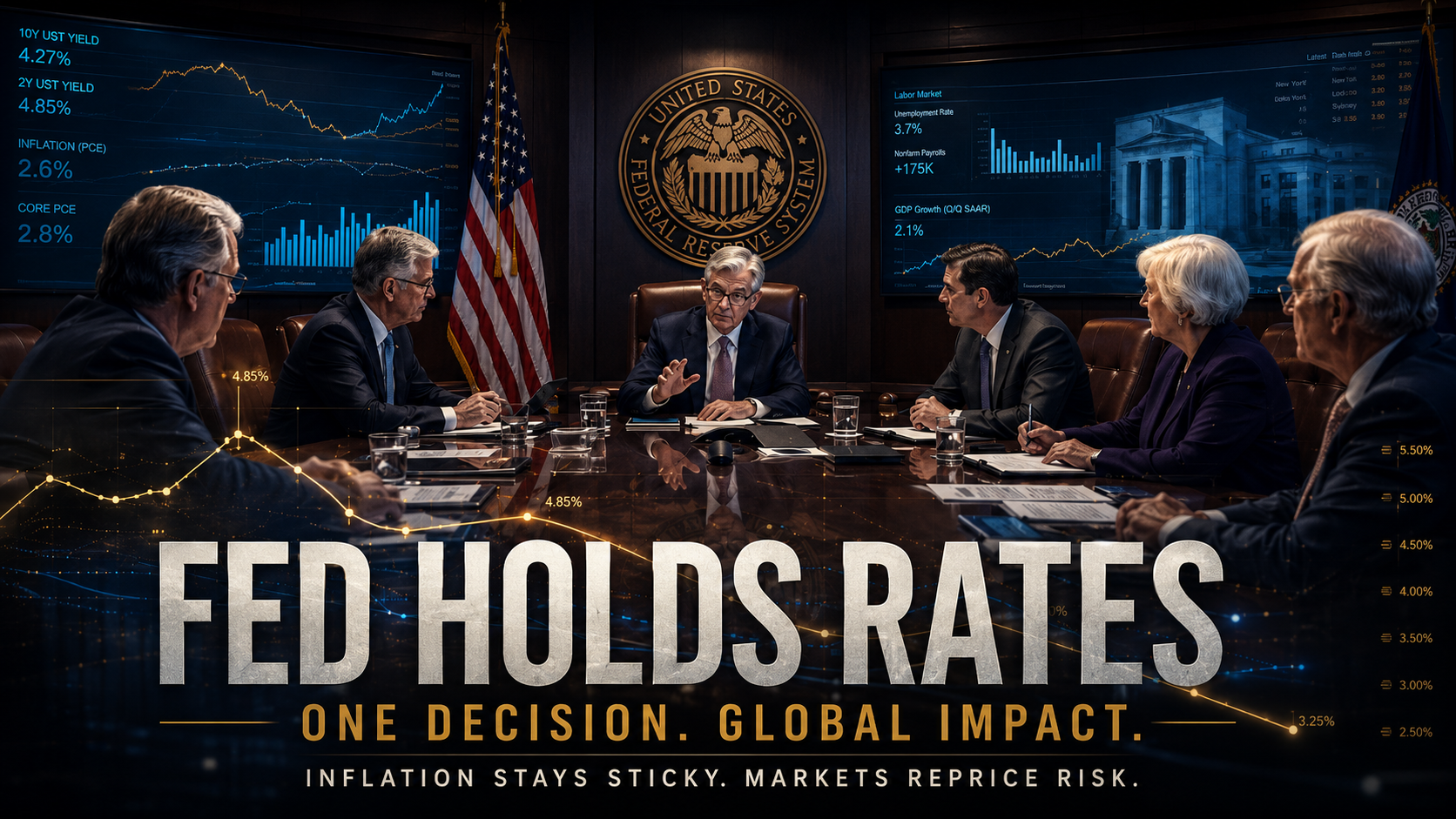
Gold, stocks, and crypto felt the heat. The real question is what comes next.
The Federal Reserves held interest rates steady again. That sounds like a quiet decision. No rate cut. No rate hike. No dramatic move on the surface.
Markets still reacted.
Stocks fell. Gold came under pressure. The U.S. dollar strengthened. Treasury yields moved higher. Crypto weakened as Bitcoin and Ethereum slipped with the broader risk-off mood.
That is the strange power of the Fed.
It does not need to move rates to move markets.
Sometimes, the signal does enough damage.
The June 17, 2026 Fed decision kept the federal funds target range at 3.50% to 3.75%. The bigger message came from the tone around inflation and the updated rate projections. Inflation remains above the Fed’s 2% target. Policymakers are no longer giving markets the easy comfort of quick rate cuts. Nearly half of Fed officials now see a possible rate hike in 2026.
That one shift changed the mood across global markets.
It reminded investors that money still has a price.
ALSO READ: What They Never Told You About the Security of Cryptocurrencies
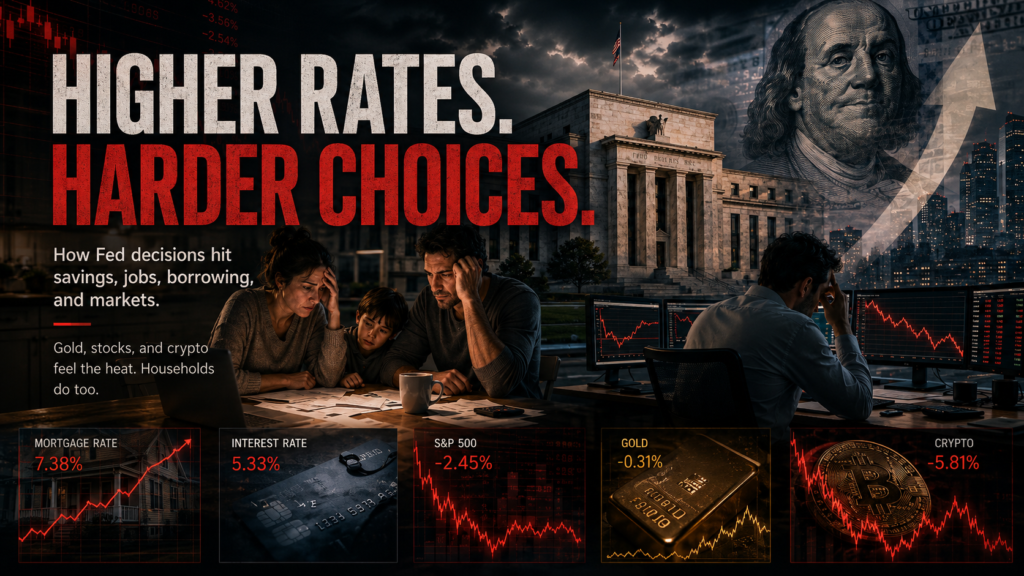
For households, it means credit remains expensive. For businesses, funding stays tight. For investors, portfolio risk needs fresh thinking. For crypto markets, liquidity remains the quiet boss in the room. For gold, higher yields and a stronger dollar can turn a safe-haven trade into a frustrating one.
This is why Fed rate decisions matter far beyond Washington.
They shape the cost of borrowing, the price of risk, the value of currencies, the direction of capital flows, and the financial choices people make every day.
The Fed may speak in policy language.
The world hears it in mortgage payments, credit card bills, stock prices, gold charts, crypto candles, business loans, and career decisions.
Why a Federal Reserves Hold Still Moved the Market
A rate hold can mislead casual readers.
People see “unchanged” and assume nothing happened.
Markets know better.
The Fed decision is only one part of the story. The statement, projections, inflation outlook, dot plot, and press conference all carry weight. Investors look for the future path, not just the current rate.
This time, the future path looked less friendly.
The Fed kept rates unchanged, but the updated projections showed officials are still worried about inflation. That matters because the market had spent months hoping for rate cuts. Investors wanted confirmation that easier money was coming. Instead, they received a reminder that the Fed may stay restrictive for longer.
That is enough to hit stocks.
Higher expected rates make future corporate earnings less attractive today. Growth stocks feel that pressure more because their valuations depend heavily on future profits. When the discount rate rises, the market starts asking harder questions.
Gold also suffered.
That may sound odd because gold often benefits during uncertainty. Yet gold does not pay interest. When Treasury yields rise and the dollar strengthens, investors can become less willing to hold a non-yielding asset, even in uncertain times.
Crypto took the hit too.
Bitcoin and Ethereum are not directly controlled by the Fed, but they are deeply sensitive to global liquidity. When investors expect tight financial conditions, speculative appetite weakens. Crypto usually feels that early because it sits near the riskier end of the financial spectrum.
This is the key point.
The Fed held rates steady, but the market heard a warning: do not assume cheap money is coming back soon.
How Federal Reserves Decisions Travel Through the Global System
The Fed does not control every economy.
It does not set mortgage rates in Dubai, business loan costs in London, crypto liquidity in Singapore, or gold demand in India.
Still, its decisions travel everywhere.
The transmission starts with U.S. interest rates.
When the Fed keeps rates high, U.S. Treasury yields tend to stay attractive. Global investors then compare every asset against that benchmark. Why take more risk if safe U.S. debt offers a strong return? That question affects stocks, commodities, emerging markets, currencies, crypto, and private investment.
Then comes the dollar.
Higher U.S. rates can strengthen the dollar because global capital often moves toward dollar assets. A stronger dollar makes imports cheaper for the U.S., but it can make life harder for countries and companies that borrow in dollars.
That pressure matters.
Many emerging-market governments, banks, and businesses carry dollar-linked debt. When the dollar rises, repayment becomes more expensive in local currency terms. Inflation can also become harder to manage because commodities such as oil are priced in dollars.
After that, the pressure reaches global trade.
A strong dollar can weaken demand in some parts of the world. It can make U.S. exports less competitive. It can tighten financial conditions for countries that rely on foreign capital. It can also force other central banks to keep their own rates higher than they would like, simply to defend currencies and contain inflation.
This is how one Fed decision becomes a global event.
The Fed speaks locally.
Markets translate globally.
The Impact on Ordinary People
Fed rate decisions may feel distant, but ordinary people meet them in very practical ways.
The first place is debt.
Credit card balances become harder to carry when rates remain elevated. Personal loans stay expensive. Car financing feels heavier. Mortgage affordability remains stretched. Anyone hoping for quick refinancing relief may need to wait longer.
That changes household behavior.
Families delay home purchases. Young professionals postpone major financial decisions. Parents rethink education costs. People with variable-rate debt feel anxious. Households with weak savings avoid risk and cut spending.
The second place is savings.
Higher rates can help savers earn more from deposits, money market funds, and short-term fixed-income products. That sounds positive, and for some people it is. But the benefit depends on whether savings income can keep up with the wider cost of living.
Inflation still matters.
If prices remain high, better savings yields may only soften the pain. They may not restore lost purchasing power.
The third place is employment.
Higher rates can slow business expansion. Companies may delay hiring, freeze projects, reduce marketing budgets, or rethink expansion plans. In sectors that depend heavily on cheap financing, the pressure can arrive faster.
That includes real estate, startups, construction, tech, crypto, venture-backed businesses, and debt-heavy companies.
Professionals feel this through fewer openings, slower salary growth, tighter budgets, and more cautious leadership decisions.
A Fed rate decision does not send a layoff email.
It changes the environment in which those emails become more likely.
What Investors Should Read from Federal Reserves Decision
Investors should avoid two lazy reactions.
The first is panic.
The second is denial.
The Fed decision does not mean the global financial system is collapsing. It also does not mean investors can ignore rate risk.
The smarter reading sits in the middle.
This Fed decision tells investors to respect the cost of capital. Every asset now needs to justify itself against a world where money is still not cheap.
For stock investors, that means valuation discipline matters again. Strong companies with real earnings, durable margins, and pricing power should command more respect than businesses built only on future hope.
For bond investors, the path is more complicated. Higher yields can create income opportunities, but bond prices can still suffer if rates rise further. Duration risk matters. So does credit quality.
For gold investors, the lesson is patience. Gold can still play a role as a hedge against inflation, geopolitical stress, and currency debasement fears. Yet higher real yields and a stronger dollar can pressure gold in the short term.
Crypto investors need the clearest warning.
Bitcoin may be a long-term monetary asset to many believers, but it still trades inside the global liquidity cycle. Ethereum, altcoins, DeFi tokens, and speculative crypto assets are even more sensitive. When the Fed sounds hawkish, leverage becomes dangerous and weak narratives get punished.
In simple terms, this is not the market for blind risk.
It is a market for selectivity.
Why Gold Felt the Heat
Gold’s reaction after the Fed decision deserves attention.
Many people assume gold should rise whenever uncertainty increases. That is only half the story.
Gold responds to several forces at once.
Inflation fear can support gold.
Geopolitical stress can support gold.
Central bank buying can support gold.
Dollar weakness can support gold.
Lower real yields can support gold.
This time, the Fed gave markets a reason to focus on yields and the dollar.
When investors believe U.S. rates may stay higher for longer, Treasury yields become more attractive. Gold then faces a tougher comparison because it pays no income. If the dollar strengthens at the same time, gold can become more expensive for non-U.S. buyers.
That is why gold can fall even when the world feels uncertain.
The asset is not broken.
The setup changed.
For long-term investors, gold may still serve as insurance. For short-term traders, the Fed remains a major driver. Those are different games. Mixing them leads to bad decisions.
Why Stocks Sold Off
Stocks hate uncertainty when it comes from interest rates.
The market can handle bad news if it sees rate cuts coming. It can also handle strong growth if inflation stays controlled. The awkward scenario is sticky inflation with no easy policy relief.
That is what investors feared after the Fed decision.
Higher-for-longer rates affect stocks in several ways.
Borrowing costs rise for companies.
Consumer spending can weaken.
Profit margins come under pressure.
Future earnings get discounted more harshly.
Debt-heavy firms look riskier.
Speculative growth stories lose shine.
This does not mean every stock falls equally.
Quality matters. Balance sheets matter. Cash flow matters. Pricing power matters. Companies that can grow without cheap debt stand on firmer ground. Businesses that need constant financing face a tougher road.
The market reaction was a reminder that liquidity still matters, even in an economy that appears stable.
Why Crypto Reacted Quickly to Federal Reserves Move
Crypto often moves like a liquidity thermometer.
When money is loose, risk appetite expands. Investors move further out on the risk curve. Bitcoin benefits. Ethereum follows. Altcoins can run hard. Leverage builds. Narratives become louder.
When liquidity tightens, the process reverses.
The Fed’s decision reminded crypto markets that the easy-money trade is not guaranteed. Bitcoin and Ethereum slipped because investors recalibrated expectations. If rate cuts move further away, speculative capital becomes more selective.
That does not destroy the long-term crypto case.
It does change the short-term trading environment.
Bitcoin may still attract investors who see it as digital scarcity. Ethereum may still benefit from network development, stablecoins, tokenization, and institutional use cases. But price does not move on belief alone. Liquidity, leverage, and macro expectations still matter.
For crypto professionals, this is important.
Content, marketing, product strategy, exchange activity, token launches, and investor education all become harder when macro conditions tighten. Audiences become more skeptical. Retail participation slows. Institutional capital asks sharper questions.
The Fed does not run crypto.
It still affects the room crypto trades in.
What This Means for Professionals
Fed rate decisions do not only affect portfolios.
They affect careers.
When rates stay higher, companies become more careful with spending. Hiring slows in some sectors. Marketing budgets face scrutiny. Startups extend runways. Real estate projects get reviewed. Crypto firms reduce risk. Venture capital becomes more selective.
Professionals need to read that shift early.
This is not the moment to position yourself as someone who only adds output. Companies under pressure want people who can protect margin, improve systems, reduce waste, manage risk, and create measurable value.
Finance teams become more important.
Risk teams gain influence.
Content teams must prove business relevance.
Marketing teams need sharper attribution.
Founders need clearer capital discipline.
Operations leaders must build efficiency.
Crypto professionals need stronger credibility, not louder hype.
The Fed’s decision may sound like a macro story, but it quietly changes workplace behavior. A company facing expensive capital does not think the same way as a company living in a cheap-money boom.
That affects hiring, promotions, budgets, freelance demand, and leadership priorities.
What Could Happen at the Next Meeting of Federal Reserves?
Nobody can predict the next Fed move with certainty.
Anyone pretending otherwise is selling confidence, not analysis.
The honest answer is that the Fed will likely stay data-dependent. Inflation, jobs, wage growth, energy prices, geopolitical shocks, consumer spending, credit stress, and financial conditions will all matter.
Still, the latest signals suggest three possible paths.
Scenario 1: The Federal Reserves Holds Again
This may be the base case if inflation remains elevated but does not accelerate. A hold would keep pressure on borrowers and risk assets, but markets may accept it if the Fed avoids sounding more hawkish.
For investors, this would mean continued range-bound behavior across many assets. Stocks could remain selective. Gold may depend heavily on the dollar and yields. Crypto could struggle without a stronger liquidity signal.
Scenario 2: The Federal Reserves Hikes Rates
A hike becomes more likely if inflation stays hot, energy prices rise further, or the labor market remains too strong for the Fed’s comfort.
This would likely hit risk assets harder.
Stocks could sell off. Gold may face more pressure if yields and the dollar rise again. Crypto would probably react quickly, especially if leverage is high.
A hike would also send a tough message to households and businesses: relief is not near.
Scenario 3: The Federal Reserves Turns Softer
A softer Fed tone would need evidence that inflation is moving clearly lower or that growth is weakening enough to justify caution.
Markets would likely welcome that.
Stocks could recover. Gold may benefit if yields fall. Crypto could see renewed risk appetite. Borrowers would still not feel instant relief, but expectations would improve.
Right now, the Fed has not handed markets that gift.
The next move depends on the data.
The market’s problem is that the data has not been kind enough yet.
Is the Global Financial System in Danger?
This question needs a careful answer.
The global financial system is not in immediate danger simply because the Fed held rates.
That would be an exaggeration.
The better answer is that the system is under pressure.
High U.S. rates, a strong dollar, sticky inflation, expensive debt, geopolitical uncertainty, and fragile liquidity can create stress across several areas at once.
Emerging markets can feel pressure through currency weakness and dollar debt.
Banks can face pressure if loan quality worsens.
Consumers can struggle with debt servicing.
Companies can reduce investment.
Real estate can slow.
Crypto can suffer from lower liquidity.
Governments with high debt burdens can face higher financing costs.
That does not equal collapse.
It does mean the margin for error becomes smaller.
Financial systems usually break when several pressures overlap. Rates alone may not be enough. But rates plus debt, inflation, weak growth, geopolitical shocks, and market leverage can create difficult conditions.
So the serious answer is this:
The global financial system is not flashing a clear collapse signal, but it is operating in a tighter, less forgiving environment.
That distinction matters.
Fear gets clicks.
Precision builds trust.
The U.S. Dollar’s Position in a Changing Global Landscape
Every few years, someone declares the dollar’s dominance finished.
The reality is more complicated.
The dollar is still the center of the global financial system. It dominates trade invoicing, reserves, debt markets, commodities pricing, and global funding channels. When stress rises, investors still often move toward dollar assets.
The latest Fed decision showed that again.
Higher U.S. rates and a stronger dollar can pull global capital toward the United States. That reinforces the dollar’s strength in the short term.
Yet the long-term landscape is changing.
Countries are exploring alternatives. Central banks have been buying gold. Some trade arrangements are slowly shifting away from dollar dependence. China wants a larger role for the yuan. Digital currencies, tokenized settlement systems, and regional payment networks may reduce dollar reliance at the edges.
Still, replacing the dollar is much harder than criticizing it.
A global reserve currency needs deep markets, legal trust, liquidity, convertibility, military and diplomatic reach, institutional credibility, and broad acceptance. The United States still has those advantages, even with political dysfunction and rising debt concerns.
The dollar’s position is not untouchable.
It is also not easily replaced.
The better way to frame it is this:
The dollar remains dominant, but the world is slowly trying to reduce its vulnerability to dollar shocks.
Fed decisions are one reason why.
When the Fed tightens, the whole world feels it. That creates resentment, adaptation, and gradual diversification. But diversification is not the same as displacement.
The dollar is still the main road.
Other countries are building side streets.
What People Should Do After Federal Reserves Latest Rate Move
This article is not financial advice.
It is a framework for thinking clearly.
For households, the priority is simple: reduce vulnerability. High-interest debt needs attention. Emergency savings matter. Big purchases should be stress-tested. Variable-rate exposure should be understood.
For investors, selectivity matters. Do not chase every dip. Do not assume rate cuts will rescue weak assets. Focus on balance sheets, cash flow, liquidity, and risk-adjusted returns.
For crypto investors, respect macro conditions. Bitcoin and Ethereum may have strong long-term narratives, but leverage can still punish short-term complacency. Altcoins need extra caution when liquidity tightens.
For professionals, this is the time to become useful in measurable ways. Companies will value people who can protect revenue, control cost, improve systems, manage risk, and communicate clearly during uncertainty.
For business owners, cash flow is king again. Debt-funded expansion should be reviewed carefully. Pricing, margins, collections, and working capital deserve close attention.
For policymakers outside the United States, the message is uncomfortable but familiar. Fed decisions still shape global financial conditions. Domestic policy cannot ignore dollar pressure.
The Real Lesson From the Fed Decision
The Fed held rates, but the world still moved.
That is the lesson.
A central bank decision can hit gold, stocks, crypto, currencies, debt markets, mortgage expectations, business funding, household budgets, and professional choices.
The impact is rarely equal.
Savers may benefit from higher yields. Borrowers may suffer. Strong companies may survive. Weak balance sheets may crack. Gold may struggle in the short term but keep its long-term role. Crypto may remain promising while still reacting badly to tighter liquidity.
Markets are not asking one question right now.
They are asking several.
Will inflation fall?
Will the Fed hike again?
Can the economy handle higher rates?
Will the dollar stay strong?
Can stocks justify valuations?
Will crypto find fresh liquidity?
Can gold regain momentum?
Will households and businesses keep absorbing the pressure?
Those questions will shape the next phase.
Federal Reserves Latest Move in a Nutshell
Fed rate decisions affect the global financial system by influencing U.S. Treasury yields, the dollar, borrowing costs, stock valuations, gold prices, crypto liquidity, business funding, household debt, and global capital flows.
The June 17, 2026 Fed decision kept rates unchanged at 3.50% to 3.75%, but markets reacted because policymakers signaled persistent inflation concern and possible rate-hike risk later in 2026. Stocks fell, gold weakened, the dollar strengthened, yields moved higher, and crypto slipped.
For ordinary people, the impact shows up through credit cards, mortgages, car loans, savings yields, job market caution, and weaker portfolio values. Investors may become more selective. Professionals may need to prove measurable value as companies manage tighter budgets.
The global financial system is not in immediate danger from one Fed hold, but it is under pressure from high rates, sticky inflation, dollar strength, debt costs, and geopolitical uncertainty.
The U.S. dollar remains dominant, although more countries are exploring ways to reduce dependence on dollar-based financial shocks.
The Final Word: Federal Reserves Holds Rate. What’s Next?
The Federal Reserves did not cut rates.
Markets wanted comfort and received caution.
That was enough.
Gold, stocks, and crypto all felt the heat because the Fed’s message changed expectations. Money remains expensive. Inflation is still a problem. The dollar still has power. Global liquidity is not moving freely enough to make investors relaxed.
For ordinary people, this means debt decisions matter. Savings strategy matters. Career positioning matters. Household budgets need realism.
For investors, discipline matters more than excitement.
For crypto markets, liquidity still sets the mood.
For the global financial system, the warning is clear but not apocalyptic. The system is not falling apart, but it is moving through a tighter corridor. Mistakes cost more there.
The next Fed move will depend on inflation, jobs, growth, energy prices, and financial stability. Until the data changes clearly, markets should not assume relief is guaranteed.
That is the real heat of the moment.
The Fed held rates.
The world still adjusted.
FAQs
What did the Federal Reserve decide in June 2026?
The Federal Reserve held its key interest rate unchanged at 3.50% to 3.75% on June 17, 2026. The decision came with signals that inflation remains a concern and that some policymakers see possible rate-hike risk later in the year.
Why did markets react if the Fed did not change rates?
Markets reacted because investors care about the future path of interest rates. The Fed’s projections and tone suggested that rates may stay higher for longer, with possible rate-hike risk if inflation remains elevated.
How do Fed rate decisions affect gold?
Fed rate decisions affect gold through Treasury yields and the U.S. dollar. Higher yields can make non-yielding gold less attractive, while a stronger dollar can pressure gold prices for global buyers.
How do Fed rate decisions affect stocks?
Higher rates can pressure stocks by increasing borrowing costs, lowering the present value of future earnings, and making safer assets more competitive. Growth stocks and debt-heavy companies often feel this more strongly.
How do Fed rate decisions affect crypto?
Crypto is highly sensitive to liquidity and risk appetite. When the Fed sounds hawkish or keeps rates high, investors often reduce exposure to speculative assets, which can pressure Bitcoin, Ethereum, and altcoins.
What impact do Fed decisions have on ordinary people?
Fed decisions influence mortgage rates, credit card costs, car loans, savings yields, business funding, job market conditions, and household spending decisions.
Is the global financial system in danger?
The global financial system is not in immediate danger because of one Fed rate decision, but it is under pressure from high rates, sticky inflation, dollar strength, debt burdens, and geopolitical uncertainty.
What could the Fed do next?
The Fed could hold rates steady, hike if inflation remains too high, or turn softer if inflation falls clearly or growth weakens. The next move will depend on incoming data.
Is the U.S. dollar losing its global power?
The dollar remains the dominant global currency, but countries are slowly exploring alternatives to reduce dependence on dollar-based financial shocks. Diversification is increasing, but full replacement remains difficult.