

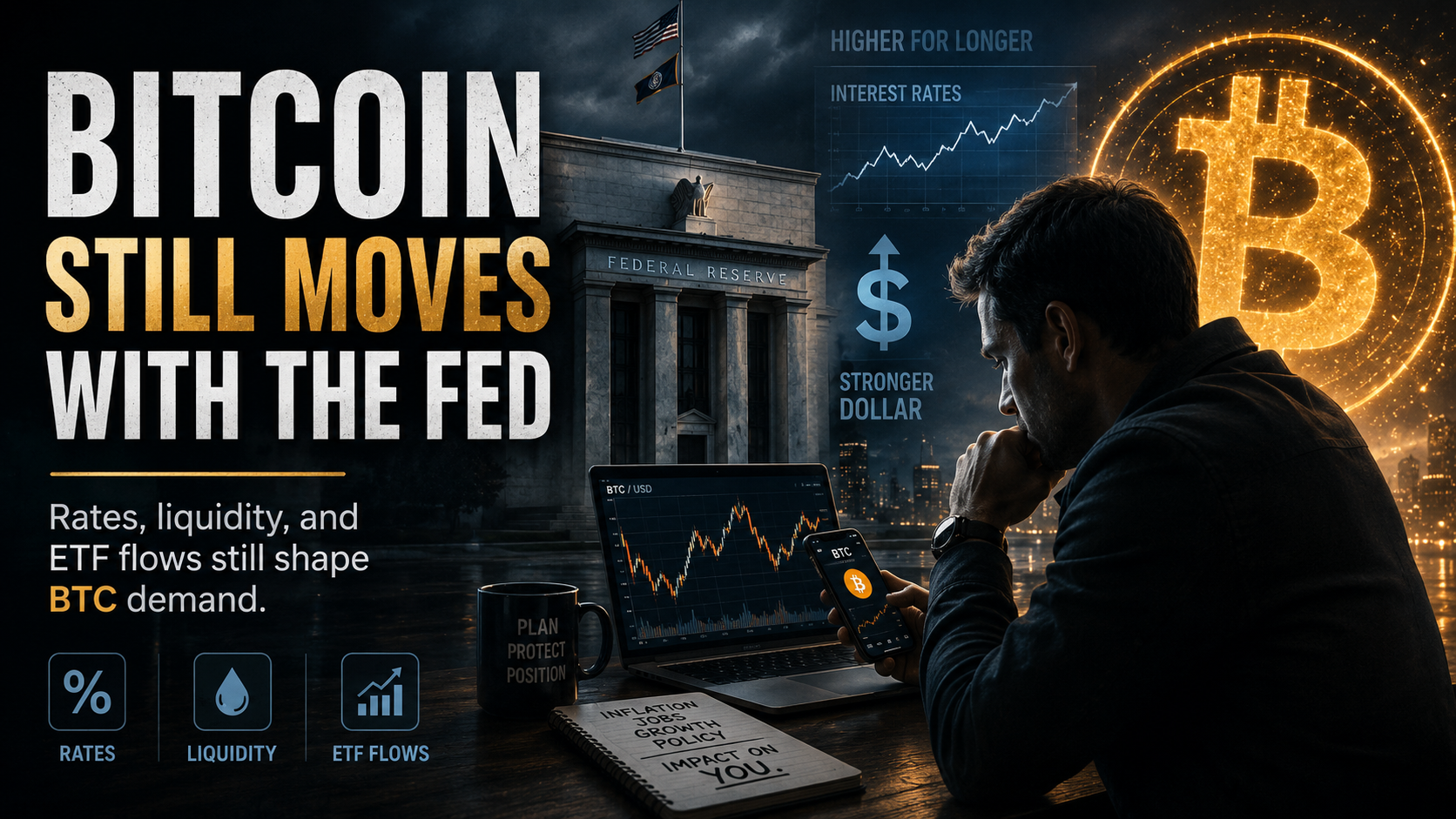
Bitcoin was built outside the central banking system. Its price still lives inside the global liquidity cycle.
Bitcoin likes to sound independent.
Its supply is fixed. Its issuance schedule is coded. No central bank can print it. No government can change the 21 million cap. No Federal Reserve chair can walk into a room and decide that Bitcoin needs a little more supply to calm markets.
That is the beauty of the asset.
It is also where many investors get careless.
Bitcoin may be independent in design, but its market price still reacts to the same forces that move stocks, bonds, gold, the U.S. dollar, and global risk appetite. The latest Federal Reserve rate decision proved that again.
The Fed held its key interest rate unchanged at 3.50% to 3.75%. On paper, that looked like no action. In markets, it landed with weight. Policymakers kept inflation at the center of the conversation, and nearly half of them now see a possible rate hike in 2026.
Bitcoin felt the message.
The price slipped near $64,000 as investors absorbed the idea that easy money may not return quickly. Gold came under pressure. Stocks weakened. The dollar strengthened. Treasury yields moved higher. Crypto, once again, traded like a liquidity-sensitive asset.
That does not make Bitcoin weak.
It makes Bitcoin honest.
ALSO READ: Zama, Morpho and Steakhouse Bring Confidential DeFi to Ethereum
For all its long-term monetary appeal, Bitcoin still trades in a world where investors compare risk, yield, liquidity, and opportunity cost every day. When the Fed keeps money expensive, capital becomes pickier. When the dollar strengthens, global liquidity tightens. When Treasury yields become more attractive, speculative assets have to work harder for attention.
Bitcoin can reject central bank control.
It cannot ignore central bank gravity.
The Fed does not control Bitcoin, but it controls the mood around risk
The Federal Reserve does not set Bitcoin’s supply.
That part is simple.
The harder part is understanding how the Fed shapes the environment around Bitcoin demand.
When U.S. interest rates are low, investors usually feel more comfortable taking risk. Cash earns little. Bonds offer weak returns. Growth stocks become more attractive. Crypto gets more attention. Venture capital expands. Retail traders get active. Leverage builds.
Bitcoin often benefits from that kind of world.
Liquidity moves outward.
When rates rise or stay high, the flow changes. Cash becomes more useful. Treasury yields compete with risk assets. Borrowing becomes expensive. Investors reduce leverage. Funds rebalance. Traders become less patient with assets that do not generate income.
Bitcoin then has to compete against safer yield.
That is not easy.
A Bitcoin believer may say the asset is digital gold, hard money, or a hedge against fiat debasement. Those arguments matter over longer periods. Yet in the short term, portfolio managers still ask one basic question: why hold more Bitcoin now when cash and Treasuries offer meaningful returns with lower volatility?
That question does not destroy Bitcoin.
It changes the timing of demand.
This is why Fed rate decisions matter even when rates are left unchanged. Markets care about what comes next. If the Fed sounds cautious, hawkish, or worried about inflation, investors adjust before the next rate move even happens.
Bitcoin reacts to expectations.
Sometimes that reaction comes before the policy change.
Bitcoin and liquidity: the quiet connection most people ignore
Bitcoin trades like a monetary asset in some periods and a high-beta risk asset in others.
That confuses people.
During banking stress, currency concerns, or sovereign-debt anxiety, Bitcoin can attract buyers who want protection from the traditional system. During broad market selloffs, it can fall with tech stocks and speculative assets.
Both behaviors can be true.
The link is liquidity.
Bitcoin needs capital willing to take risk. It needs buyers with cash, confidence, and time. If global liquidity improves, Bitcoin often finds support. When liquidity tightens, the market becomes less forgiving.
This is why Fed decisions travel into crypto so quickly.
Higher rates pull money toward safer dollar assets. A stronger dollar makes global funding tighter. Reduced risk appetite lowers demand for speculative positions. Leveraged traders get squeezed faster. ETF flows become more sensitive. Retail excitement fades.
Bitcoin’s fixed supply does not stop any of that.
Supply scarcity matters most when demand is strong.
When demand weakens, even a scarce asset can fall.
That is not a contradiction. It is how markets work.
The dollar still sits in the middle of Bitcoin’s story
Bitcoin is often described as an alternative to the dollar.
Fair enough.
Many long-term holders see it as protection against monetary debasement, government debt, inflation, and central bank mistakes. That narrative has carried Bitcoin through several cycles.
Yet Bitcoin’s price is still mostly quoted in dollars. Most institutional flows are measured in dollars. ETF inflows and outflows happen in dollar terms. Stablecoin liquidity is dollar-heavy. Global crypto trading still depends heavily on dollar-based settlement rails.
So when the dollar strengthens, Bitcoin feels it.
ALSO READ: How Bhutan Raises a Huge Sovereign Traeasury Question with $34.5M Bitcoin Move to Binance
A stronger dollar usually means tighter global financial conditions. It can pressure commodities, emerging-market assets, gold, and crypto. It also increases the cost of dollar funding outside the United States.
That matters because Bitcoin is global.
A trader in Asia, a fund in Europe, a remittance user in Africa, a miner in Latin America, and an ETF investor in the United States all interact with a market where dollar liquidity sets the tone.
Bitcoin may challenge the dollar in theory.
In daily trading, it still breathes through dollar liquidity.
This is where the Fed remains powerful. A hawkish Fed can support the dollar, lift yields, and reduce the appetite for assets that need fresh risk capital. Bitcoin can survive that environment, but it usually does not enjoy it.
ETF flows made Bitcoin more institutional, and more macro-sensitive
Spot Bitcoin ETFs changed the market.
They made Bitcoin easier to buy for institutions, advisers, funds, and traditional investors. That helped bring serious capital into the asset. It also connected Bitcoin more directly to traditional portfolio behavior.
That connection cuts both ways.
When ETF inflows are strong, Bitcoin can absorb selling pressure more easily. New demand enters through regulated market channels. Institutions allocate. Advisers rebalance. Media attention improves. Confidence builds.
Outflows create the opposite feeling.
If investors pull money from spot Bitcoin ETFs, the market reads it as a sign that institutional demand is cooling. That becomes especially important when macro conditions are already difficult.
Recent ETF outflow pressure has been one of the clearest signals that Bitcoin is no longer trading only on crypto-native enthusiasm. Traditional investors now matter. Their behavior depends on interest rates, dollar strength, equity market risk, bond yields, client positioning, and portfolio volatility.
Bitcoin wanted institutional adoption.
It got it.
Now it also gets institutional discipline.
Funds do not always hold because the community believes. They rebalance. They reduce exposure. They manage risk. They respond to Fed signals. They answer to clients.
This is one reason Bitcoin may move more with macro conditions than some early believers expected.
The asset entered Wall Street.
Wall Street brought its habits.
Why Bitcoin reacts faster than many investors expect
Crypto trades 24/7.
That gives Bitcoin a strange role in global markets. When a major policy signal hits, Bitcoin often reacts before traditional markets fully reopen or before slower investors can reposition.
A Fed decision lands.
Bond yields move.
The dollar reacts.
Stock futures adjust.
Crypto traders respond instantly.
That speed can make Bitcoin look more fragile than it is. In reality, the market is simply always open. It absorbs emotion, leverage, fear, and speculation in real time.
This is why Fed days can produce sharp moves.
Traders are not only reacting to the current rate. They are reacting to the dot plot, inflation forecasts, press conference tone, dollar direction, ETF flow expectations, and what the bond market is pricing next.
The first move is often emotional.
The second move is usually more useful.
After the initial reaction, investors start asking whether Bitcoin’s long-term thesis has changed. Most of the time, it has not. The supply cap remains. The halving schedule remains. The network keeps producing blocks.
What changes is the price investors are willing to pay today.
That difference matters.
Bitcoin’s protocol can be steady while its market price remains highly sensitive.
The Fed rate decision and Bitcoin’s current setup
The latest Fed decision arrived at a delicate moment for Bitcoin.
The asset was already under pressure from weaker liquidity, ETF outflows, stronger dollar conditions, and growing doubt over near-term risk appetite. The Fed then added another layer by keeping rates unchanged while maintaining a tough inflation stance.

Markets did not hear relief.
They heard patience.
Patience sounds calm in central-bank language. In risk markets, it can feel like pressure.
If rates stay higher for longer, Bitcoin has to wait for a stronger catalyst. That catalyst could come from renewed ETF inflows, dollar weakness, falling inflation, a softer Fed tone, stronger institutional allocation, or fresh demand from long-term holders.
Without one of those, rallies may struggle.
This is the current tension.
Bitcoin’s long-term story remains powerful, but the short-term environment is not generous.
Our broader analysis of how Fed rate decisions affect the global financial system explains why the Fed’s signal can pressure gold, stocks, crypto, the dollar, and household finances at the same time. Bitcoin is part of that system now, whether its culture likes the idea or not.
That is not an insult to Bitcoin.
It is the price of becoming a global macro asset.
Bitcoin as digital gold: useful, but incomplete
Bitcoin is often compared with gold.
The comparison makes sense in some ways. Both are scarce. Both sit outside ordinary corporate earnings. Both attract buyers who worry about fiat currency, inflation, debt, and political risk.
Still, the comparison has limits.
Gold has thousands of years of monetary history. Central banks hold it. Jewelry demand supports it. Institutional investors understand its role as a hedge, even when they disagree about allocation size.
Bitcoin is younger, more volatile, more reflexive, and more dependent on market liquidity.
Gold can fall when yields rise because it pays no interest. Bitcoin can do the same, but often with larger moves because its investor base is more risk-sensitive and its market structure includes more leverage.
That does not make Bitcoin inferior.
It makes it different.
Bitcoin may become a stronger store-of-value asset over time. For now, it still behaves like a hybrid: part digital gold, part tech-like risk asset, part liquidity barometer, part institutional flow product.
That hybrid nature explains why it can rally on monetary fears and fall on hawkish Fed signals.
Investors who understand this are less likely to be surprised.
Why Bitcoin independence is often misunderstood
Bitcoin’s independence is technical and monetary.
It is not emotional.
It means the protocol does not bend to central banks. It does not mean the market ignores human behavior.
Investors still need cash to buy Bitcoin. Funds still need mandates. Traders still use leverage. Miners still pay bills. ETF holders still rebalance. Companies still manage treasury risk. Governments still move coins. Exchanges still depend on liquidity.
The network can be independent while the market remains connected.
That distinction is vital.
A common mistake is assuming Bitcoin should rise every time the Fed looks weak or inflation stays high. Sometimes it does. At other times, the same conditions strengthen the dollar, lift yields, reduce risk appetite, and pressure Bitcoin.
ALSO READ: Ripple Enters African Payments Race with Flutterwave Investment
The path matters.
Inflation with falling real yields may help Bitcoin.
Inflation with a hawkish Fed may hurt it.
Dollar weakness can support Bitcoin.
Dollar strength can weigh on it.
ETF inflows can create demand.
ETF outflows can drain momentum.
This is not betrayal by Bitcoin.
It is market structure.
What investors should watch now
The next stage of Bitcoin’s move will likely depend on five signals.
1. Fed tone
The market will watch whether the Fed sounds more worried about inflation or more concerned about growth. A softer tone could help Bitcoin. A tougher tone may keep pressure on risk assets.
2. Dollar strength
A strong dollar usually makes Bitcoin’s job harder. If the dollar weakens, global liquidity conditions may improve and crypto could find more room.
3. Treasury yields
Higher yields compete with Bitcoin. Falling yields can support risk appetite, especially if inflation expectations cool.
4. Spot Bitcoin ETF flows
ETF flows are now one of the clearest institutional demand signals. Sustained inflows can change sentiment quickly. Continued outflows may keep rallies weak.
5. Long-term holder behavior
If long-term holders keep coins off exchanges, supply pressure may remain controlled. If more large holders move coins to exchanges, traders will become more cautious.
The recent story about Bhutan moving Bitcoin to Binance shows why large-holder behavior still matters. Even when one transfer does not define the market, it can affect sentiment when investors are already nervous.
Bitcoin does not trade on one signal anymore.
It trades on a full dashboard.
What this means for long-term holders
Long-term Bitcoin holders do not need to panic every time the Fed speaks.
That would be exhausting.
The better approach is to understand the difference between thesis and timing.
The thesis is about scarcity, decentralization, monetary discipline, network security, and long-term adoption.
Timing is about liquidity, rates, ETF flows, leverage, dollar strength, and investor positioning.
A strong long-term thesis does not protect anyone from short-term drawdowns.
That is why position sizing matters. So does patience. So does avoiding leverage when macro conditions are unstable.
Bitcoin may remain one of the most important financial assets of the next decade. It can still punish investors who pretend macro does not matter.
The market respects conviction.
It punishes arrogance.
What this means for traders
Traders need to treat Fed weeks with respect.
Bitcoin can move sharply before, during, and after policy announcements. The first reaction is not always the final direction. Liquidity can thin. Leverage can unwind. Stop-loss clusters can get hit. ETF flow expectations can shift.
The smartest traders watch the bond market, the dollar index, tech stocks, ETF data, and funding rates alongside the Bitcoin chart.
A Bitcoin-only screen is no longer enough.
That may annoy purists, but it reflects reality.
Bitcoin now sits inside a larger macro trade. Ignoring that setup is like watching the waves and refusing to check the weather.
What this means for the crypto industry
The Federal Reserves also affects crypto businesses.
When liquidity is loose, users are more active. Exchanges see more volume. Token launches attract attention. DeFi yields feel exciting. Venture capital gets easier. Marketing becomes louder. Retail investors return.
Tighter conditions change the room.
Users become cautious. Token launches struggle. Exchanges fight for volume. DeFi strategies face more scrutiny. Projects without real utility lose attention. Institutional investors ask harder questions.
That is not bad for the industry.
It can clean the market.
Weak narratives often need cheap money. Strong infrastructure can survive tighter conditions because it solves real problems.
This is why stablecoins, payments, tokenization, security, custody, and institutional DeFi may matter more in the next phase than hype-driven launches.
Bitcoin remains the anchor.
The rest of crypto has to prove usefulness.
The Crypto Encounter take
Bitcoin’s independence is real.
Its isolation is not.
The asset was built as an alternative to central bank money, but its market price still responds to the cost of capital, dollar liquidity, ETF flows, and investor behavior. That is what happens when an asset becomes large enough to enter global portfolios.
This should not weaken the Bitcoin case.
It should mature it.
The old idea that Bitcoin floats completely outside the financial system sounds clean, but markets rarely stay that clean. Bitcoin is now held by funds, traded through ETFs, watched by macro desks, used by companies, mined by industrial operators, and tracked by governments.
That makes it more important.
It also makes it more exposed to global signals.
The Fed does not control Bitcoin.
It controls enough of the financial weather to make Bitcoin react.
Final Word
Bitcoin can be independent in code and still sensitive in price.
That is the reality investors need to accept.
The latest Fed decision showed it clearly. Rates stayed unchanged, but the message was not soft. Inflation remains a concern. Possible rate-hike risk is back on the table. The dollar strengthened. Yields moved higher. Risk assets felt pressure. Bitcoin slipped with them.
None of that changes the 21 million supply cap.
It does change the market’s appetite today.
Bitcoin’s long-term believers may still be right about scarcity, monetary discipline, and digital value. Short-term traders may still be right that liquidity decides the next move.
Those views can sit in the same room.
The serious investor understands both.
Bitcoin does not need the Fed’s permission to exist.
It still needs global capital to bid higher.
FAQs
Why does Bitcoin move with the Fed?
Bitcoin moves with the Fed because interest rates affect liquidity, dollar strength, Treasury yields, risk appetite, ETF flows, and investor behavior. Bitcoin’s supply is independent, but its market price still depends on demand.
Does the Federal Reserve control Bitcoin?
No. The Fed does not control Bitcoin’s supply, network, issuance schedule, or protocol rules. However, Fed policy strongly affects the financial environment in which Bitcoin trades.
Why do higher rates pressure Bitcoin?
Higher rates make safer assets such as Treasury bills and money market funds more attractive. That can reduce demand for riskier assets, including Bitcoin, especially when the dollar strengthens.
How do Bitcoin ETFs affect the market?
Spot Bitcoin ETFs make it easier for institutional and traditional investors to buy Bitcoin. Strong ETF inflows can support demand, while outflows may pressure sentiment and liquidity.
Is Bitcoin still a hedge against inflation?
Bitcoin may act as a long-term hedge for some investors, but it does not always rise during inflationary periods. If inflation leads to a hawkish Fed, higher yields and a stronger dollar can pressure Bitcoin.
Why does the U.S. dollar matter for Bitcoin?
Bitcoin is priced largely in dollars, and much of crypto liquidity is dollar-linked. A stronger dollar can tighten global liquidity and reduce demand for risk assets.
Should long-term holders worry about Fed decisions?
Long-term holders do not need to react to every Fed decision, but they should understand how rates and liquidity affect short-term price action. Position sizing and time horizon matter.