


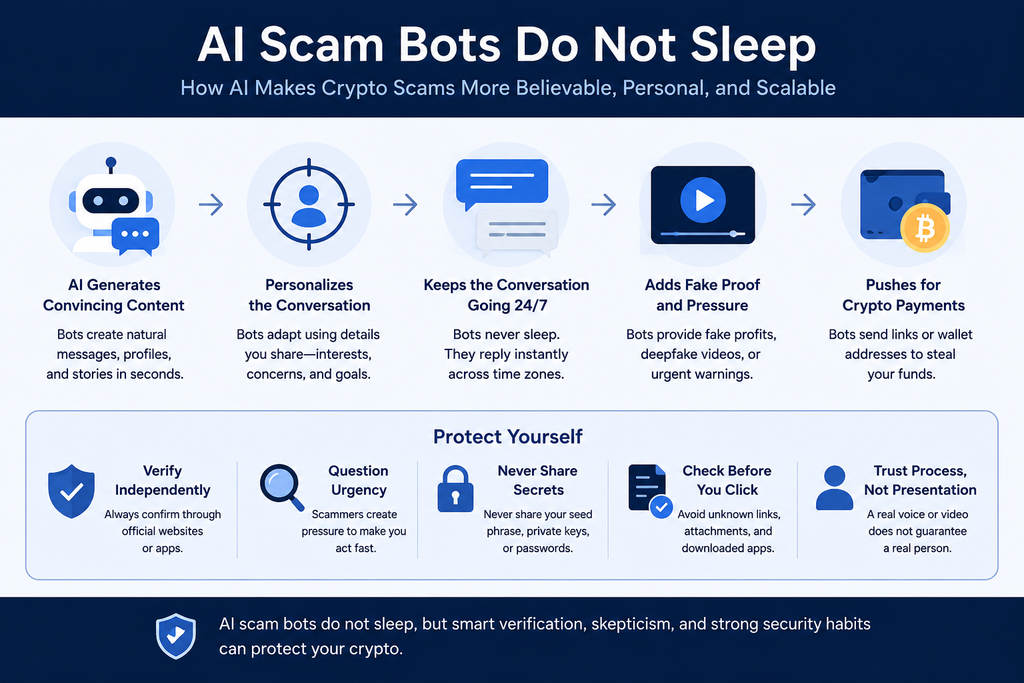
AI scam bots are changing the economics of crypto fraud. A scammer once had to write messages, answer questions, imitate a real person, and manage victims one conversation at a time. Now, AI scam bots can generate polished investment pitches, personalize replies, imitate trusted voices, translate messages instantly, and keep hundreds or thousands of conversations moving at once. Crypto makes the problem more dangerous because payments can move quickly and may be difficult to reverse after a victim authorizes them. Therefore, the central risk is no longer simply spotting bad grammar or an obviously fake profile. AI scam bots can look patient, informed, helpful, and surprisingly human. Understanding that shift is becoming an essential part of crypto safety.
AI Scam Bots Do Not Sleep, and That Changes the Scale of Fraud
The phrase “AI scam bots do not sleep” describes more than nonstop automation.
Traditional fraud required labor. Someone had to find targets, write messages, remember previous conversations, answer objections, and decide when to ask for money. Consequently, every additional victim created more work.
AI scam bots weaken that limitation.
A criminal can use artificial intelligence to draft messages, summarize conversations, generate replies, translate between languages, create fake profile content, and adjust the tone of a pitch. Meanwhile, automated systems can keep contacting potential victims regardless of time zone.
That matters because fraud is partly a numbers game. If criminals can approach more people at lower cost, they do not need every attempt to succeed.
The FBI’s 2025 Internet Crime Report illustrates the wider scale of the problem. The agency said Americans reported more than $11 billion in losses involving cryptocurrency across 181,565 complaints. Separately, AI-related complaints accounted for nearly $893 million in reported losses across 22,364 complaints. The FBI specifically highlighted fake social profiles, voice cloning, false identification documents, and believable videos among AI-enabled scam techniques.
Readers can review the FBI’s findings in its 2025 Internet Crime Report summary on cryptocurrency and AI scams.
Those figures do not mean every cryptocurrency complaint involved AI. Likewise, they do not mean every AI complaint involved crypto. However, the overlap creates a powerful fraud environment.
Crypto gives criminals a payment rail.
AI gives them scale, persuasion, and personalization.
What Are AI Scam Bots?
AI scam bots are automated or semi-automated systems that use artificial intelligence to communicate with potential victims, generate deceptive material, or support fraudulent activity.
They can perform several jobs.
For example, AI scam bots may:
- Write investment messages that sound natural.
- Respond to questions in real time.
- Translate a scam into multiple languages.
- Produce convincing customer-support replies.
- Generate fake biographies or social posts.
- Adapt a story using information that a victim reveals.
- Create voice or video impersonations.
- Maintain long conversations without obvious repetition.
However, not every bot that discusses cryptocurrency is fraudulent. Exchanges, wallet providers, and legitimate companies also use automated support systems.
The important question is therefore not, “Is this a bot?”
Instead, ask what the conversation is trying to make you do.
If someone wants you to send crypto, reveal a recovery phrase, connect a wallet, approve an unfamiliar transaction, deposit money into an unknown platform, or act under pressure, the risk rises sharply.
That distinction connects with a broader crypto security problem. As our guide explains, crypto can be secure without being safe. A blockchain may process a technically valid transaction even when deception caused the user to authorize it.
Why AI Scam Bots Feel More Believable
Older online scams often exposed themselves through obvious mistakes.
The message contained strange spelling. The conversation felt repetitive. The scammer forgot something you had said. A supposed American investment professional wrote in unnatural English.
AI scam bots can remove many of those warning signs.
For instance, a scammer can ask an AI system to rewrite a message professionally. The same tool can change the tone from formal to friendly, summarize a victim’s previous messages, and suggest a personalized response.
Therefore, grammar is becoming a weaker fraud detector.
Personalization creates another problem.
Imagine that someone contacts you on a social platform. At first, they discuss work, travel, markets, or hobbies. Gradually, you reveal details about your job, financial concerns, investing experience, and family.
AI scam bots can use that information to produce increasingly tailored responses.
Someone worried about inflation may receive a “stable crypto income” pitch.
Someone interested in artificial intelligence may hear about an “AI trading platform.”
A person who recently lost money might receive an offer from a supposed recovery specialist.
In each case, the story can change while the objective remains the same.
Build trust. Create urgency. Move money.
AI Scam Bots Exploit Trust Before They Exploit Blockchain
One important misconception is that crypto scammers primarily attack blockchains.
Often, attacking the person is easier.
Bitcoin does not need to fail for a Bitcoin holder to lose funds. Ethereum does not need to break for someone to sign a malicious transaction. Likewise, a hardware wallet can protect a private key while its owner still approves the wrong destination.
Our guide to the myth of the unhackable blockchain explains why network security cannot protect every person using the network.
AI scam bots fit directly into this gap.
Rather than defeating cryptography, criminals can persuade a victim to cooperate.
They may say:
“Your exchange account has been compromised.”
“Move your Bitcoin before the hacker withdraws it.”
“Connect your wallet so we can verify ownership.”
“Your account requires a security deposit.”
“You need to pay tax before withdrawing profits.”
“Send funds to this secure wallet immediately.”
Technically, the eventual blockchain transaction may look ordinary.
The victim controls the wallet.
The victim signs.
The blockchain confirms.
Yet the transaction can still be the result of fraud.
That is why our explanation of why a valid crypto transaction can still be a scam is especially relevant when AI scam bots enter the conversation.
The blockchain verifies authorization, not honesty
A blockchain can verify that the correct cryptographic credentials approved a transaction.
It usually cannot determine why the person approved it.
For example, imagine that a victim sends 0.5 BTC to a wallet after speaking with someone claiming to represent an exchange security department.
The network can confirm:
- the sender had authority over the Bitcoin,
- the transaction followed protocol rules,
- the destination address received the funds.
However, Bitcoin cannot determine whether a convincing AI-generated voice pressured the sender.
That difference separates technical validity from informed consent.
As a result, AI scam bots attack the part of crypto that blockchain consensus cannot solve: human judgment.
Deepfakes Make “I Saw Them” Much Weaker Evidence
AI scam bots can also operate alongside synthetic audio and video.
A deepfake uses artificial intelligence to generate or alter media so that a person appears to say or do something they never actually said or did.
That creates a difficult verification problem.
Previously, a video call seemed like strong proof of identity. Today, it should provide evidence, but not unquestionable proof.
The FBI explicitly warns that cryptocurrency investment fraud may involve deepfake technology. Its guidance also notes that criminals sometimes use real people during calls, meaning even a genuine human face does not automatically prove that an investment opportunity is legitimate.
Therefore, users should separate two questions:
Is this a real person?
and
Is this request legitimate?
Those questions are not identical.
Even a real employee account can become compromised. Likewise, a real influencer can have their identity copied. Furthermore, a genuine video clip can be edited and attached to a fraudulent investment pitch.
AI scam bots exploit the assumption that believable presentation equals trustworthy intent.
It does not.
AI Scam Bots Can Create an Entire Fake Reality
The most dangerous AI scam bots may not rely on one fake message.
Instead, criminals can build an environment around the victim.
Consider a fictional example.
A person named Daniel receives a message from someone discussing AI investments.
First, the conversation stays casual.
Later, the contact shares screenshots showing supposed trading profits.
Daniel asks questions. The answers sound detailed.
Next, he receives a link to a professional-looking platform. The website shows market charts, customer support, account balances, and an AI trading dashboard.
After depositing $500 in crypto, Daniel sees his balance rise to $680.
He withdraws $50 successfully.
That small withdrawal creates confidence.
Therefore, Daniel deposits $5,000.
The account soon displays $8,200.
However, when he requests a withdrawal, “customer support” says he must pay a liquidity fee.
Then another representative explains that tax verification requires a second payment.
Finally, an automated compliance agent warns that the account will freeze unless Daniel acts within 24 hours.
None of those interfaces need to represent real investing.
The numbers can simply exist inside a database controlled by the scammer.
AI scam bots can make every stage feel staffed, responsive, and professional.
The FTC warns that cryptocurrency investment scams can begin through social media, dating platforms, unexpected messages, emails, or calls. It also cautions that scammers may create polished websites and fabricated supporting material to make fake crypto projects appear legitimate.
The FTC provides additional warning signs in its consumer guide to cryptocurrency scams.
Why AI Scam Bots Target Crypto Users So Effectively
Crypto creates several characteristics that scammers value.
First, users already expect digital communication.
Second, wallets use unfamiliar addresses.
Third, transactions can settle quickly.
Fourth, users often interact with platforms they have never visited physically.
Finally, many newcomers struggle to distinguish protocol security from transaction safety.
AI scam bots take advantage of that uncertainty.
A believable “wallet technician” may explain technical terminology confidently. A fake investment mentor can discuss Bitcoin cycles. An impersonated exchange representative can describe two-factor authentication. A fraudulent analyst can produce charts within seconds.
Consequently, knowledge-like language can create false authority.
Readers should therefore judge requests by independently verifiable facts, not by how sophisticated the speaker sounds.
This problem mirrors the broader crypto security gap between experts and ordinary users. Crypto often expects users to make high-stakes technical decisions while interfaces, permissions, custody models, and wallet behavior remain difficult to interpret.
AI Scam Bots Learn From the Information You Give Them
Personalization becomes more powerful when victims continue talking.
Every answer can provide useful information.
Your profession can reveal likely income.
Your city reveals a time zone.
Your investing history shows financial experience.
Your complaints expose emotional pressure points.
Your wallet questions reveal technical confidence.
Even refusing one investment strategy can help a scammer propose another.
Therefore, prolonged conversation itself can create risk.
AI scam bots do not need access to a secret intelligence database to personalize a scam. Much of the information may come directly from what someone says during the conversation, combined with public social media information.
For that reason, uncertainty should reduce disclosure.
If an unknown person contacts you about crypto, avoid sharing portfolio size, exchange balances, wallet screenshots, income, recovery information, account identifiers, or detailed financial problems.
The Most Dangerous AI Scam Bot May Pretend to Protect You
Fraud does not always arrive as an opportunity.
Sometimes it arrives as help.
A message may claim:
“Suspicious activity was detected.”
“Your wallet was compromised.”
“Your account is under investigation.”
“Your assets must be moved to cold storage.”
“This recovery service traced your stolen funds.”
Fear can work faster than greed.
AI scam bots can reinforce that fear with patient explanations, fake case numbers, polished documents, automated follow-ups, and apparently knowledgeable support personnel.
Therefore, urgency deserves suspicion.
The strongest security habit may simply be creating time between the message and the transaction.
Our guide on why your crypto is only as safe as your worst habit explains how false links, exposed recovery phrases, password reuse, malicious approvals, and social engineering can defeat otherwise secure technology.
How to Verify a Crypto Request When AI Scam Bots Look Human
AI scam bots make appearance-based verification less reliable. Therefore, users need process-based verification.
| Situation | Weak verification | Stronger verification |
|---|---|---|
| Exchange warning | Reply to the message | Open the official app independently |
| Wallet support | Trust the profile logo | Use the wallet provider’s official support page |
| Friend asks for crypto | Trust their voice | Contact them through a separate known channel |
| Investment platform | Trust screenshots | Verify the company, operators, and regulatory status |
| Token opportunity | Trust influencer video | Check official project channels independently |
| Wallet request | Approve because it looks familiar | Read the transaction and permissions before signing |
| Recovery service | Pay because they promise success | Verify the organization independently and reject guarantees |
The core principle is simple:
Do not verify a suspicious claim using information supplied by the suspicious source.
If a message says it comes from an exchange, do not use the phone number inside that message.
Open the official website yourself.
If a friend supposedly needs crypto urgently, call a number you already know.
If a wallet pop-up requests a signature, determine what the signature actually authorizes.
Moreover, never reveal a recovery phrase to someone offering technical help.
AI scam bots become less powerful when users move verification outside the conversation.
Crypto’s “Secure” Label Can Create the Wrong Kind of Confidence
Another problem involves language.
People hear that blockchain is secure and assume their entire crypto experience inherits that security.
It does not.
A blockchain can use strong cryptography while a fake interface tricks someone into signing a transaction. Similarly, encryption can protect communication while the person on the other side lies.
That distinction is explored further in Crypto Security vs Safety: Why Being Secure Isn’t the Same as Being Safe.
Likewise, our article on the lie behind encrypted crypto payments explains why encryption does not automatically establish identity, fairness, or legitimacy.
AI scam bots benefit when people confuse secure infrastructure with trustworthy participants.
AI Agents Create a Second Risk: Software Can Spend Without Waiting for You
The blockchain-AI overlap extends beyond human-facing scams.
AI agents are beginning to interact with digital services and, in some systems, make payments.
That introduces a different question.
What happens when software can authorize economic activity automatically?
The issue does not mean autonomous crypto payments are inherently fraudulent. However, automation can amplify mistakes and security weaknesses because machine-speed activity may occur before a human notices.
The Crypto Encounter’s analysis of x402 security flaws and AI-agent crypto payments examines this emerging risk directly.
This creates two separate AI-crypto security problems:
AI persuading humans to send crypto.
AI systems themselves receiving authority to spend crypto.
The first threatens judgment.
The second can threaten delegated control.
As AI agents become more capable, both deserve attention.
Practical Rules for Living With AI Scam Bots
Nobody can perfectly identify every synthetic message, voice, image, or video.
Fortunately, safety does not require perfect detection.
Instead, build rules that remain useful even when the scam looks real.
First, never send cryptocurrency because an unexpected caller says your funds are unsafe.
Second, never reveal a recovery phrase.
Third, open financial services independently instead of clicking links from unsolicited messages.
Fourth, verify urgent requests through a second communication channel.
Fifth, treat guaranteed or unusually consistent investment returns as a major warning sign.
Additionally, read wallet permissions before approving them.
Use separate wallets for experimental applications where appropriate.
Protect email accounts with strong authentication.
Keep sensitive financial information out of casual online conversations.
Finally, slow down.
AI scam bots gain power from speed, pressure, and uninterrupted conversation.
A deliberate pause breaks that rhythm.
AI Scam Bots Do Not Sleep, but You Do Not Have to Outspeed Them
AI scam bots do not sleep, and ordinary users cannot compete by staying permanently alert.
That would be unrealistic.
Instead, users need verification habits that work even when a scam message looks polished, personal, technically informed, and emotionally convincing.
AI scam bots can write better messages. They can maintain longer conversations. They can impersonate trusted identities. They can support fake investment platforms. Furthermore, they can operate at a scale that human-only fraud teams could never sustain.
However, artificial intelligence does not make a fraudulent wallet address legitimate. It does not turn guaranteed returns into evidence. It does not make an unsolicited recovery service trustworthy. Most importantly, it does not change the basic rule that high-stakes crypto requests deserve independent verification.
The deeper lesson is therefore simple. AI scam bots do not sleep, but blockchain users should not rely on perfect scam detection. They should build friction into important decisions.
Verify the person.
Verify the platform.
Verify the transaction.
Then decide.
FAQs
What are AI scam bots?
AI scam bots are automated or AI-assisted systems that help criminals communicate with victims, personalize fraudulent stories, create deceptive content, or manage scam conversations at scale.
Why are AI scam bots dangerous for crypto users?
AI scam bots can make fraudulent investment pitches and impersonation attempts appear more believable. Crypto transactions can also become difficult to reverse after users authorize them, which increases the cost of deception.
Can AI scam bots copy someone’s voice?
AI tools can generate synthetic or cloned voices using recordings of real people. Therefore, a familiar-sounding voice should not serve as the only verification for an urgent financial request.
Can a blockchain detect an AI scam?
Usually, no. A blockchain validates transactions according to protocol rules. It generally cannot determine whether fraud, manipulation, or an AI-generated impersonation persuaded the owner to authorize a transaction.
How can I protect myself from AI scam bots?
Verify requests through independent channels, avoid unsolicited financial links, never share recovery phrases, inspect wallet permissions, reject pressure tactics, and verify investment platforms independently before sending money.
Will AI scam bots become harder to detect?
They may become more convincing as generative AI improves. Therefore, users should rely less on appearance, grammar, voice, or video quality and more on independent verification procedures.
Disclaimer
This article is for informational and educational purposes only. It does not provide financial, investment, legal, tax, or accounting advice. Cryptocurrency and digital asset markets involve risk, including possible loss of capital. Readers should conduct their own research before making any financial decision.