


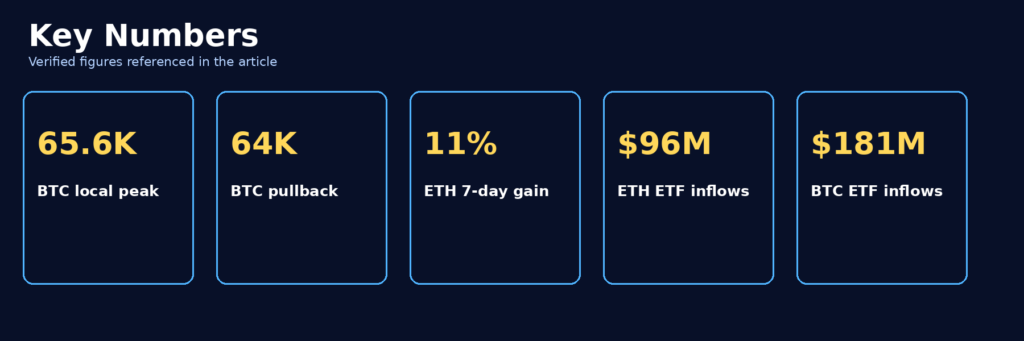
Bitcoin’s latest rebound lost momentum after renewed U.S.-Iran tensions shifted market attention away from favorable U.S. inflation data and back toward geopolitical risk. Bitcoin had climbed from below $62,000 to roughly $65,600 after June consumer and producer price readings came in softer, but it later retreated toward the $64,000 to $64,800 range. Meanwhile, Ether remained stronger over the week and attracted renewed spot ETF inflows.
The contrast matters because it shows that crypto investors are not responding to macro uncertainty in a uniform way. Bitcoin remains highly sensitive to global risk sentiment. Ether, however, is receiving narrower support from ETF demand and network-specific activity. Neither development guarantees a lasting trend, but together they show a market balancing inflation relief against military escalation and selective institutional positioning.
Why This Story Matters
Bitcoin’s reaction illustrates how closely digital assets now trade alongside global macroeconomic forces.
On July 14, the U.S. Bureau of Labor Statistics reported that the Consumer Price Index fell 0.4% in June on a seasonally adjusted basis. It was the largest monthly decline since April 2020. Annual consumer inflation slowed to 3.5% from 4.2% in May.
One day later, the Producer Price Index for final demand fell 0.3% in June. Producer energy prices dropped 6.4%, while final-demand goods prices declined 1.4%.
Those releases improved the immediate inflation picture. In turn, crypto prices rose as investors considered whether easing price pressures could reduce the need for restrictive monetary policy.
However, the relief did not last.
Fresh military operations involving the United States and Iran, along with conflicting messages about possible negotiations, returned geopolitical risk to the center of the market narrative. The resulting price reversal does not prove that one diplomatic statement caused Bitcoin to fall. Still, the timing shows that macro optimism remained vulnerable to changing security conditions.
Bitcoin’s Inflation Rebound Fades Near $65,600
Alt text
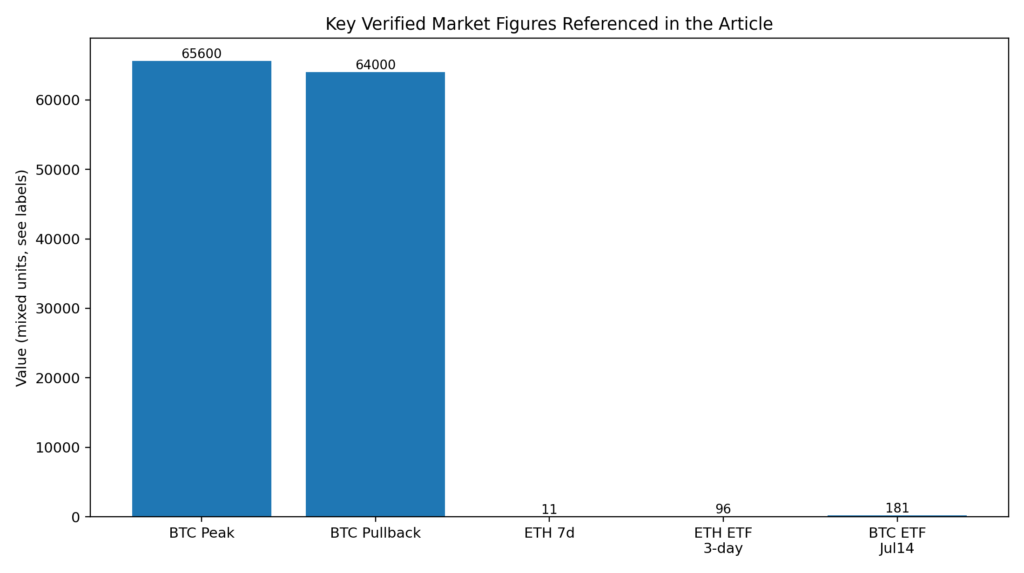
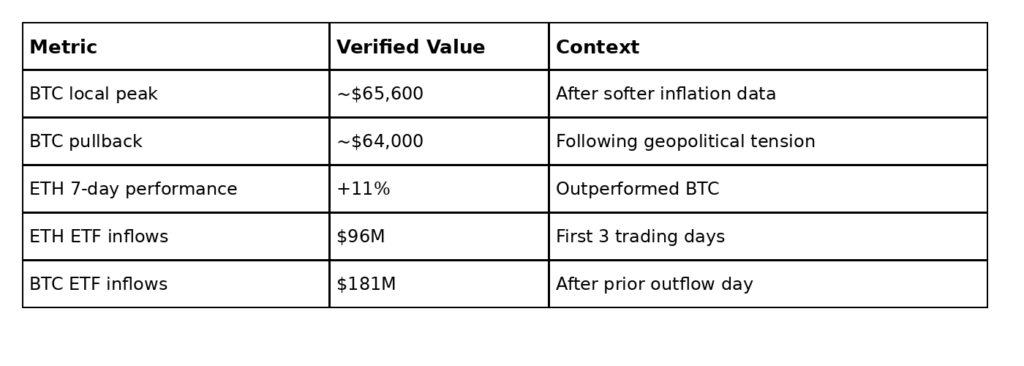
Bitcoin had fallen below $62,000 before recovering alongside the inflation releases. CryptoPotato reported that the asset regained $64,000 and $65,000 before reaching approximately $65,600, its highest level in about three weeks. It then lost roughly $1,500 and returned toward $64,000.
Crypto.news placed Bitcoin near $64,800 at 7:44 p.m. UTC on July 15, down less than 1% for the day.
These price references come from different timestamps. Therefore, they should not be treated as contradictory.
More importantly, the pullback should not be attributed to geopolitics alone. Bitcoin had also reached a recent resistance area after a rapid rebound. Profit-taking, technical selling, ETF activity, and derivatives positioning may have influenced the decline.
The available evidence supports a cautious conclusion: geopolitical escalation coincided with Bitcoin giving back part of its inflation-driven gains.
Conflicting U.S. and Iranian Statements Add Uncertainty
The main political development involved competing accounts of possible negotiations.
Crypto.news reported that President Donald Trump said Iran had previously reached out and wanted to make a deal. Iran’s Foreign Ministry, however, said there were no current plans for negotiations and that the country’s immediate priority was defense.
These statements should not be treated as equivalent to confirmed diplomatic progress.
Trump’s comments represent the U.S. president’s account. Iran’s response represents Tehran’s official position. Neither statement, by itself, establishes whether indirect communications occurred or whether formal talks were under preparation.
The phrase “peace push” may also overstate the available evidence. The reports confirm public discussion of negotiations, but they do not establish an agreed framework, a scheduled meeting, or a formal peace process.
Military Operations Raise Wider Market Risks
The diplomatic disagreement unfolded as military operations continued.
CENTCOM said U.S. forces carried out a 90-minute wave of strikes against coastal-defense systems and cruise-missile storage and launch sites on Greater Tunb Island. The command later announced a second wave targeting Iranian military capabilities that it said threatened shipping through the Strait of Hormuz.
Those descriptions are official U.S. military claims. Independent reporting from Reuters confirmed a new wave of U.S. strikes and reported that Iran responded by targeting U.S. assets in Gulf states.
The operational impact of the strikes cannot be fully verified from the public information reviewed here.
For markets, the Strait of Hormuz matters because disruption to shipping could affect energy supply, transportation costs, and inflation expectations. That creates a direct tension with the softer CPI and PPI data that had supported risk assets only hours earlier.
In other words, the market received two opposing signals:
- Domestic inflation data suggested easing price pressure.
- Geopolitical escalation created renewed energy and supply-chain risk.
Bitcoin’s reversal showed which signal dominated short-term sentiment.
Why Ethereum Held Up Better
Ether did not escape the broader pullback. It briefly approached $1,950 before falling below $1,900, according to CryptoPotato.
Still, its weekly performance remained stronger than Bitcoin’s.
A CoinDesk analysis republished by FXStreet placed Ether near $1,920 on July 16. It was up 2.2% for the day and approximately 11% across seven sessions. Bitcoin was near $64,600, down 0.3% for the day and up 4.2% over seven sessions.
That difference does not prove that investors were broadly rotating from Bitcoin into Ether.
Instead, two narrower factors appear to have supported Ethereum.
First, U.S. spot Ether ETFs attracted $96 million in net inflows during the first three trading days of the week. That exceeded the $84 million reported for the entire previous week.
Second, the Wednesday inflow was highly concentrated. Of $53.8 million in total inflows, BlackRock’s ETHA received $45.3 million and ETHB received $4 million. Together, those products captured about 91.6% of the day’s net inflow.
That concentration weakens the case for describing the move as broad institutional demand across the Ether ETF market.
ETF Flows Show Activity, Not a Durable Rotation
Bitcoin ETF activity was more volatile.
U.S. spot Bitcoin ETFs recorded $424 million in net outflows on July 13 and $181 million in net inflows the next day, according to SoSoValue data cited by CoinDesk and FXStreet.
The two-day sequence shows that institutional trading remained active. However, it does not establish stable long-term allocation.
ETF flows can reflect several activities, including portfolio rebalancing, short-term tactical trades, basis strategies, hedging, and shifts between issuers. A daily inflow is not automatically equivalent to a long-term investment decision.
The same caution applies to Ether.
Its ETF flows were positive, but the time window was short and the demand was concentrated in two BlackRock funds. A durable rotation would require broader and more persistent inflows, stronger trading volumes, and evidence that investors were reducing Bitcoin exposure while increasing Ether holdings over a longer period.
The current data do not yet meet that standard.
The Wider Crypto Market Also Pulled Back
The market decline extended beyond Bitcoin.
CryptoPotato reported that total crypto market capitalization fell by about $40 billion from its intraday peak to approximately $2.270 trillion on July 16. Bitcoin’s market capitalization stood near $1.285 trillion on CoinGecko at the same reporting point.
Several large-cap assets traded lower, while Ether remained the clearest relative outperformer among major cryptocurrencies.
This pattern supports a more nuanced interpretation than a general market exit.
Risk appetite weakened, but investor behavior remained selective. Bitcoin lost part of its macro-driven rebound. Ether also pulled back, yet retained stronger weekly momentum and received targeted ETF inflows.
Risks, Limitations, and Unanswered Questions
Several limitations affect the interpretation of this market move.
First, short-term prices cannot prove causation. Geopolitical headlines, inflation releases, technical resistance, derivatives positioning, and ETF flows all occurred within the same period.
Second, official military and diplomatic statements come from parties directly involved in the conflict. They require attribution and may not provide a complete picture.
Third, ETF flows remain volatile. Three days of Ether inflows do not establish a structural change in institutional preference.
Fourth, the supporting reports use different market-data providers and timestamps. That explains variations in prices, market capitalization, and Bitcoin-dominance figures.
Finally, Ethereum’s relative strength may fade if ETF inflows narrow, network activity weakens, or the wider risk environment deteriorates. Conversely, Bitcoin could regain momentum if geopolitical tensions ease or institutional demand strengthens. These are scenarios, not forecasts.
What to Watch Next
Readers should monitor a group of indicators rather than a single price target.
The first is diplomacy. Confirmed announcements from the U.S. and Iranian governments would carry more weight than public claims about private contact.
The second is military activity around the Strait of Hormuz. Any verified disruption to shipping could affect oil prices and inflation expectations.
Third, upcoming economic releases may show whether June’s decline in consumer and producer inflation was temporary or part of a broader cooling trend.
ETF flows also remain important. A sustained Ether trend would require inflows across more issuers and over a longer period. For Bitcoin, investors should watch whether daily flows stabilize after the sharp reversal between July 13 and July 14.
Finally, market breadth will matter. If Ether continues to outperform while most major assets weaken, the move may remain asset-specific. Broader participation would provide stronger evidence of improving crypto risk appetite.
FAQs
Why did Bitcoin fall after reaching about $65,600?
Bitcoin retreated as geopolitical tensions intensified, but no single cause has been proven. Technical resistance, profit-taking, ETF flows, and changing risk sentiment may also have contributed.
What inflation data supported Bitcoin’s rebound?
The June CPI fell 0.4% month over month, while the June PPI fell 0.3%. Both releases came from the U.S. Bureau of Labor Statistics on July 14 and July 15, 2026.
Did Iran formally reject a peace agreement?
No formal peace agreement was reported. Iranian officials rejected suggestions that negotiations were currently planned. That is different from rejecting an agreed settlement.
Why did Ether outperform Bitcoin?
Ether had stronger seven-day momentum and received $96 million in U.S. spot ETF inflows over the first three trading days of the week. However, most of Wednesday’s inflow went to two BlackRock funds.
Are institutions rotating from Bitcoin into Ethereum?
The evidence is not sufficient to confirm a durable rotation. Ether inflows were positive but concentrated, while Bitcoin ETF flows reversed sharply over two days.
What should readers monitor next?
Key indicators include official diplomatic announcements, military developments near the Strait of Hormuz, oil-market reactions, future U.S. inflation data, and the breadth and persistence of Bitcoin and Ether ETF flows.
Disclaimer
This article is for informational and educational purposes only. It does not provide financial, investment, legal, tax, or accounting advice. Cryptocurrency and digital asset markets involve risk, including possible loss of capital. Readers should conduct their own research before making any financial decision.